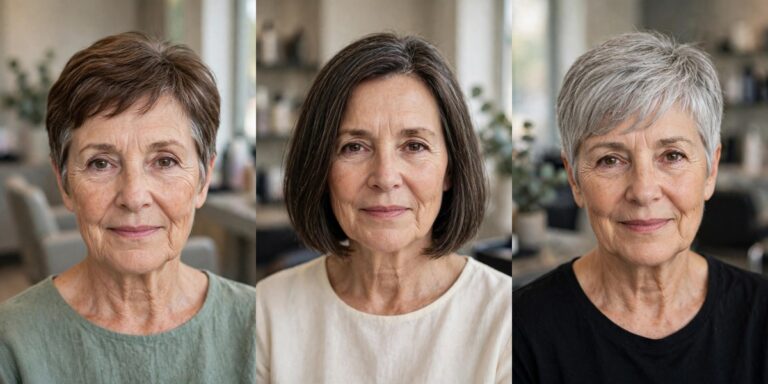
Curly Hairstyles for Women Over 50 That Embrace Natural Texture
This post contains affiliate links. As an Amazon associate, I earn from qualifying purchases. I only recommend products that are of high quality and that I would use myself.
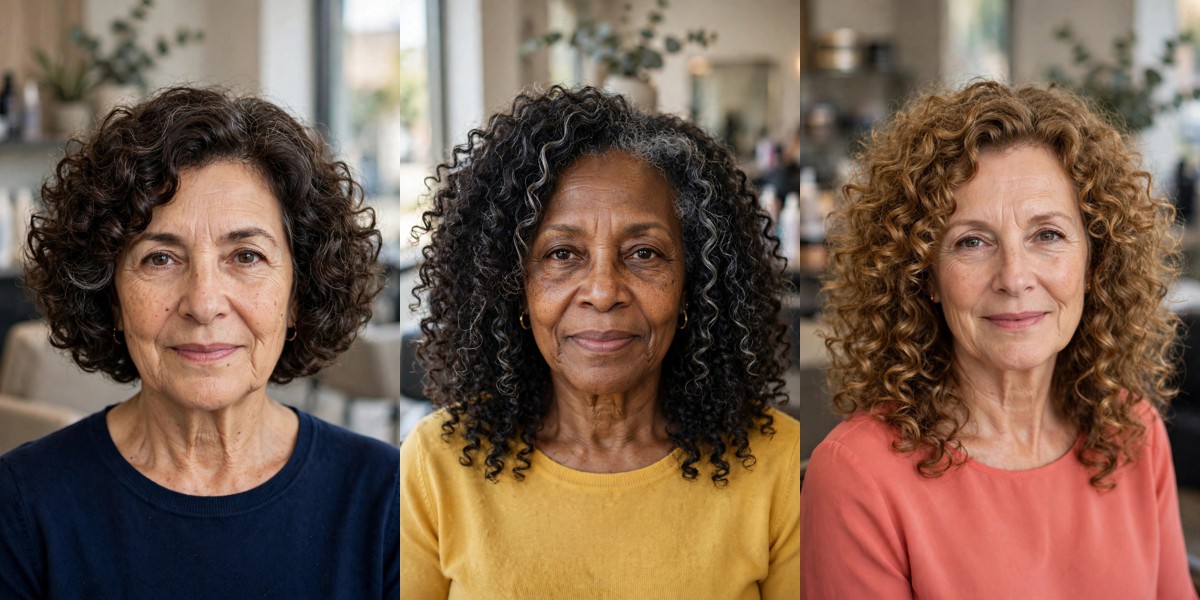
If you have spent years fighting your curls — straightening them, smoothing them, apologising for them — this is the article that gives you permission to stop. After 50, natural texture is not a problem to manage. It is volume where hair is thinning, softness where features are sharpening, and movement that no round brush can fake. The secret is simply a cut that is designed for curls from the start, instead of a straight-hair cut that your curls are expected to squeeze into.
The 20 styles below cover every length, from a tapered silver pixie to long natural coils, and every curl type from loose spirals to tight coils. Each one is shown on a woman in her mid-fifties with genuinely curly hair, and each comes with the styling routine it actually needs — no twelve-step rituals, we promise. If you are still deciding on length, our overviews of short hairstyles for women over 50 and the medium and long styles further down this page will help you narrow it down.
One honest note before we start: curly hair changes after 50. It often becomes drier, the pattern can loosen or tighten, and gray strands behave differently from the hair you grew up with. Every style here was chosen to work with the curls you have now — and the care checklist near the end will help those curls look their best at any age.
Table of Contents
- 1. Classic Curly Bob with Defined Ringlets
- 2. Curly Shag with a Soft Curtain Fringe
- 3. Long Curls with Long Layers
- 4. Tapered Curly Pixie in Salt and Pepper
- 5. Silver Curls in a Short Rounded Crop
- 6. Wash-and-Go Midi Curls
- 7. Curly Lob with a Deep Side Part
- 8. Voluminous Natural Curls and Coils
- 9. Curly French Bob with a Curly Fringe
- 10. Medium Layered Curls with Face-Framing Highlights
- 11. Curly Bixie in Warm Chestnut
- 12. Shoulder-Length Curls with Soft Curly Bangs
- 13. Chin-Length Curly Bob with a Full Fringe
- 14. Long Silver Curls with Soft Layers
- 15. Curly Crop with Height at the Crown
- 16. Asymmetrical Curly Bob
- 17. Curly Half-Up Style with Loose Tendrils
- 18. Tousled Curly Lob with Balayage
- 19. Stacked Curly Bob with a Lifted Back
- 20. Big Bouncy Midi Curls with Diffused Volume
- Recommended Products
- FAQs
💡 How to choose your curly cut — the 4 rules that matter most
- Match the cut to your curl pattern, not a photo of someone else’s. Loose spirals, tight coils and everything between them all need different layering — bring photos of your own texture.
- Put volume where it lifts. Crown height and cheekbone-level fullness flatter women over 50; bulk below the chin rarely does.
- Always have curls cut dry. Wet curls stretch and lie. A dry, curl-by-curl cut shows you the true finished length in the chair.
- Plan for your real routine. If you will not diffuse daily, choose a wash-and-go shape (ideas 6, 8 and 20) over a style that needs heat.
1. Classic Curly Bob with Defined Ringlets
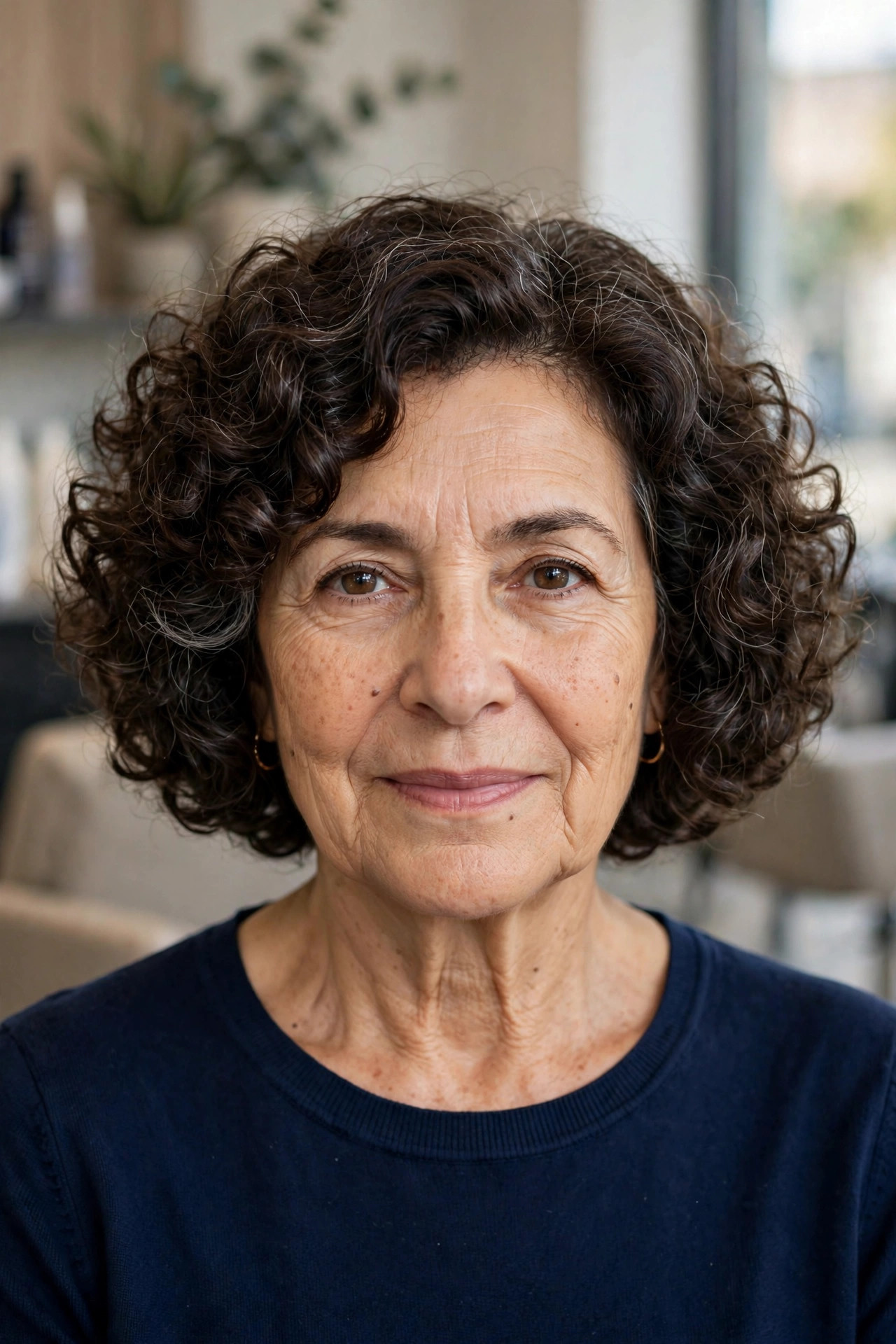
The curly bob is where most women over 50 should start their natural-texture journey, because it gives curls a clear shape to spring into instead of letting them drift. Cut to sit around the chin and jaw, with light layering through the ends, it forms a soft rounded frame that lifts the face and keeps the volume where it flatters — beside the cheeks, not dragging below them.
Ask your stylist to cut it dry, curl by curl, so the length you see in the chair is the length you live with at home; curly hair cut wet almost always springs up shorter than expected. Day to day, rake a curl cream through soaking-wet hair, scrunch upward with a cotton T-shirt rather than a rough towel, and let it air-dry or diffuse on low. If you have been thinking about a shorter shape, our guide to bob haircuts for women over 50 shows how the classic bob family compares.


2. Curly Shag with a Soft Curtain Fringe
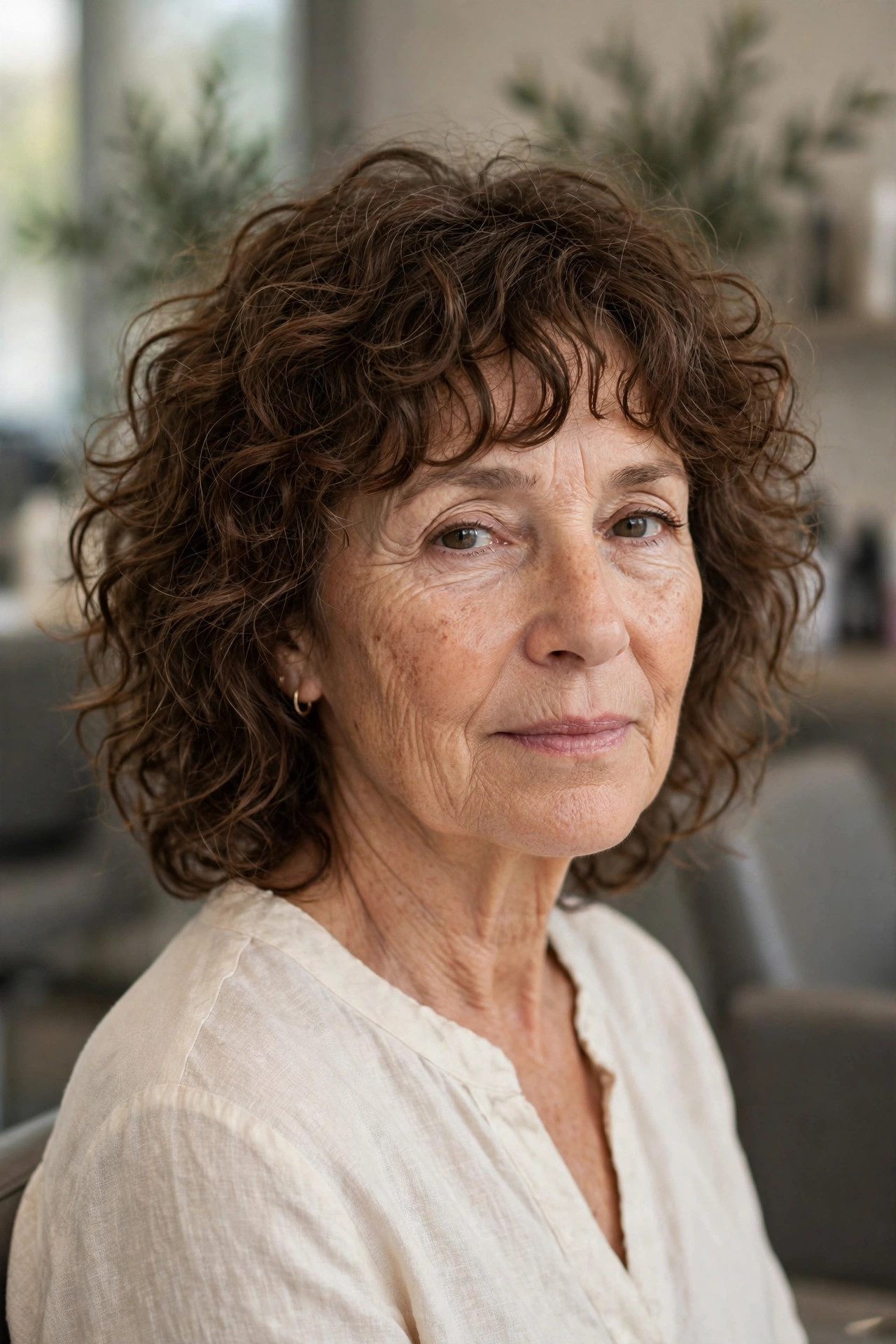
If your curls feel heavy and triangular — flat on top, wide at the bottom — a curly shag is the fix. Choppy layers through the crown release the weight that pulls curls down, while shorter pieces around the face open into a soft curtain fringe that skims the cheekbones. The result is movement in every direction and a shape that looks deliberately undone rather than over-styled.
The shag is famously kind to second- and third-day hair, because a little frizz reads as texture instead of mess. Refresh in the morning with a water mister, a pea-size amount of mousse scrunched into the ends, and two minutes of patience. Women who love this lived-in feel often enjoy our roundup of shag haircuts for women over 50 as well. Keep salon visits to every eight to ten weeks — this cut grows out gracefully by design.


3. Long Curls with Long Layers
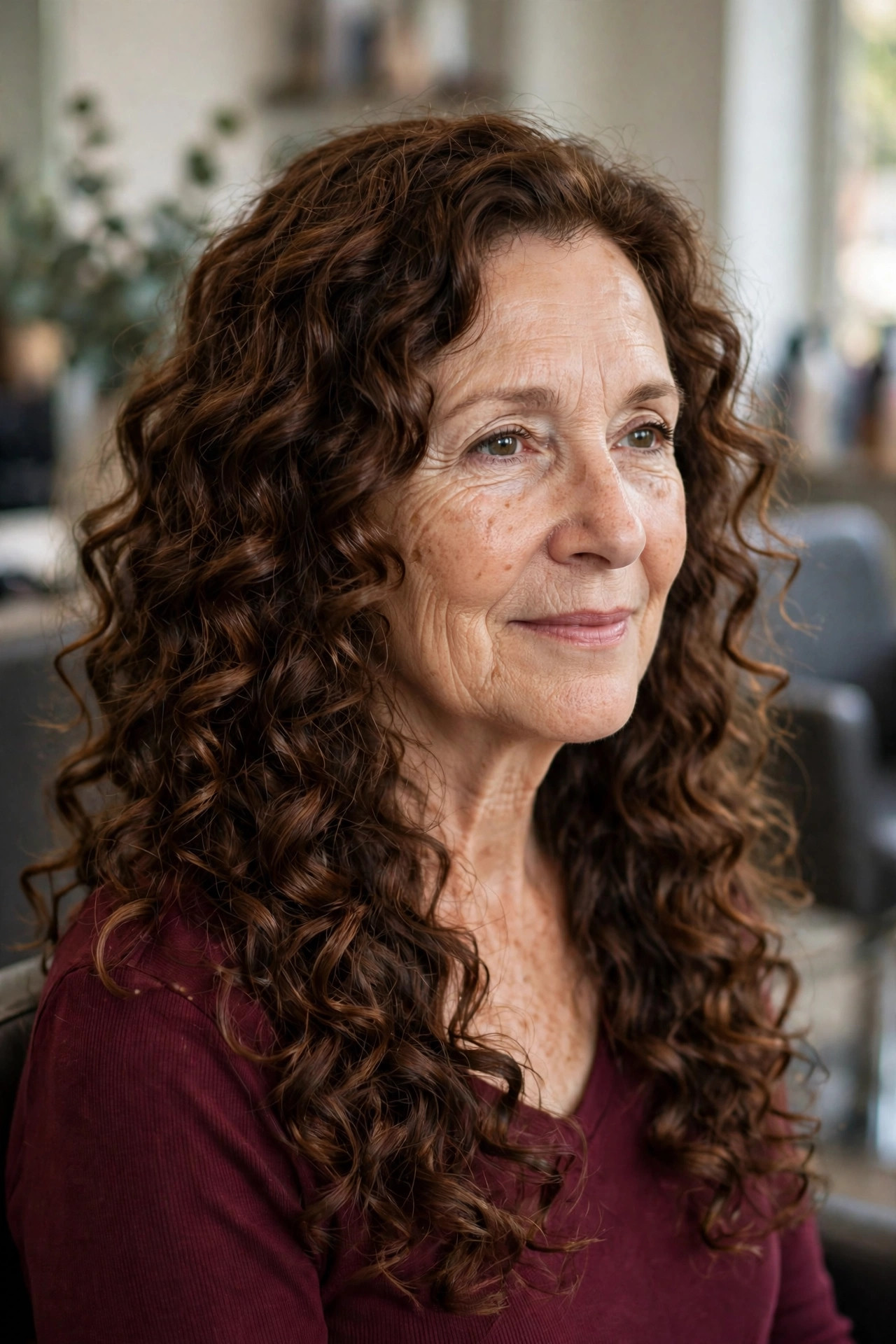
Yes, you can keep your length after 50 — the secret is that long curly hair needs long layers, not one blunt weight line. Layers that start below the chin remove the bulk that stretches curls into limp waves, so each spiral keeps its bounce from root to tip. The length itself becomes an asset: it elongates the face, softens the jawline, and moves beautifully when you walk.
Long curls drink more moisture than short ones, so treat conditioner as a styling step, not an afterthought — leave a little in, then layer your curl cream over it. Sleep with your hair in a loose pineapple on top of your head to protect the spirals overnight. If you are weighing up longer styles in general, see how these compare with the cuts in long layered haircuts for women over 50.


4. Tapered Curly Pixie in Salt and Pepper
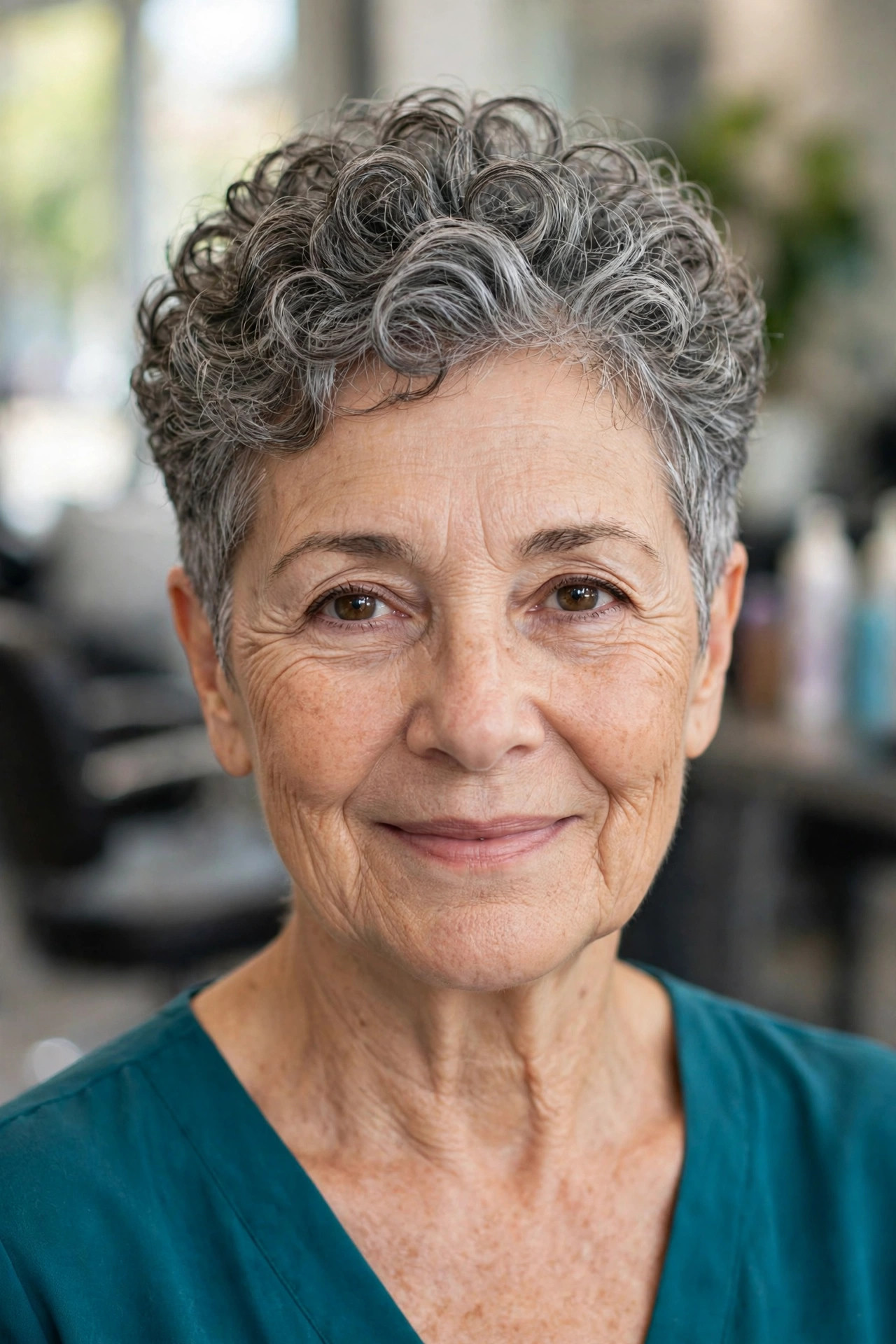
Short on the sides, joyful on top: the tapered curly pixie keeps the neckline and temples clean while a cluster of defined curls does all the talking at the crown. In natural salt and pepper, every curl catches the light differently, so the texture itself becomes the colour story — no dye appointments, no regrowth line, just dimension you were born with.
This is one of the lowest-maintenance cuts in this whole list. A light foam scrunched into damp curls, a few minutes with a diffuser or open air, and you are done in under ten minutes. It particularly suits women whose hair has thinned at the sides, because the taper makes the fuller top look thicker by contrast. Trims every five to six weeks keep the silhouette crisp; explore more short options in our pixie cuts for women over 50 collection.


5. Silver Curls in a Short Rounded Crop
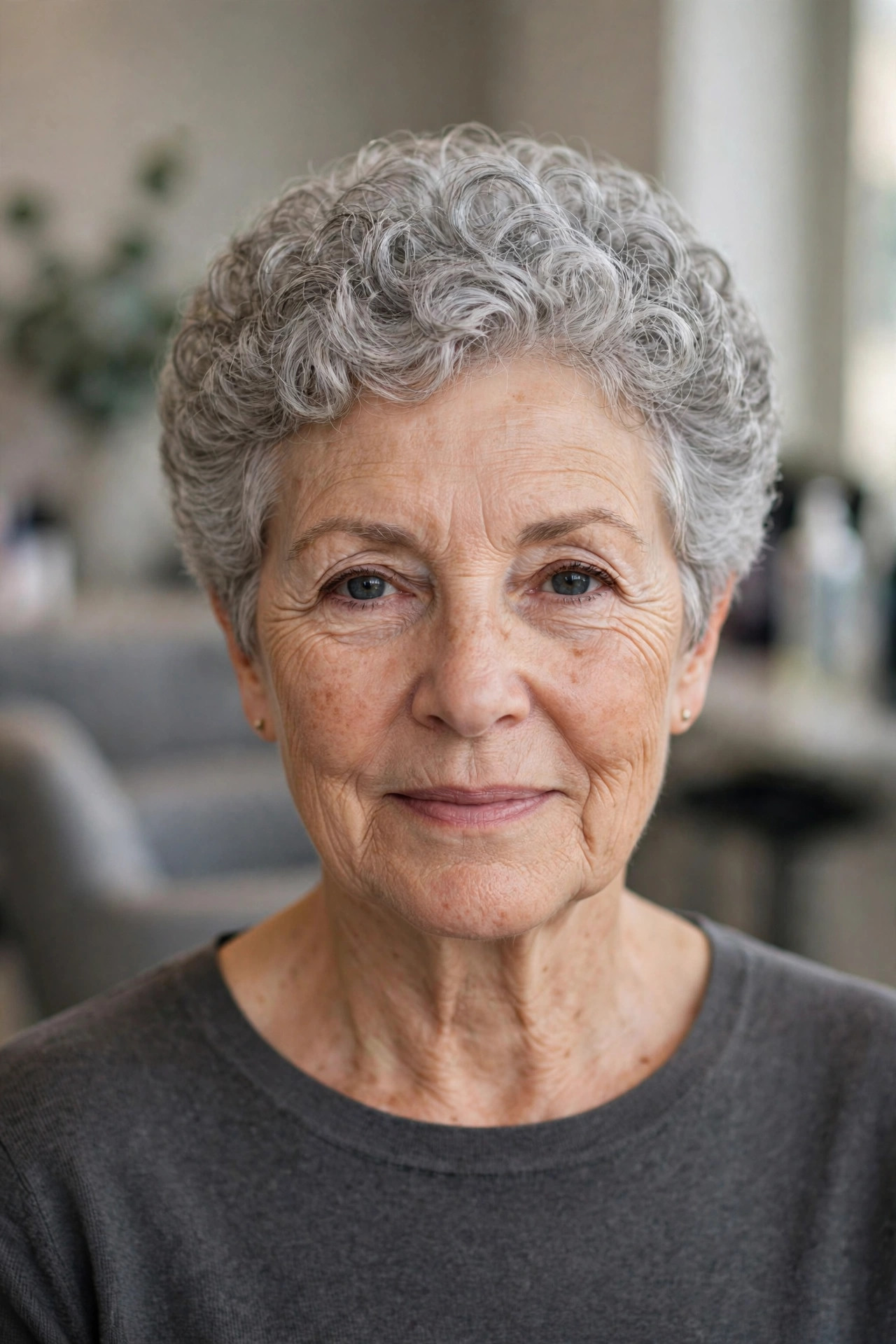
A short rounded crop is the silver curl’s best friend. Kept above the ears and shaped into a soft halo, it lets fully gray curls show off their natural brightness — and silver curls, looked after well, have a luminous quality no bottle can copy. The rounded silhouette also softens strong features and draws attention straight to the eyes.
Gray curls tend to be drier and more wiry than pigmented hair, because each gray strand is coarser. Answer with moisture first and hold second: a rich curl cream on wash day, and a purple shampoo once a week to stop environmental yellowing from dulling the silver. A satin pillowcase makes a real difference here, since dry silver curls snag and frizz on cotton. For more inspiration, browse gray hairstyles for women over 50.

✂️ Not sure of your exact face shape?
The most flattering curly cut starts with knowing your shape for certain. Try our free Face Shape Finder — it takes a minute and tells you exactly which lengths, parts and fringes will love your face back.
6. Wash-and-Go Midi Curls
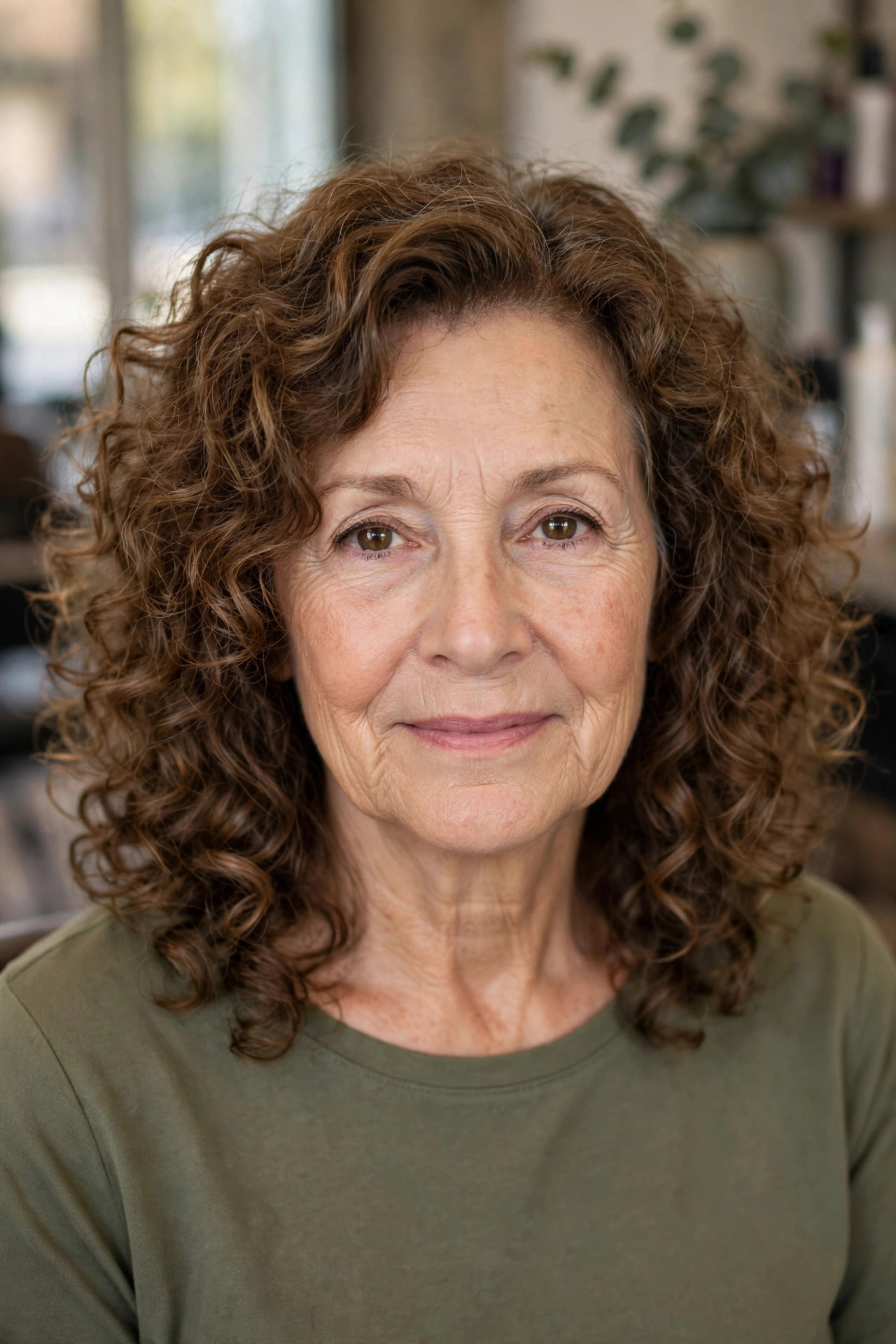
The wash-and-go midi is exactly what it promises: shoulder-skimming curls that are styled in the shower and finished by the air. The midi length is the sweet spot for many women over 50 — long enough to feel feminine and to pull back on a hot day, short enough that the curls keep their spring instead of being weighed down.
The technique matters more than the product shelf. Apply your cream and gel to dripping-wet hair in sections, scrunch, then do not touch it until it is completely dry — most frizz is simply curls disturbed while setting. Once dry, shake the roots with your fingertips and gently scrunch out any gel crunch until the hair feels soft. Done well, this routine gives you two or three good hair days from a single wash.
7. Curly Lob with a Deep Side Part
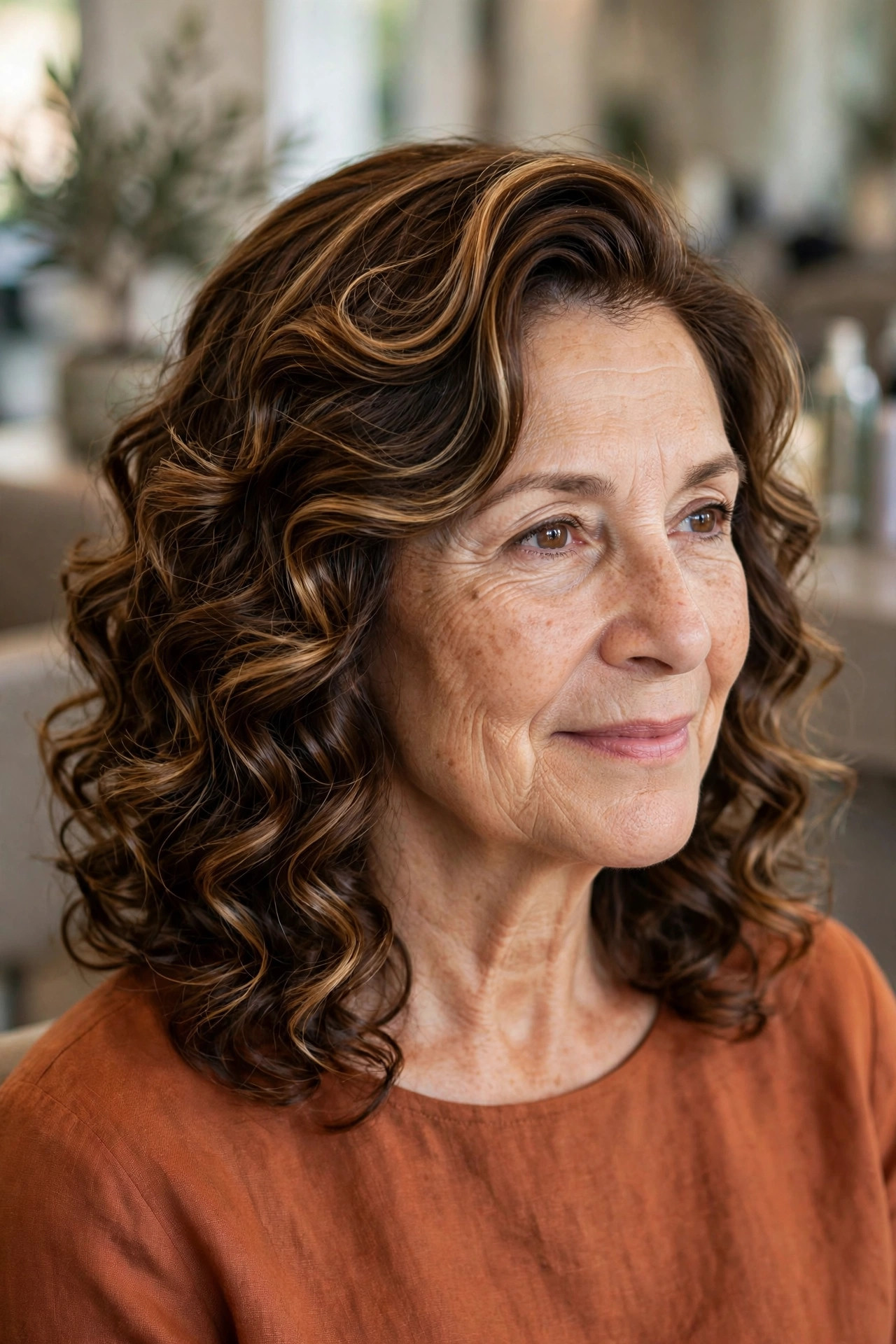
A collarbone-length lob already flatters almost everyone; worn curly with a deep side part, it becomes genuinely transformative. The deep part sweeps the bulk of the curls to one side, creating height at the root, a diagonal line across the forehead, and that glamorous over-one-eye fall of curls that softens every feature it passes.
Flip your part to the opposite side every few weeks — you will get an instant root lift, because the hair is not trained flat in that direction. A flexible hairspray, misted from a distance after diffusing, holds the sweep without freezing it. Honey-toned highlights woven through the front, as shown here, brighten the skin; ask your colourist for pieces one or two shades lighter than your base, concentrated where the sun would naturally fall.

8. Voluminous Natural Curls and Coils
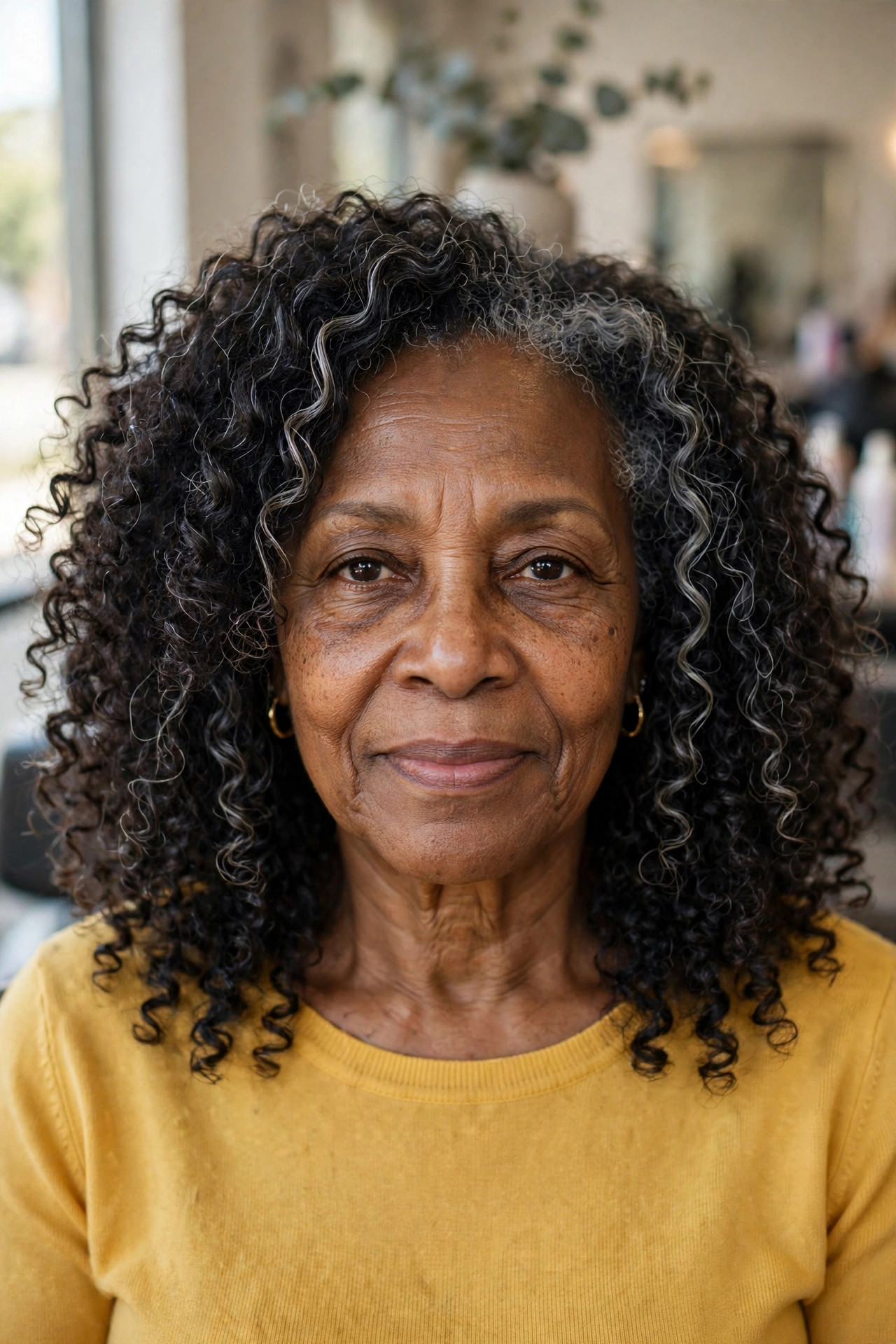
For women with naturally coily hair, volume is not a problem to solve — it is the whole point. Worn at shoulder length with layers shaped to your curl pattern, coils build a glorious, rounded cloud that frames the face like a halo, and silver strands threading through dark coils add a dimension salons charge a fortune to imitate.
Coily hair is the driest of all curl types, so moisture layering is non-negotiable: a leave-in or rich curl smoothie worked through in sections, sealed with gel for definition. Stretch the style across the week by pineapple-ing at night and refreshing individual coils with wet fingers and a dab of cream in the morning. Shrinkage is real — a shoulder-length look may need to be cut several inches longer when dry, so always have coily hair cut in its natural, dry state.
9. Curly French Bob with a Curly Fringe
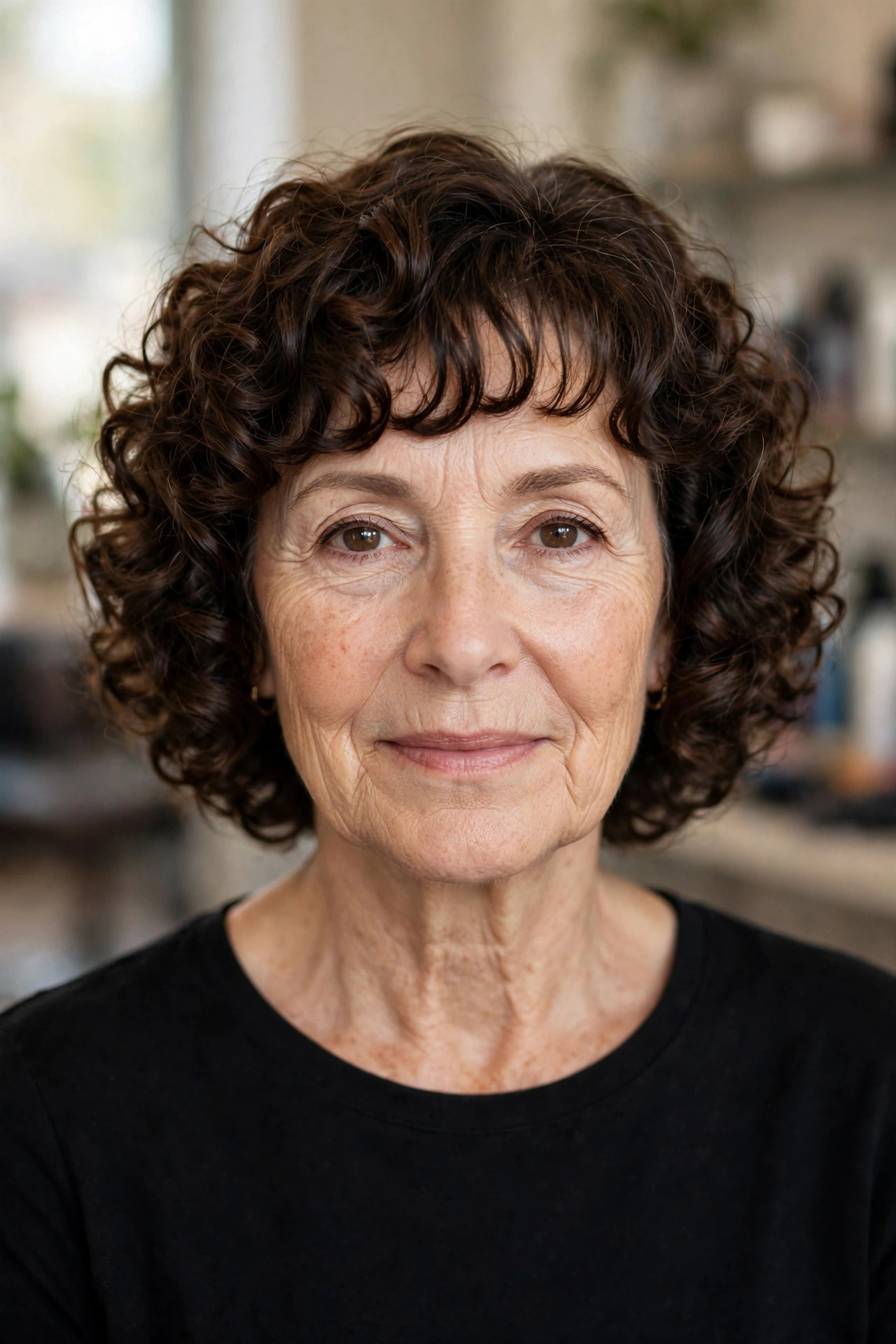
The French bob — jaw-skimming, fringe included — was practically invented for natural curls. Cut just below the jaw with a short curly fringe that grazes the brows, it has that effortless, slightly undone polish that looks expensive precisely because it does not look laboured over. Espresso and dark chocolate shades make the curls look glossy and dense.
A curly fringe is far more forgiving than a straight one: it is meant to sit in soft spirals, so a humid day improves it instead of ruining it. Keep the fringe a touch longer than you think — curls spring up — and refresh it between washes with a water spray and a finger-coil. If the fringe misbehaves on a given morning, sweep it to the side and the cut simply becomes a side-parted bob; it is two hairstyles in one.
10. Medium Layered Curls with Face-Framing Highlights
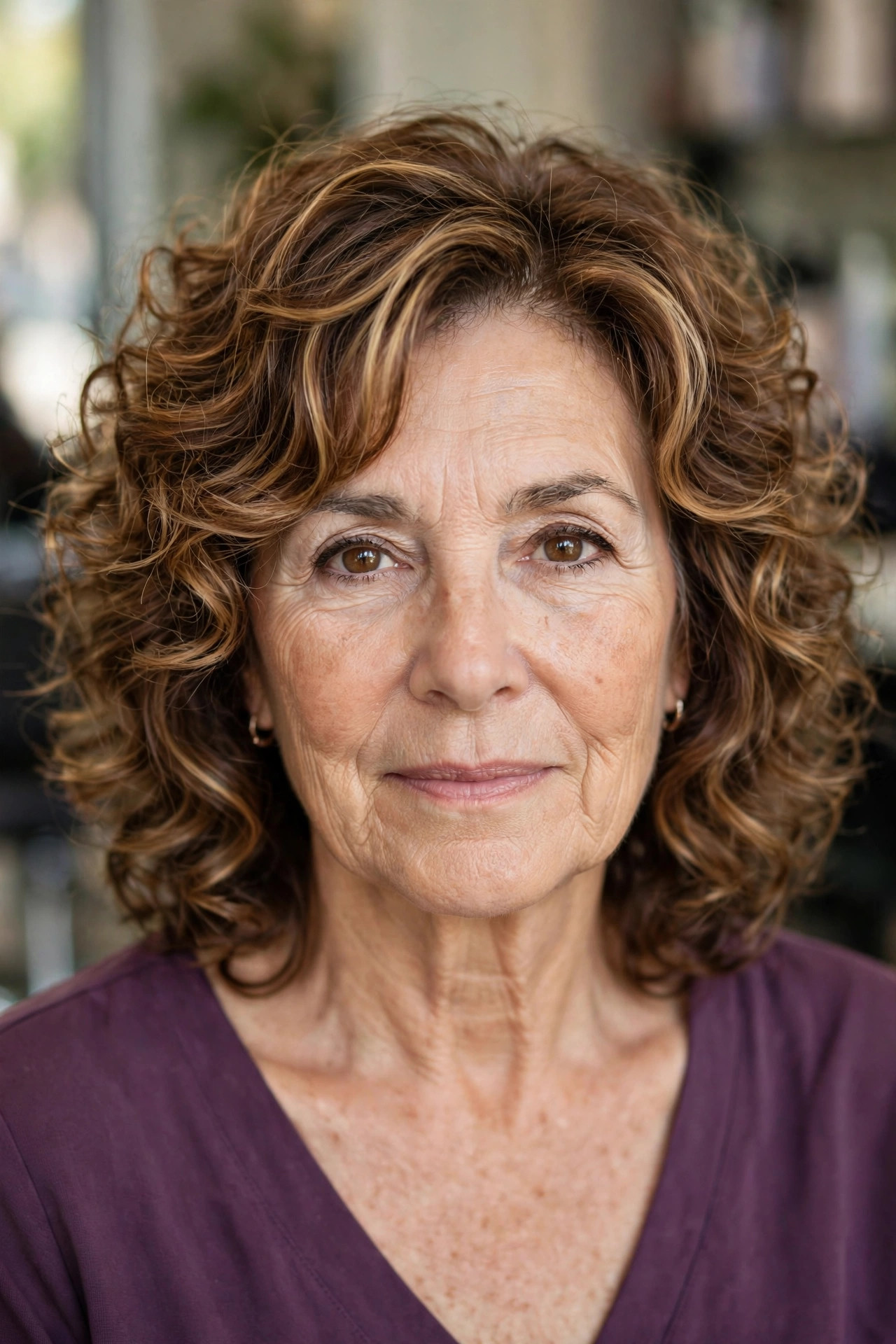
When curls start to look like one solid mass, face-framing highlights are the fastest cure. Ribbons of caramel placed around the face and through the top layers separate each curl visually, so the shape reads as movement and light rather than bulk — and the brightness against your skin does the same job as a good illuminating foundation.
Ask for the highlights to follow your curl pattern rather than being placed in straight-hair foils; a curl-aware colourist will paint them freehand. Because lightened curls are thirstier, alternate your regular cream with a richer one on the highlighted front sections. This medium length is also a kind halfway house if you are growing out a bob: long enough for a ponytail, short enough to stay bouncy.
11. Curly Bixie in Warm Chestnut
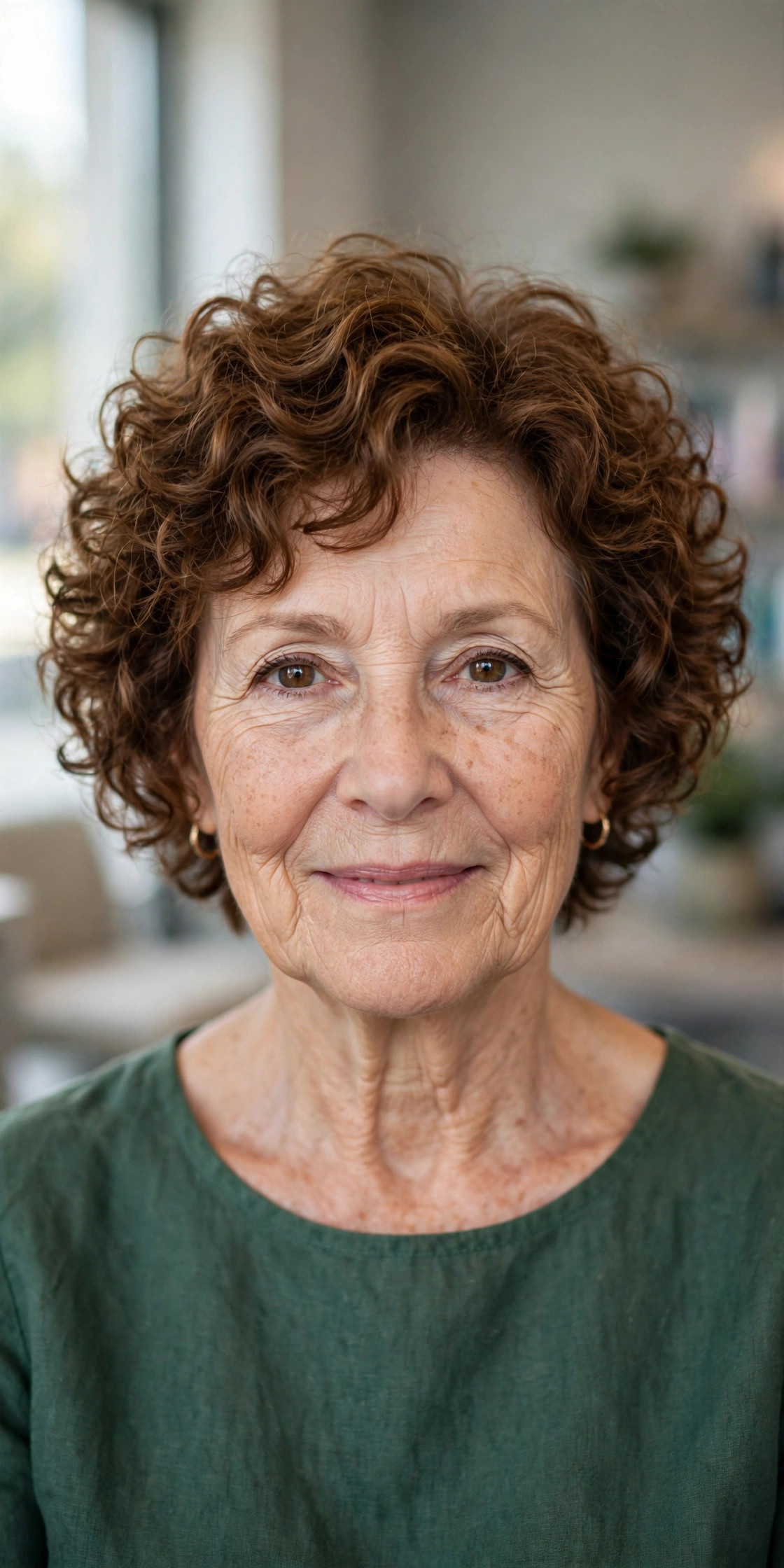
Half bob, half pixie, the curly bixie keeps a pixie’s easy cropped back and nape while leaving enough length on top and at the sides for real curls to form. That makes it ideal for women who want to go shorter but fear losing their texture — here, the curls are the style, sitting in defined spirals across the crown and feathering softly in front of the ears.
Chestnut warmth flatters skin that has lost a little colour over the years, but this cut is just as striking in silver. Styling is minimal: a firm-hold gel scrunched through damp hair sets the spirals, and the cropped back means the whole head dries in minutes. It is also a brilliant growing-out cut — as it lengthens it simply becomes a curly bob, with no awkward stage in between.


12. Shoulder-Length Curls with Soft Curly Bangs
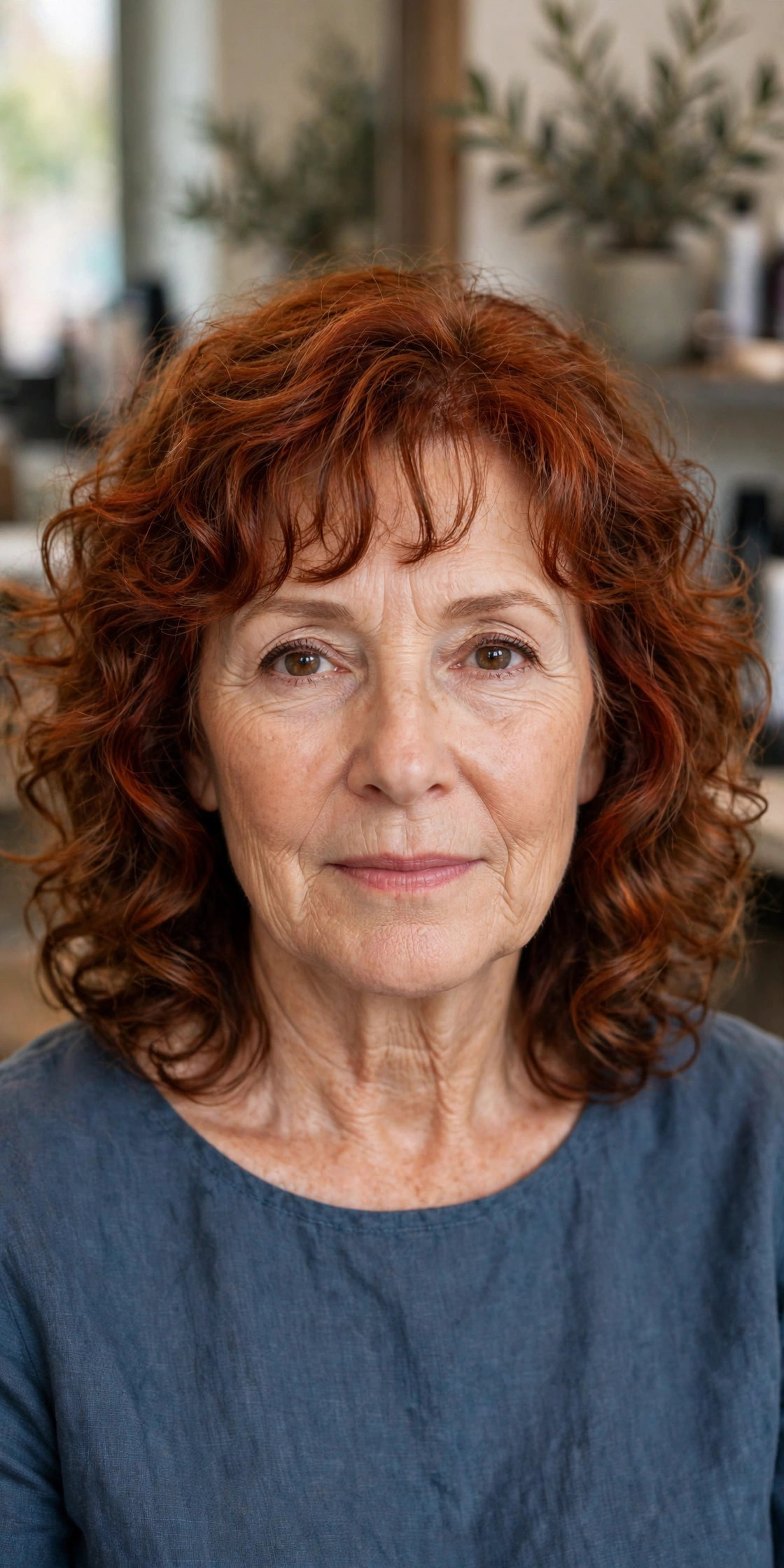
Curly bangs have shaken off their old reputation. Cut long and wispy rather than short and blunt, they melt into shoulder-length curls and take years off by softening the forehead and drawing the eye down to the eyes and cheekbones. Auburn and copper shades, as in this example, make the whole arrangement glow against mature skin.
The golden rule of curly bangs: cut them at least an inch longer than the finished look, because the spring factor is strongest at the front. Style them by finger-coiling two or three spirals while wet and leaving them strictly alone afterward. If you are bang-curious but nervous, start with longer cheekbone-length pieces — they deliver most of the softening effect with an easy grow-out if you change your mind.
13. Chin-Length Curly Bob with a Full Fringe
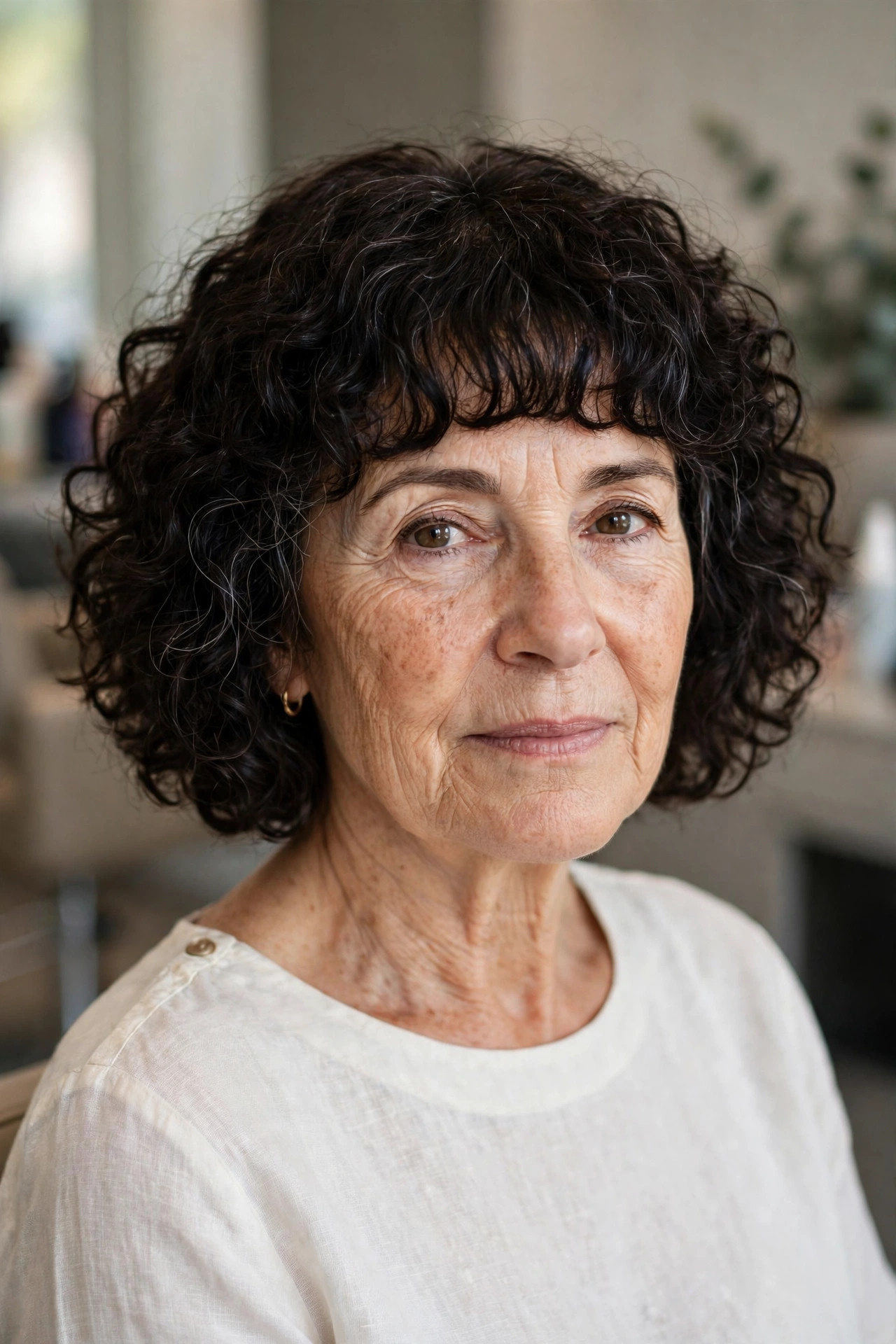
A full curly fringe with a chin-length bob is a bold, joyful combination — the fringe covers forehead lines more kindly than any cream, while the bob’s clean outline keeps the look sharp rather than girlish. In near-black and deep espresso shades, the density of curls around the face creates a striking frame that makes eyes look brighter by contrast.
Balance is everything here: the bob should end at or just below the chin, never above it, or the combination can widen the face. A styling gel raked through wet hair and scrunched gives the fringe and the bob the same defined finish, so the silhouette stays unified. This is a statement cut that still behaves itself Monday to Friday — the fringe needs only a water refresh most mornings.
14. Long Silver Curls with Soft Layers
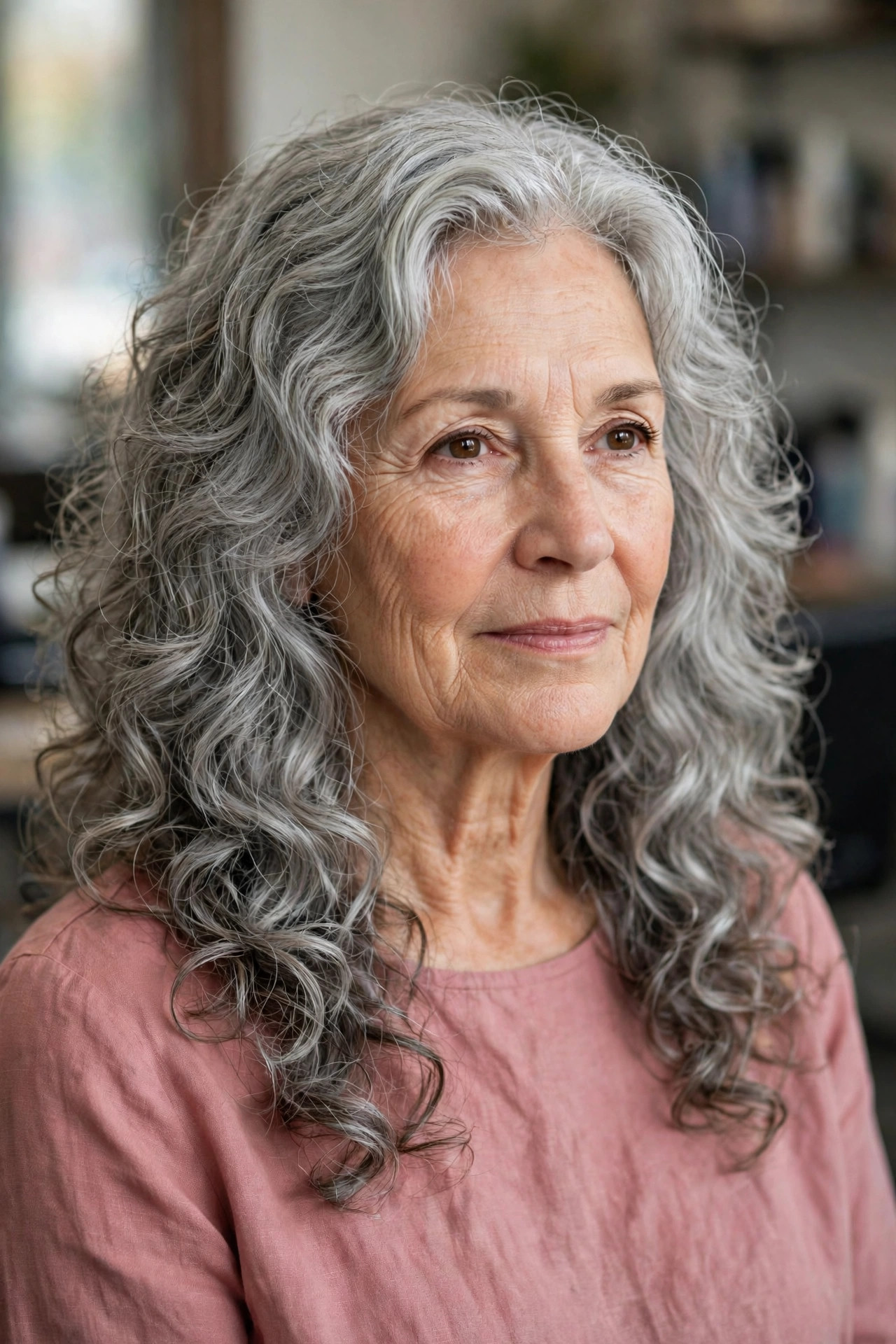
Long silver curls are a quiet rebellion against the idea that gray hair must be cropped. Past the shoulders, silver spirals have a romantic, almost storybook quality — and because the hair is fully natural, there is no demarcation line, no salon colour bill, and no pretending. Soft layers keep the weight distributed so the curls spiral instead of dragging.
Long gray curls do need defending: they yellow more easily than short ones because they have been exposed to sun and water for longer. A purple shampoo every week or two keeps the tone icy rather than brassy, and a satin pillowcase prevents the fragile lengths from roughing up overnight. Trim just the ends every ten to twelve weeks — long curls forgive overdue trims better than any other style in this list.
15. Curly Crop with Height at the Crown
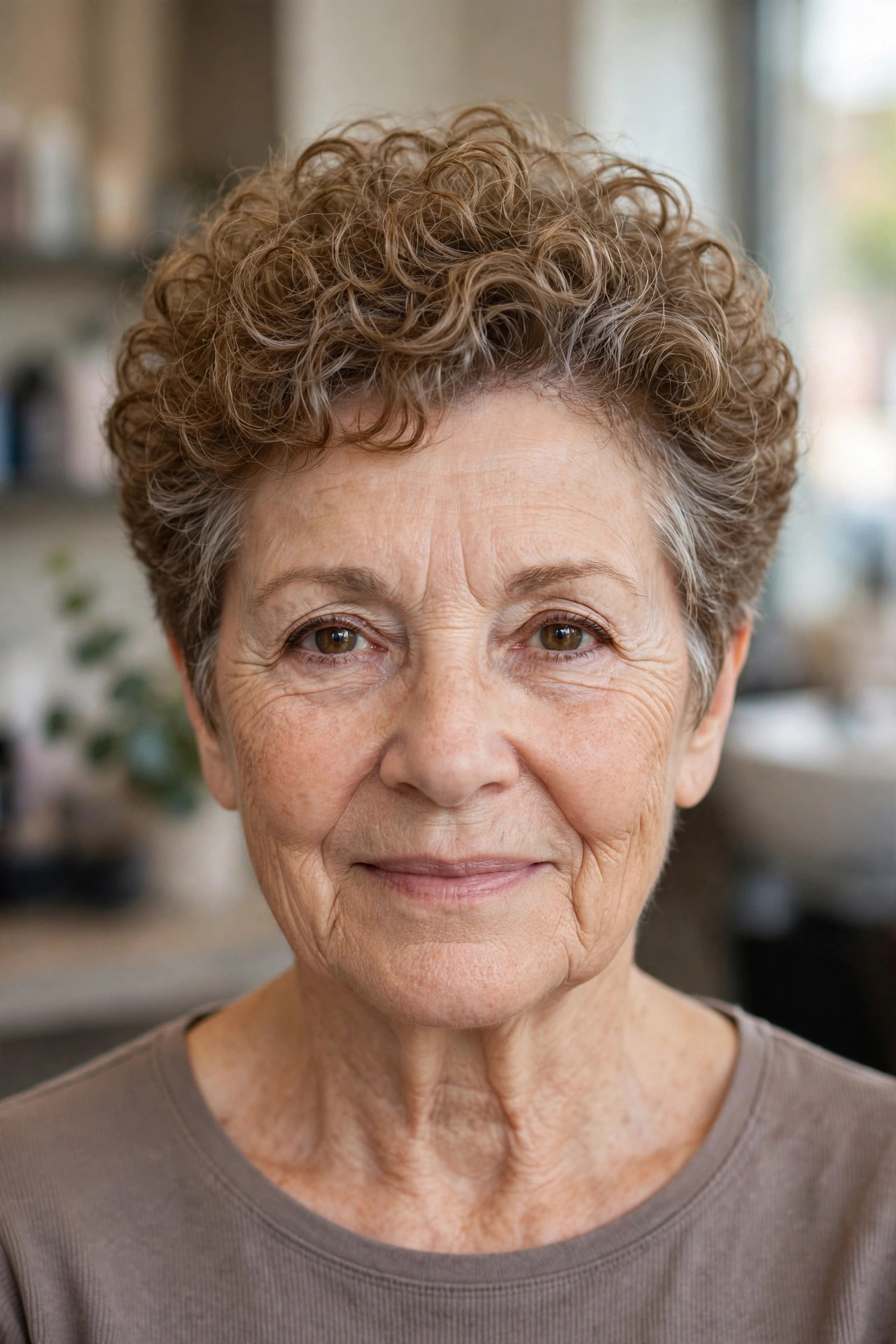
Building the height at the crown is the oldest elongating trick in hairdressing, and the curly crop uses it beautifully. The sides stay neat and short while the top is left long enough for the curls to stack upward, which draws the eye vertically and gives the whole face a lifted look — particularly flattering if your features have softened or your hair has thinned at the front.
Light brown with natural gray blending at the temples, as shown, is an easy transitional colour if you are growing out dye. Work a volumising foam into the roots before diffusing upside-down for two minutes; that brief upside-down blast is what sets the crown height for the day. A firm gel on just the front spirals keeps the height from wilting by lunchtime.
16. Asymmetrical Curly Bob
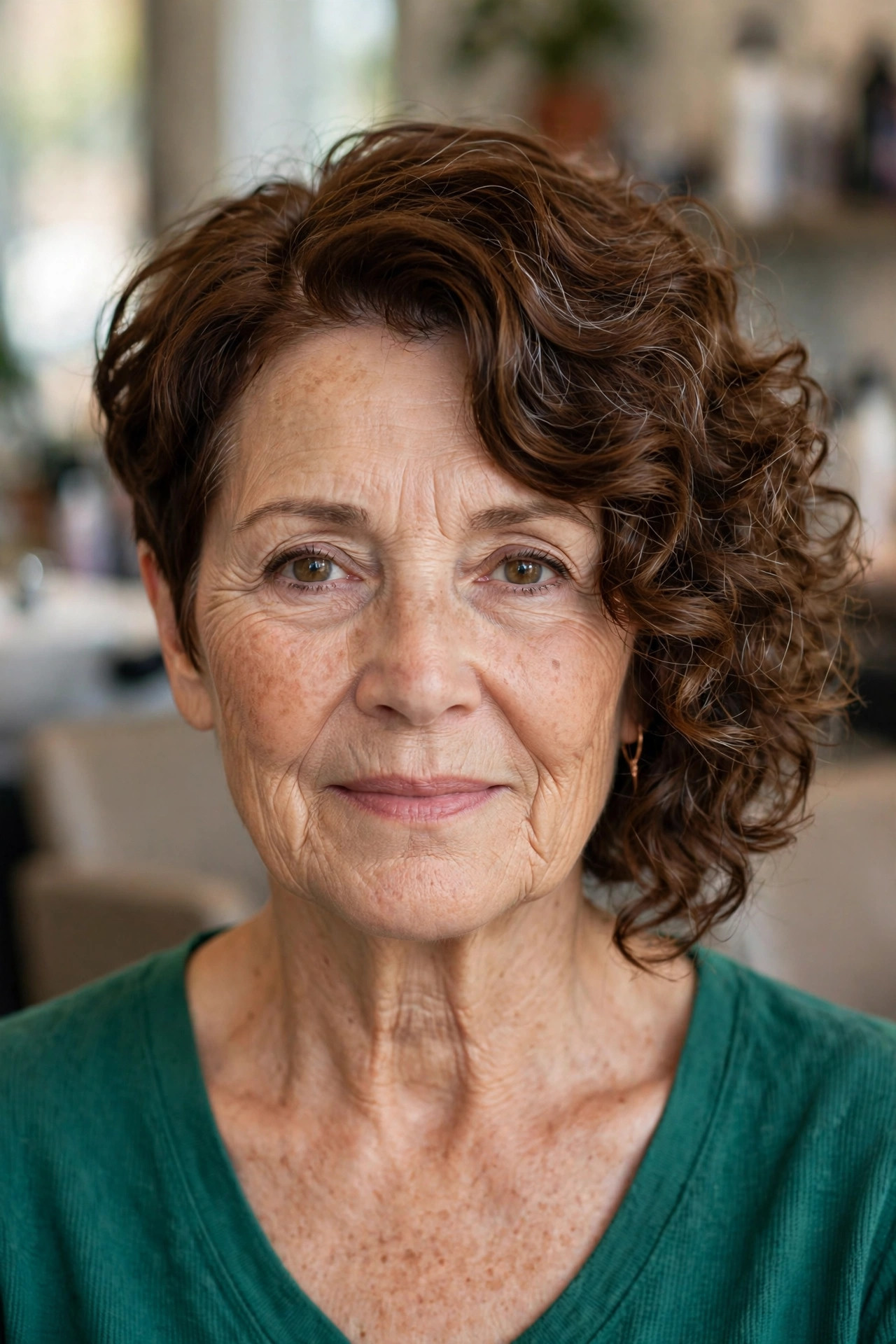
One side sweeping long past the jaw, the other tucked shorter — the asymmetrical curly bob is for the woman who has always liked a little edge. The uneven line creates a strong diagonal that slims the face, and the longer side gives you a curtain of curls to play with, tuck behind an ear, or pin up for the evening.
Choose your long side based on your favourite profile or the side you part naturally; the cut follows your habits, not the other way around. Because the two sides dry at different speeds, diffuse the longer side a touch longer and finish both with the same gel so the definition matches. Asymmetry needs rebalancing every six to eight weeks — once both sides reach the same length, the magic quietly disappears.
17. Curly Half-Up Style with Loose Tendrils
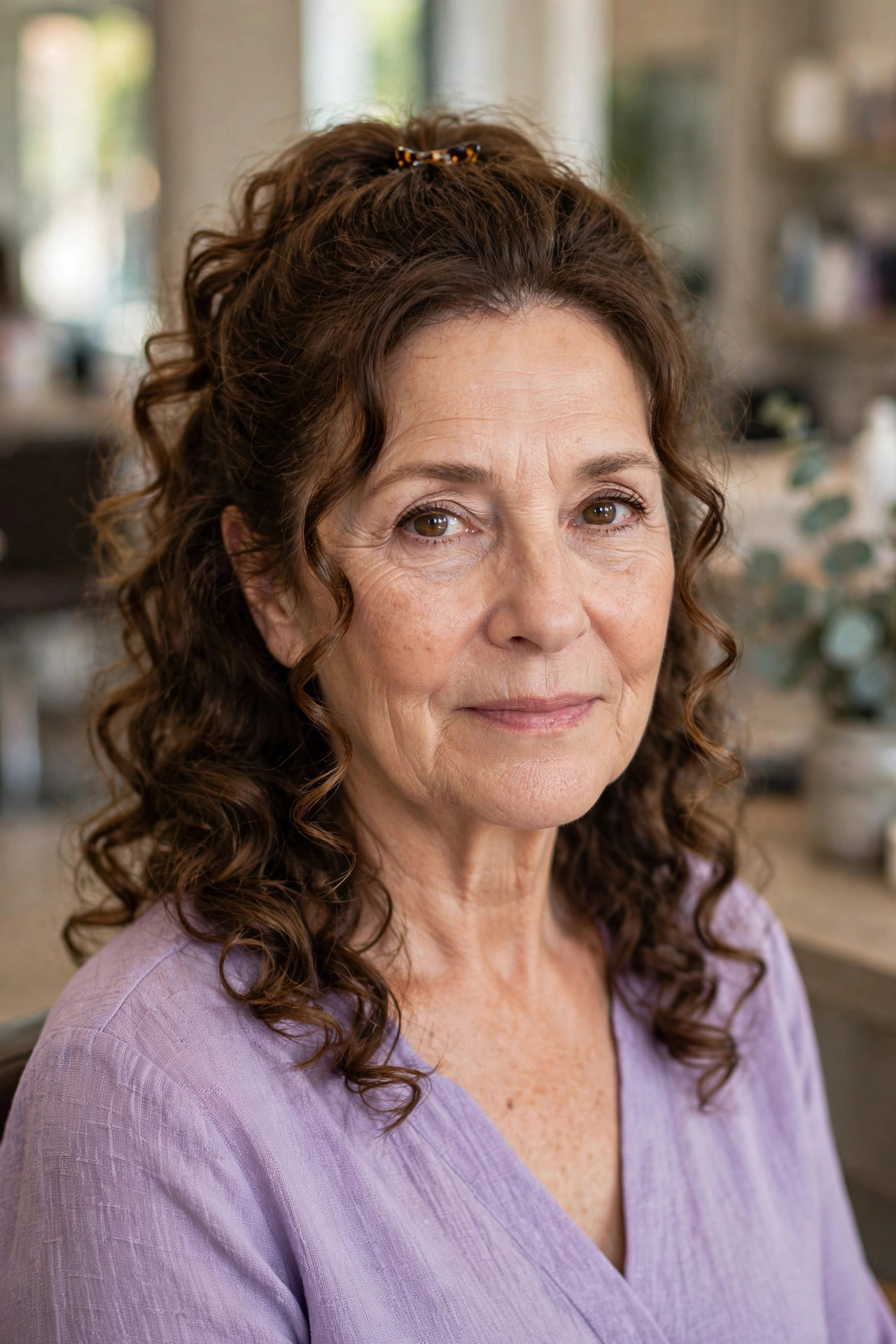
Not every great curly hairstyle is a haircut. The half-up style — top section loosely gathered with a claw clip, the rest falling free — is the five-minute answer for days when your curls are good but your schedule is not. Pulling the front up opens the face and adds crown height, while two loose tendrils left out at the front stop it looking severe.
It works on any curl type from mid-length up, and it is kind to hair that hates heat, because nothing here needs a dryer or an iron. A tortoiseshell claw clip holds surprisingly thick curls without the headache a tight elastic can cause. This is also the style that rescues third-day hair: the gathered top hides flat roots, and the free curls below can be refreshed with a light mist of water and cream.

18. Tousled Curly Lob with Balayage
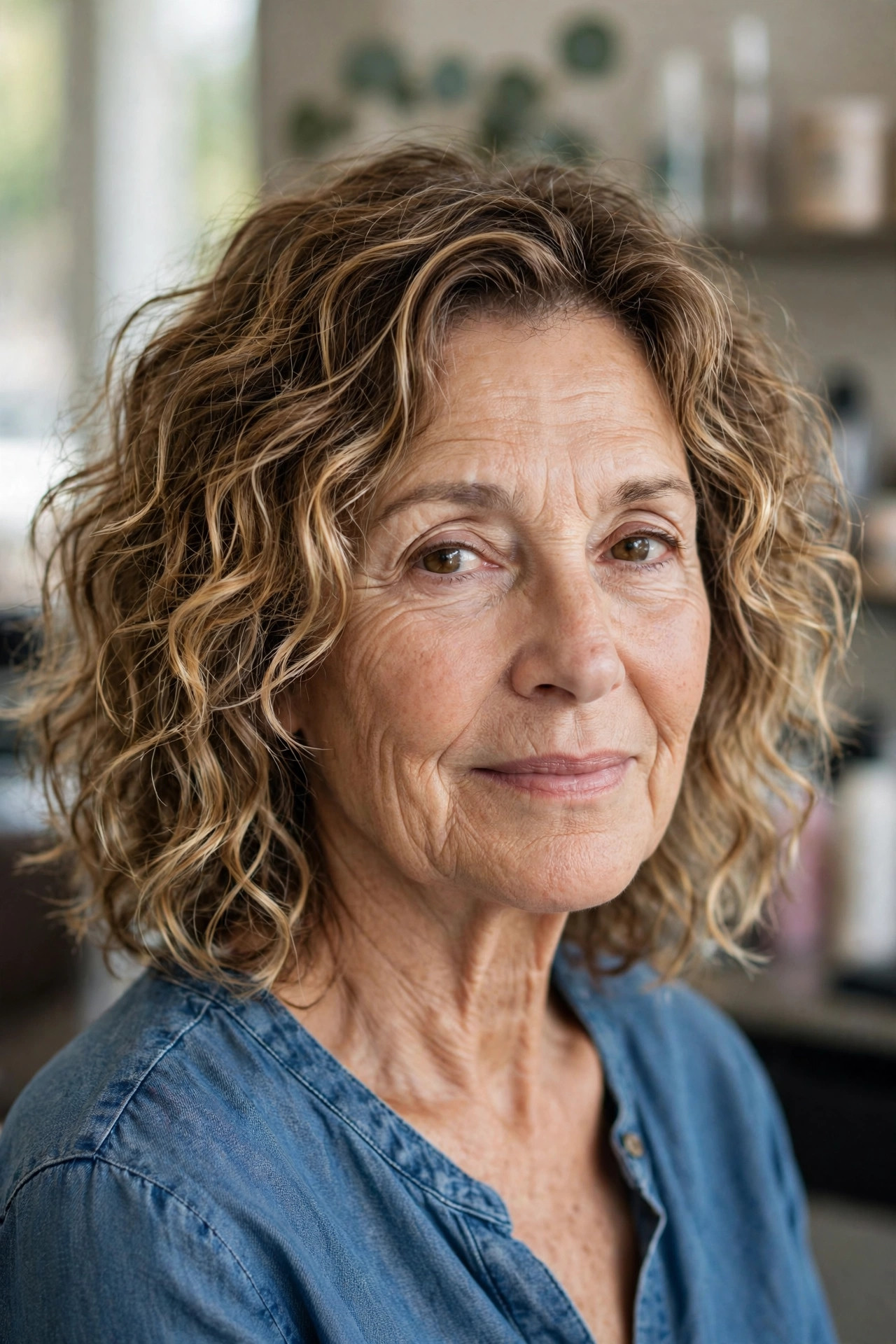
The tousled curly lob is the beach holiday that lives in your hair all year. Collarbone length, deliberately imperfect curls, and balayage painted through the ends so the lightest pieces sit where movement happens — it reads relaxed and expensive at the same time, and the freehand colour grows out with no harsh line, which suits a low-maintenance life perfectly.
A sea-salt or texture spray is the natural partner here: mist it through damp curls, scrunch, and let the air do the styling. On finer curls, go gently — salt sprays can dry — and alternate with a cream on wash days. The tousled finish forgives frizz and uneven curl patterns, which makes this one of the most wearable styles in the entire list for real life.

19. Stacked Curly Bob with a Lifted Back
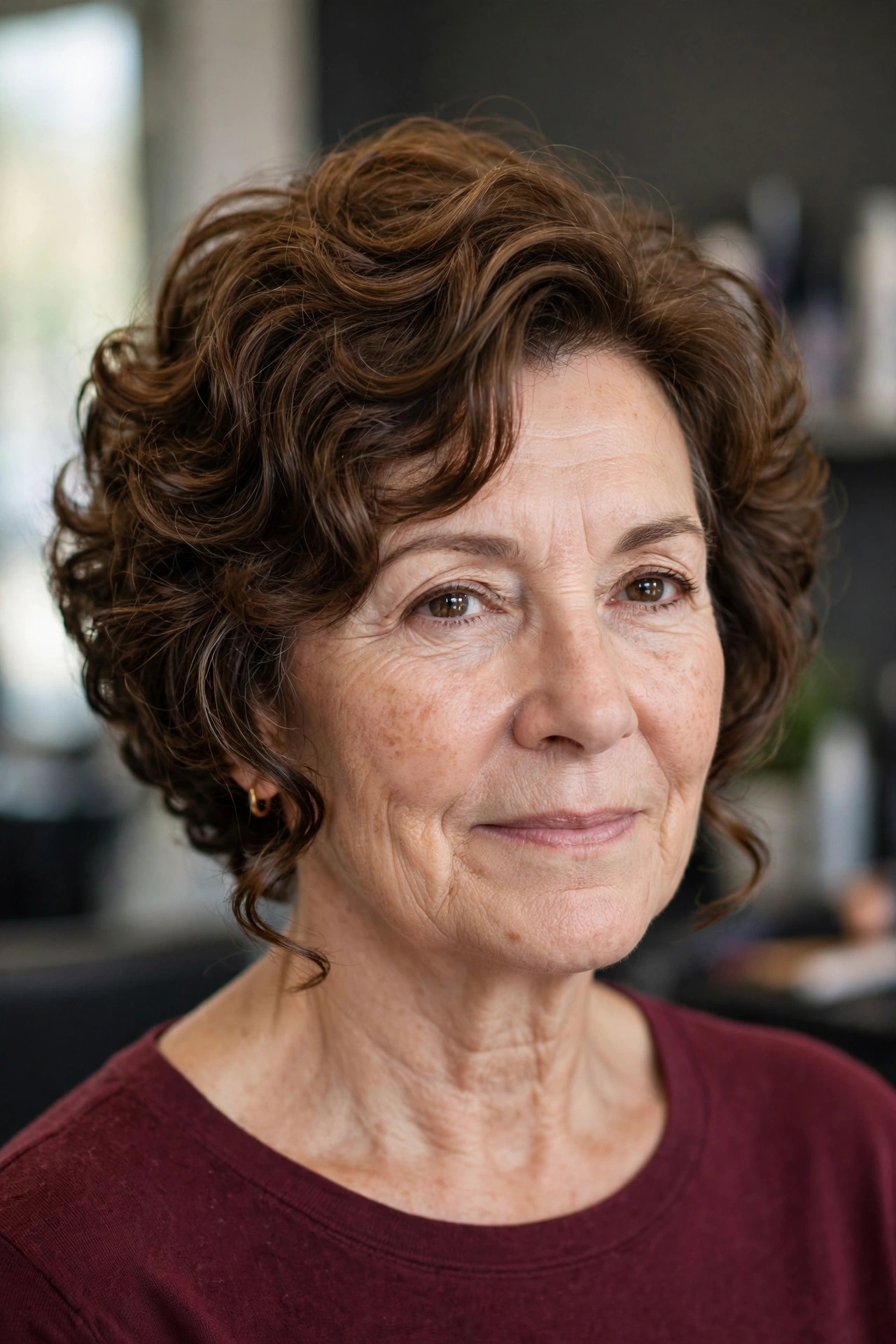
The stacked curly bob borrows the architecture of the classic stacked bob — shorter, graduated layers building volume at the back — and lets natural curls soften every angle. The lift sits behind the crown, the front sweeps longer toward the jaw, and the profile gains a beautiful, deliberate shape that a one-length curly bob cannot achieve.
If the back of your hair tends to fall flat while the front misbehaves, this graduation redistributes the weight exactly where you need it. Our stacked bob haircuts for women over 50 guide explains the shape in more depth. Style by diffusing the back first, scrunching upward to encourage the stack, and finish the front spirals with a little sculpting foam for polish.
20. Big Bouncy Midi Curls with Diffused Volume
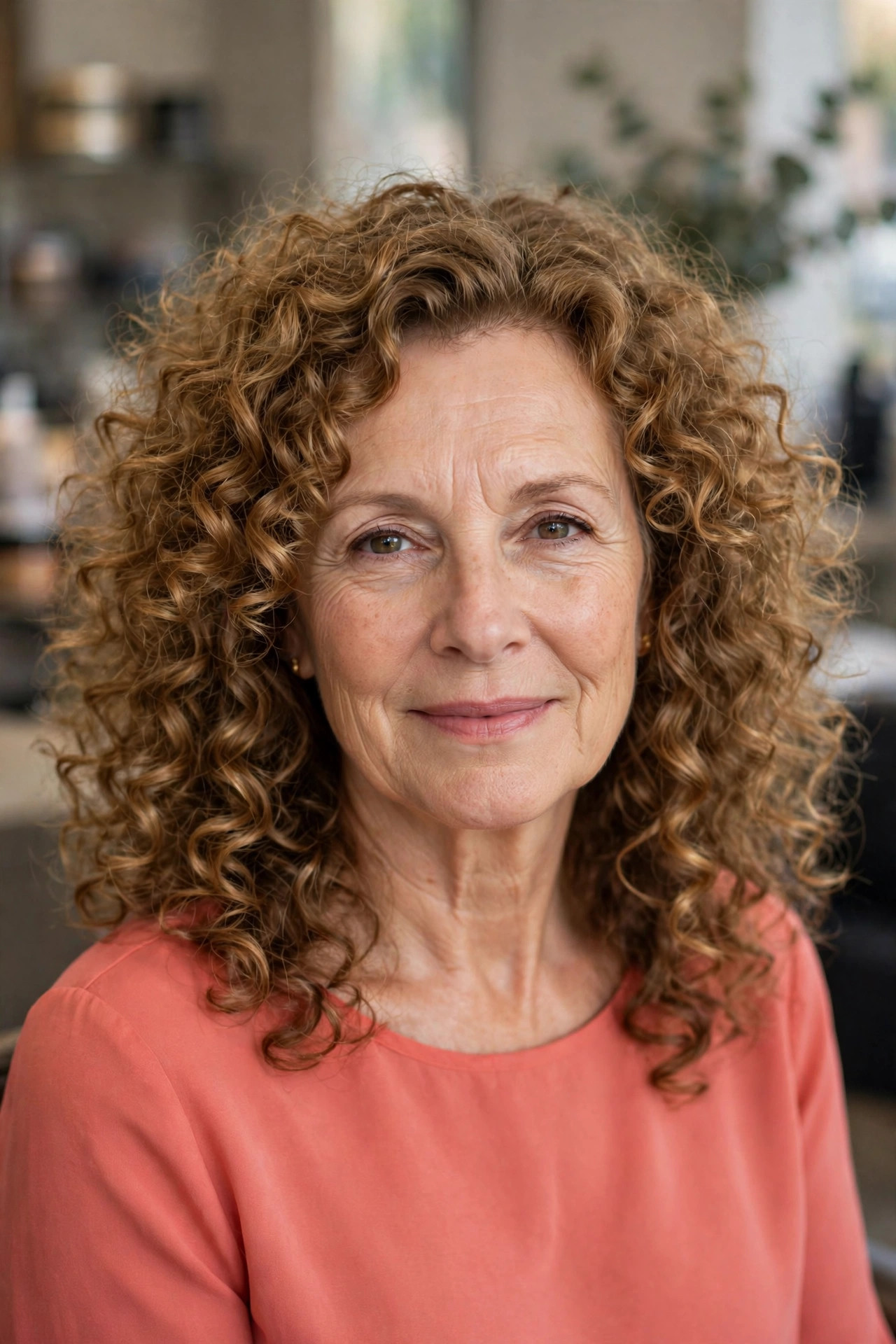
We end with pure celebration: midi-length curls diffused to their biggest, bounciest best. This is the style that makes women fall back in love with hair they spent decades straightening — golden, springy spirals with real presence, the kind of hair that enters the room half a second before you do and starts conversations.
The diffuser is the hero tool here. After applying gel to wet hair, cup sections of curls in the diffuser bowl and dry on medium heat, medium airflow, holding each section still for thirty seconds — moving it constantly creates frizz. When the hair is fully dry and cooled, flip it upside down and shake the roots hard; that is where the volume in this photograph comes from. A strong-hold gel keeps the bounce defying gravity and humidity well into the evening.
Recommended Products
Of everything mentioned in this article, these are the six products we would put in a starter kit for natural curls over 50: two creams for moisture and definition, two gels for hold that survives humidity, a purple shampoo to keep silver curls bright, and a satin pillowcase to protect it all overnight.
How to Keep Natural Curls Happy After 50
Great curly hair after 50 is mostly a routine, not a product haul. Mature curls are drier, gray strands are coarser, and the pattern you have now may not be the pattern you had at 35 — so the habits that matter are the gentle, moisture-first ones below. Build them into your week and every cut in this article becomes easier.
✅ Natural curl care checklist for women over 50
- Apply styling products to soaking-wet hair — curls clump and define best before the water leaves.
- Scrunch with a cotton T-shirt or microfibre towel, never a rough bath towel.
- Once you start drying, hands off until the hair is 100% dry — touching sets frizz free.
- Sleep on satin and pineapple longer curls on top of your head to protect the pattern overnight.
- Refresh instead of rewashing: a water mister plus a dab of cream revives most curls for day two and three.
- Clarify gently once a month — product build-up weighs mature curls down and dulls silver.
- Trim every 8–12 weeks (5–6 for pixies and crops) so the shape, not the split ends, decides your silhouette.
If your curls have changed dramatically — much looser, much frizzier, or suddenly straight in patches — mention it at your next check-up as well as to your stylist. Hair is often the first place hormonal and thyroid changes show up, and a cut can only do so much if something underneath needs attention.
Frequently Asked Questions
How often should women over 50 trim curly hair?
Most curly cuts hold their shape for eight to twelve weeks, because curls disguise growth better than straight styles. The exceptions are short shapes — tapered pixies, crops and asymmetrical bobs — which need a tidy-up every five to six weeks to keep the taper and balance that make them work. If your curls start forming a triangle, with flat roots and wide ends, you are overdue.
Should women over 50 avoid long curly hair?
No — long curly hair can look wonderful after 50, provided it has long layers to keep the curls springy and enough moisture to stay glossy. The styles that date long hair are blunt, one-length cuts with no shaping, which drag the face down. Ideas 3 and 14 in this list show long curls done the modern way, in both rich chestnut and fully natural silver.
Why are my gray curls frizzier than my curls used to be?
Gray strands grow in coarser and produce less natural oil, so they absorb moisture unevenly and frizz more readily. The fix is moisture layering — conditioner left partially in, a rich curl cream, then gel to seal it — plus sleeping on satin to reduce friction. A purple shampoo once a week also keeps gray curls bright, since dull, yellowed silver reads as frizzier than it really is.
Is a diffuser or air-drying better for curls after 50?
Both work; they give different results. Air-drying gives softer, looser curls and zero heat exposure, which fragile mature hair appreciates. Diffusing on medium heat gives more root lift, volume and spring — the better choice for fine or thinning curls that need height at the crown. Many women air-dry in summer and diffuse in winter, which is a perfectly sensible compromise.
What products do curly-haired women over 50 actually need?
Fewer than the internet suggests. A gentle cleanser, a good conditioner, one curl cream for moisture and definition, and one gel for hold will cover almost every style in this article. Add a purple shampoo if you are gray or silver, and a satin pillowcase to protect your work overnight. Technique — applying to wet hair, scrunching, and not touching while drying — matters more than owning ten products.
Can I wear a curly fringe after 50?
Absolutely, and it is one of the most flattering choices available: a soft curly fringe covers forehead lines, shortens a long face, and draws attention to the eyes. Ask for it cut long and wispy, at least an inch past where you want it to sit, because front curls spring up the most. Ideas 2, 9, 12 and 13 show four different ways to wear it.
The Bottom Line
Your curls are not a phase you were supposed to grow out of. Cut for their actual pattern, kept moisturised, and left to dry in peace, natural curls after 50 are soft where you want softness, full where hair is thinning, and entirely, unmistakably yours. Pick the two or three styles above that made you pause, take them to a curl-aware stylist, and let your hair do what it has been trying to do all along.