Braided Hairstyles for Black Women Over 60 That Are Gentle on Hair
This post contains affiliate links. As an Amazon associate, I earn from qualifying purchases. I only recommend products that are of high quality and that I would use myself.
Braids after 60 are not about giving up on your hair — they are about resting it intelligently. Hair in this decade is often finer at the edges, drier along the length, and slower to forgive a style that pulls. A braided style that ignores those facts can cost you the very hairline it was meant to protect. A braided style chosen with them in mind does the opposite: weeks of low-manipulation rest, real length retention, and mornings that start with your hair already done.
The twenty styles below were chosen on one test: does it stay gentle in practice, not just in name? That means knotless or gradual starts instead of tight knots, medium and larger parts instead of tiny sections, lengths and weights that respect finer hair, and honest wear times with a firm end date. If you are building a protective-style routine for the first time, our easy natural hairstyles guide is a good companion for the weeks between installs.
Table of Contents
- 1. Medium Knotless Box Braids at Shoulder Length
- 2. Large Knotless Braids with Wide, Comfortable Parts
- 3. Silver-Gray Knotless Braids
- 4. Gentle Straight-Back Cornrows
- 5. Braided Crown Halo Updo
- 6. Lightweight Jumbo Senegalese Twists
- 7. Bob-Length Box Braids
- 8. Crochet Braids with Soft Curls
- 9. Feed-In Braids with a Soft, Gradual Start
- 10. Side-Swept Cornrows into a Low Bun
- 11. Low Braided Bun from Medium Box Braids
- 12. Salt-and-Pepper Box Braids
- 13. Medium Senegalese Rope Twists
- 14. Large Goddess Braids with Loose Curly Ends
- 15. Braided Top-Knot Bun in Black and Silver
- 16. Chin-Length Braided Bob with a Center Part
- 17. Shoulder-Length Passion Twists
- 18. Cornrow Ponytail with a Loose, Comfortable Base
- 19. Fulani-Inspired Braids with Soft Parts
- 20. Two Gentle Silver French Braids
- Recommended Products
- FAQs
- Thinning or tender edges? Medium knotless braids (idea 1), feed-in braids (idea 9), or the chin-length braided bob (idea 16) — the lowest-tension starts and loads.
- Fine hair that cannot carry weight? Passion twists (idea 17), jumbo twists (idea 6), or two French braids in your own hair (idea 20).
- Embracing silver? Silver knotless braids (idea 3) or salt-and-pepper box braids (idea 12).
- Shortest appointment? Large knotless braids (idea 2), goddess braids (idea 14), or crochet braids (idea 8).
- An occasion coming up? The halo crown (idea 5), the low braided bun (idea 11), or the black-and-silver top knot (idea 15).
- The golden rules, whatever you choose: medium or larger parts, no pain after day one, four to six weeks maximum, and a real rest week between installs.
1. Medium Knotless Box Braids at Shoulder Length
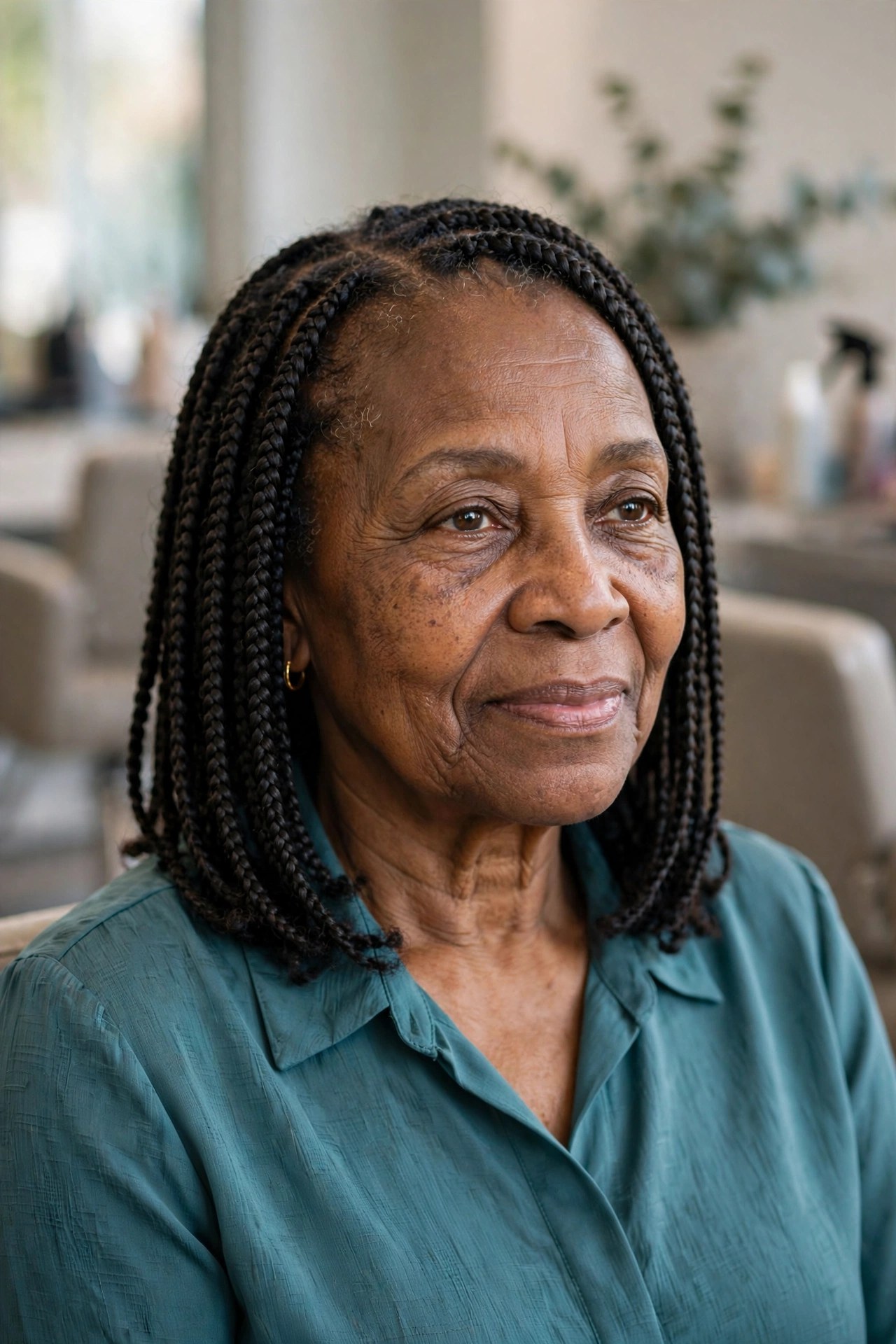
If you try only one style from this list, make it this one. Knotless braids are started by feeding extension hair in gradually, a little at a time, instead of beginning with the tight knot traditional box braids use. That difference is everything after 60: no hard pull on day one, no headache by evening, and far less stress on edges that are finer than they once were.
Shoulder length keeps the weight honest. Medium parts — especially around the hairline — spread what weight there is across more of your own hair, and the finished style can be worn loose, half-up, or in a low ponytail without dragging. Plan on four to six weeks of wear, and tell your braider plainly before she starts: comfortable first, neat second. A good braider hears that as professionalism, not pickiness.


2. Large Knotless Braids with Wide, Comfortable Parts
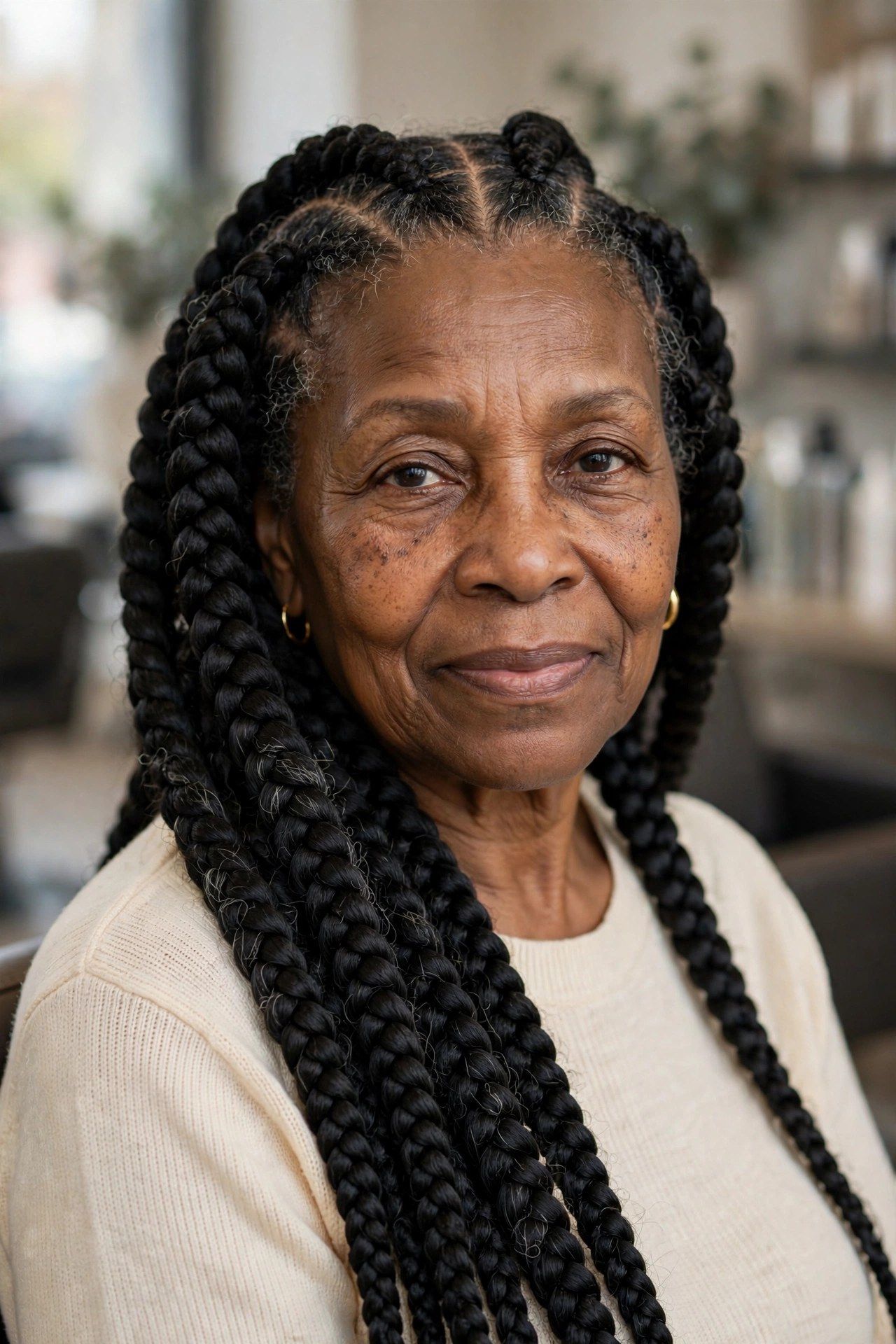
Large knotless braids give you the bold, graphic look of jumbo braids with two built-in kindnesses: far fewer braids to sit through, and knotless starts that do not grip the root. Wide parts are the detail that matters most here — each braid is anchored in a generous section of your own hair, so no single strand is asked to carry more than its share.
The honest trade-off is weight per braid, so keep the length at or just past the shoulders rather than reaching for extra-long hair. Fewer braids also means a faster install and a much quicker, gentler takedown. If your hair is fine, ask for large — not super-jumbo — sections, and enjoy a morning routine that takes about ninety seconds.
3. Silver-Gray Knotless Braids
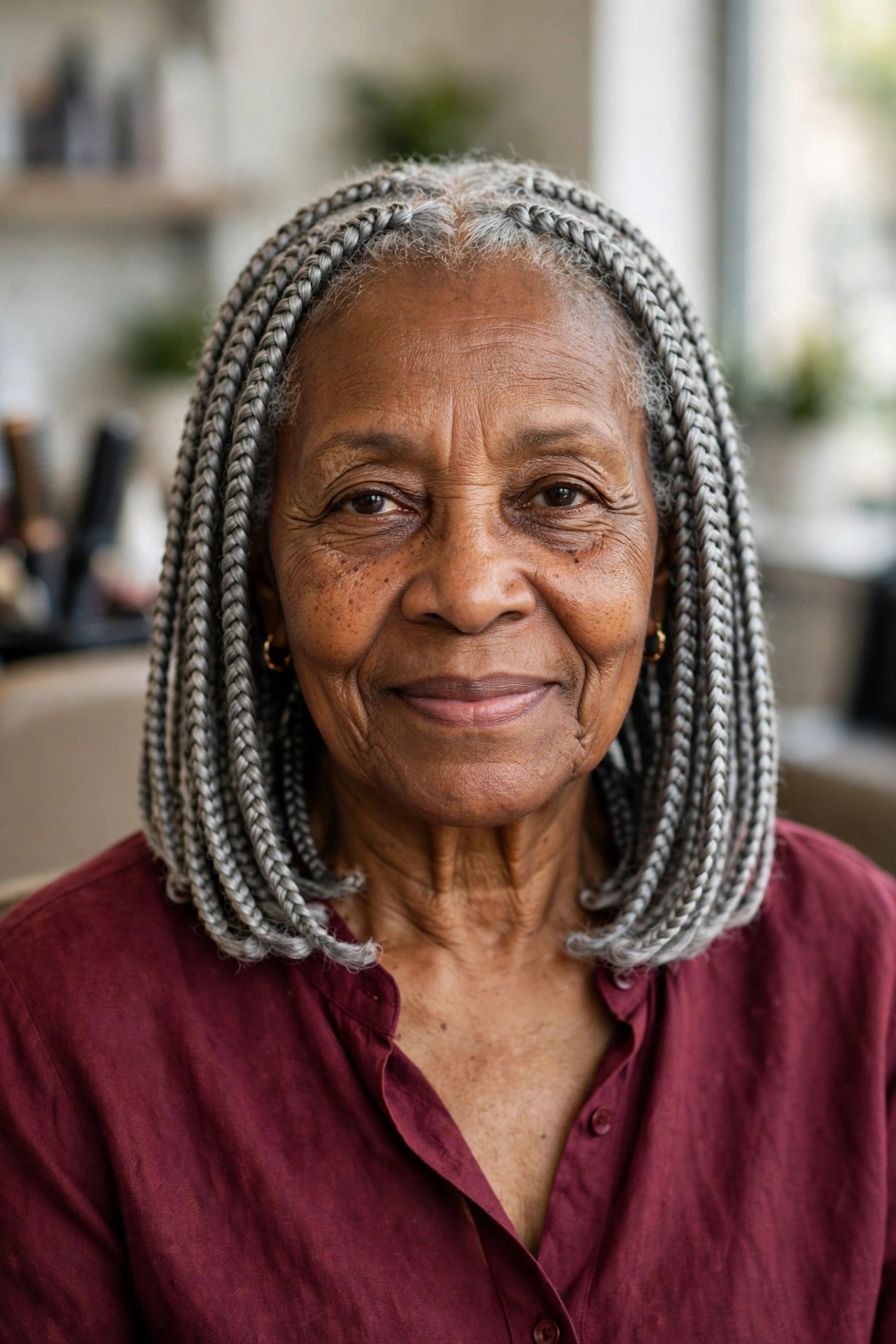
Your silver is not a problem to cover — it is a color story to build on. Knotless braids worked in silver and soft gray extension hair turn new growth into part of the design, so week five looks deliberate instead of overdue, and there is no dye appointment and no harsh line of demarcation to manage.
Ask your braider to blend two or three gray tones rather than one flat silver; the mix reads natural and catches light beautifully against deeper skin. If you are still deciding how to wear your gray day to day, our guide to gray hairstyles for women over 60 shows the cut-based options that pair well between installs. Knotless starts keep this glamorous style comfortable at the hairline, where silver hair is often at its most delicate.

4. Gentle Straight-Back Cornrows
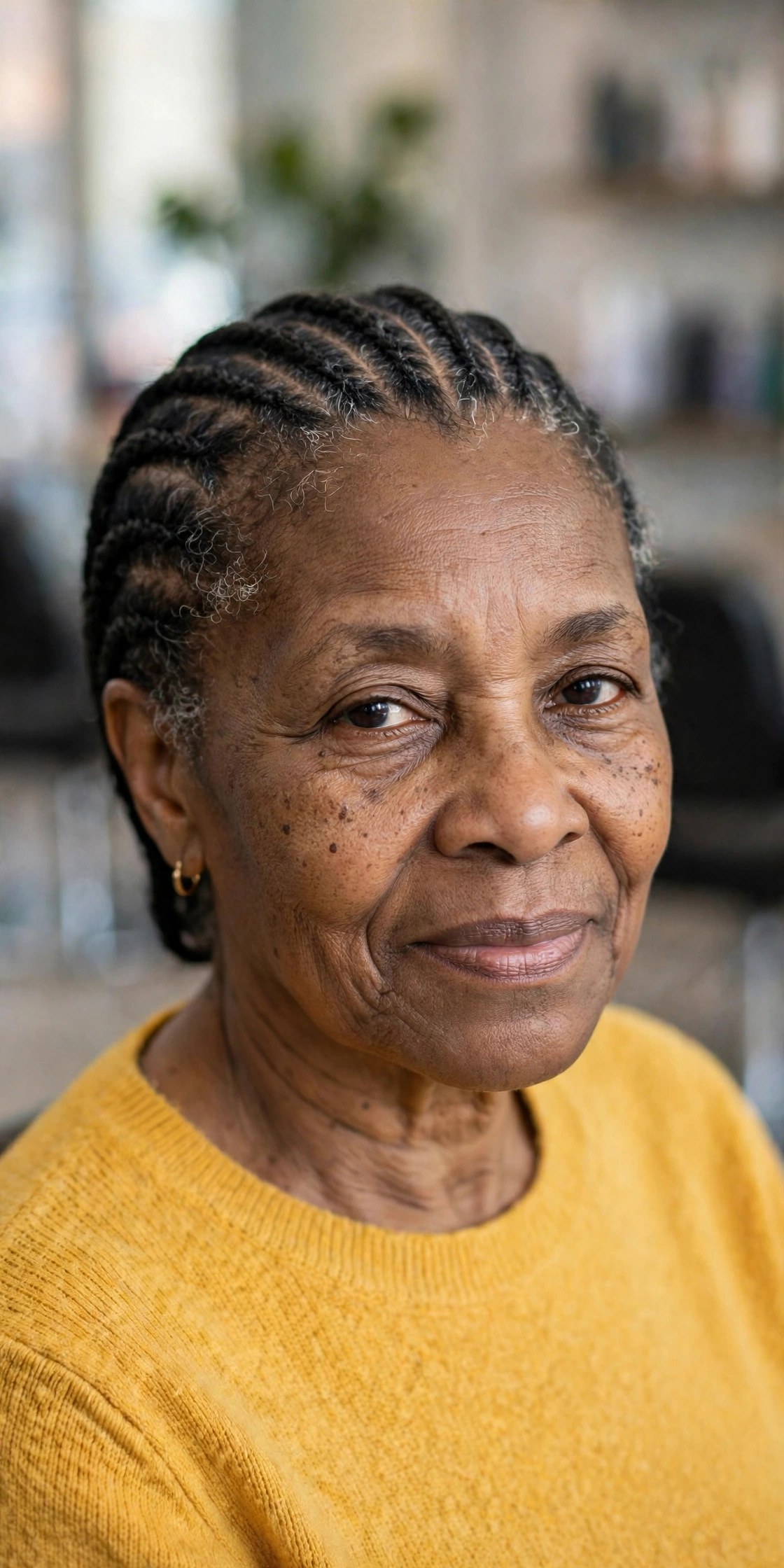
Cornrows are a classic for good reason, and the gentle version is simply a matter of sizing and touch: medium rows, braided firmly enough to hold but never so tight that your scalp feels lifted, with the very front edges left soft. Straight-back rows keep hair off the face and neck, rest your own hair completely, and sit flat under a scarf, hat, or wig if you like options.
Skip the very fine, intricate row patterns — they take longer, grip smaller sections, and are harder on a mature hairline. Medium cornrows usually look fresh for two to three weeks. Cleanse along the parts every week or so with a gentle co-wash worked in with your fingertips, rinse well, and let them dry fully before covering.

5. Braided Crown Halo Updo
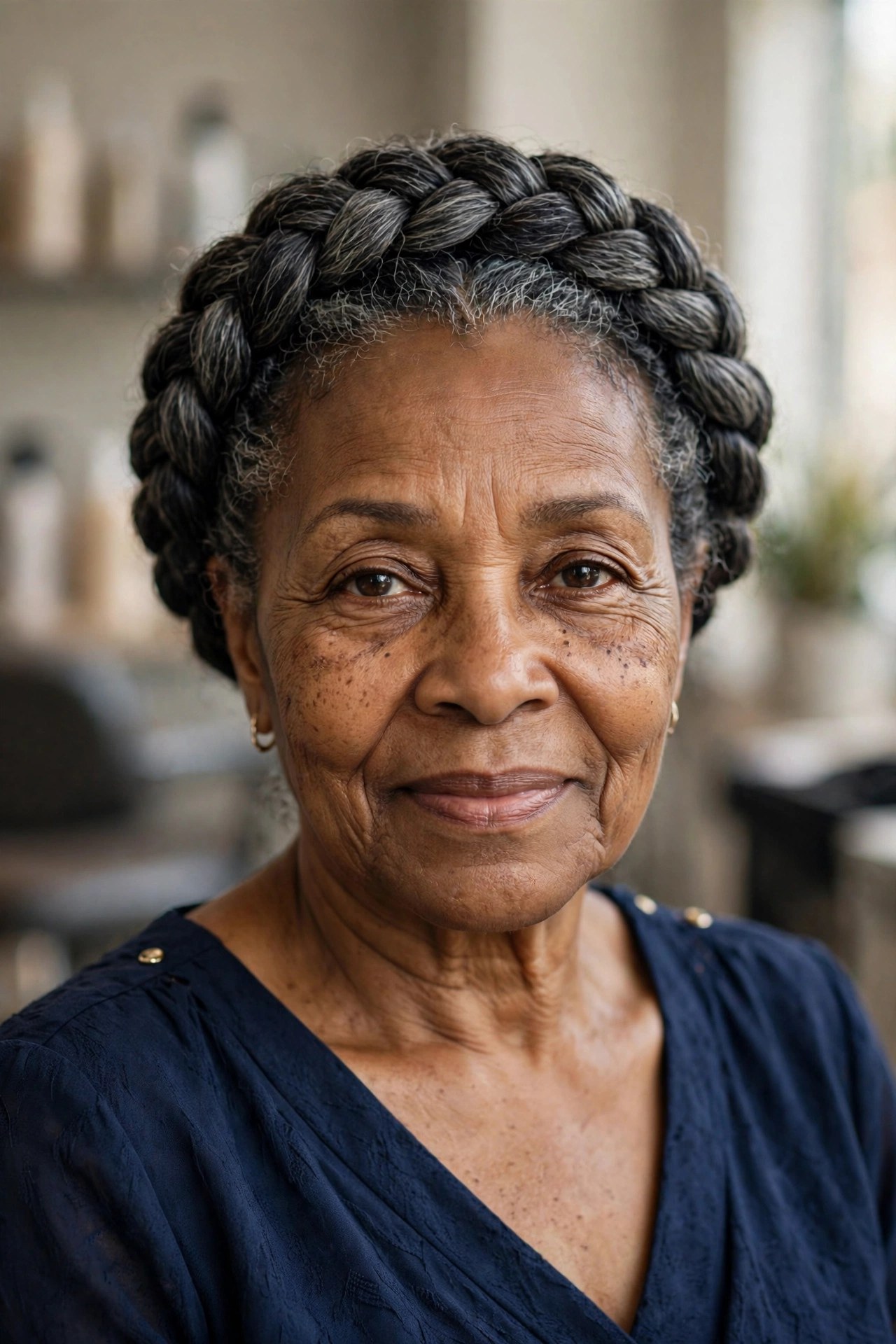
One generous braid circling the head like a crown: the halo is elegance without a single extension-heavy install. It lifts the face, shows off earrings and bone structure, and keeps every strand off your neck — lovely for church, celebrations, and warm weather, and achievable on your own hair if it has some length, or with a small amount of added hair for fullness.
The rule here is comfort at the temples. The braid should rest on the head, not pull at it; if you can feel it when you raise your eyebrows, it is too tight and should be redone looser. A halo lasts a week or two, which makes it the lowest-commitment style on this list — a complete rest for your hair with a genuinely regal finish.
6. Lightweight Jumbo Senegalese Twists
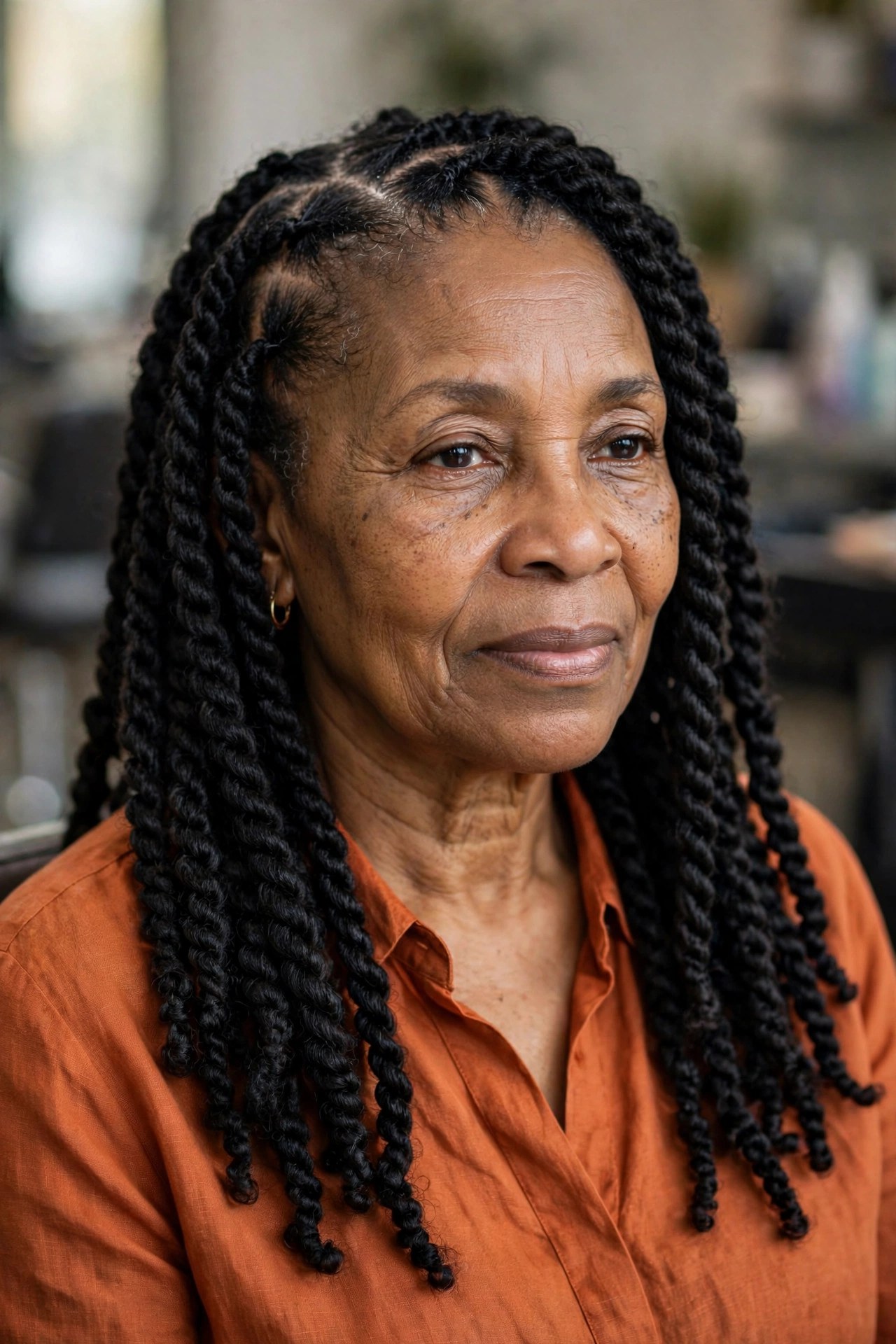
Senegalese twists are two-strand rope twists with a smooth, polished finish, and in a jumbo size they are one of the lightest full-head protective styles you can wear. Twists do not need the gripping base a braid does, the install is comparatively quick, and large sections mean your scalp stays easy to reach for cleansing and moisture.
Keep them just past shoulder length so the swing stays graceful rather than heavy, and ask for the front twists to start with a soft hand — the first twist at each temple sets the comfort for the whole style. Expect three to five comfortable weeks, refreshing individual twists at the front if they loosen rather than redoing the whole head.


7. Bob-Length Box Braids
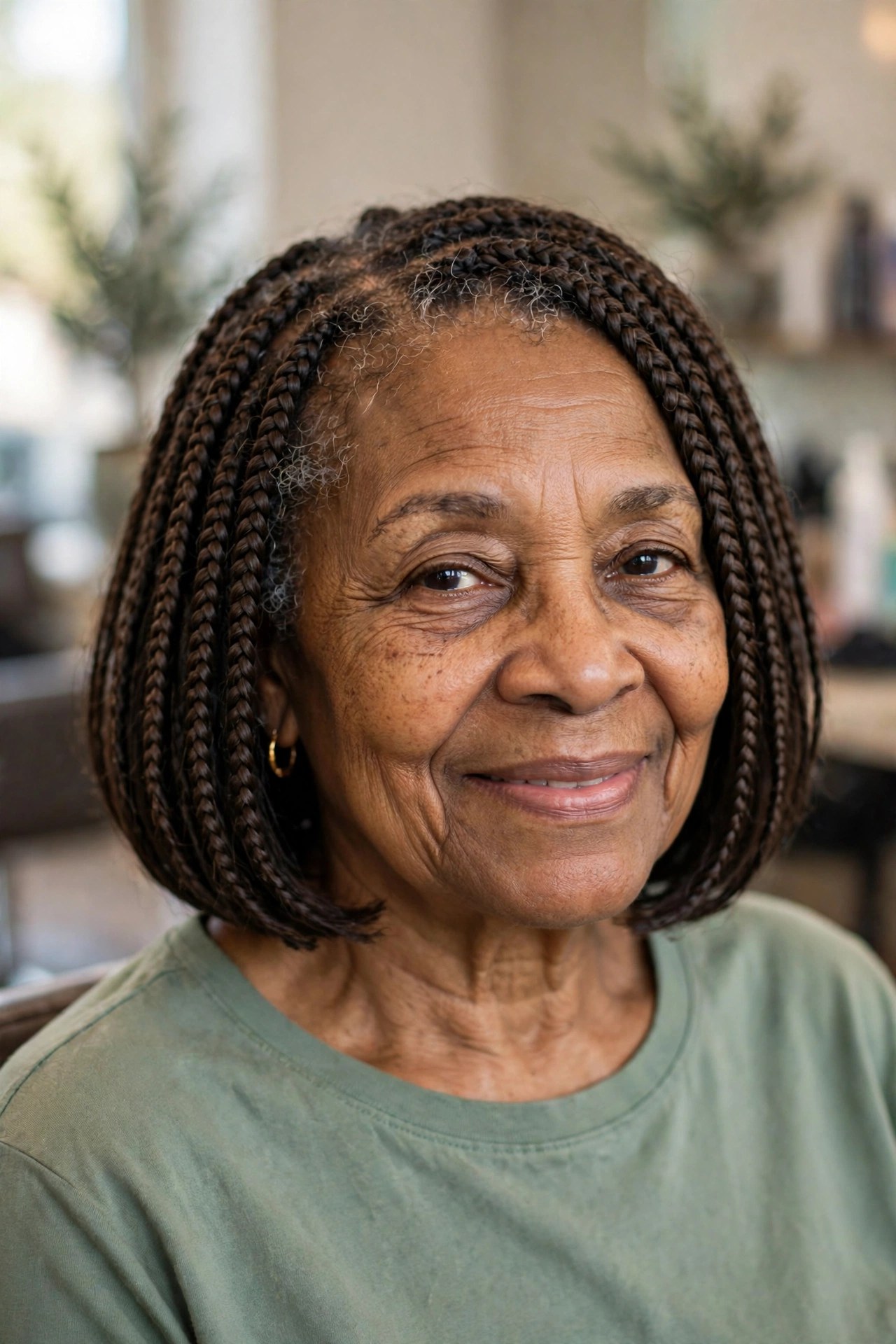
All the polish of a bob, none of the daily heat styling: box braids installed or cut to bob length frame the face, clear the shoulders, and carry noticeably less weight than longer braids. That lighter load is a real kindness to your neck and to roots supporting finer hair — and the shape still reads tailored and intentional.
Ask for knotless starts at the front so the shorter braids around your face sit comfortably from the first day, and medium parts throughout. A braided bob dresses up instantly with earrings and a lip, and takedown is faster than any long style. It is one of the easiest first braided styles if you are returning to braids after years away from them.

8. Crochet Braids with Soft Curls
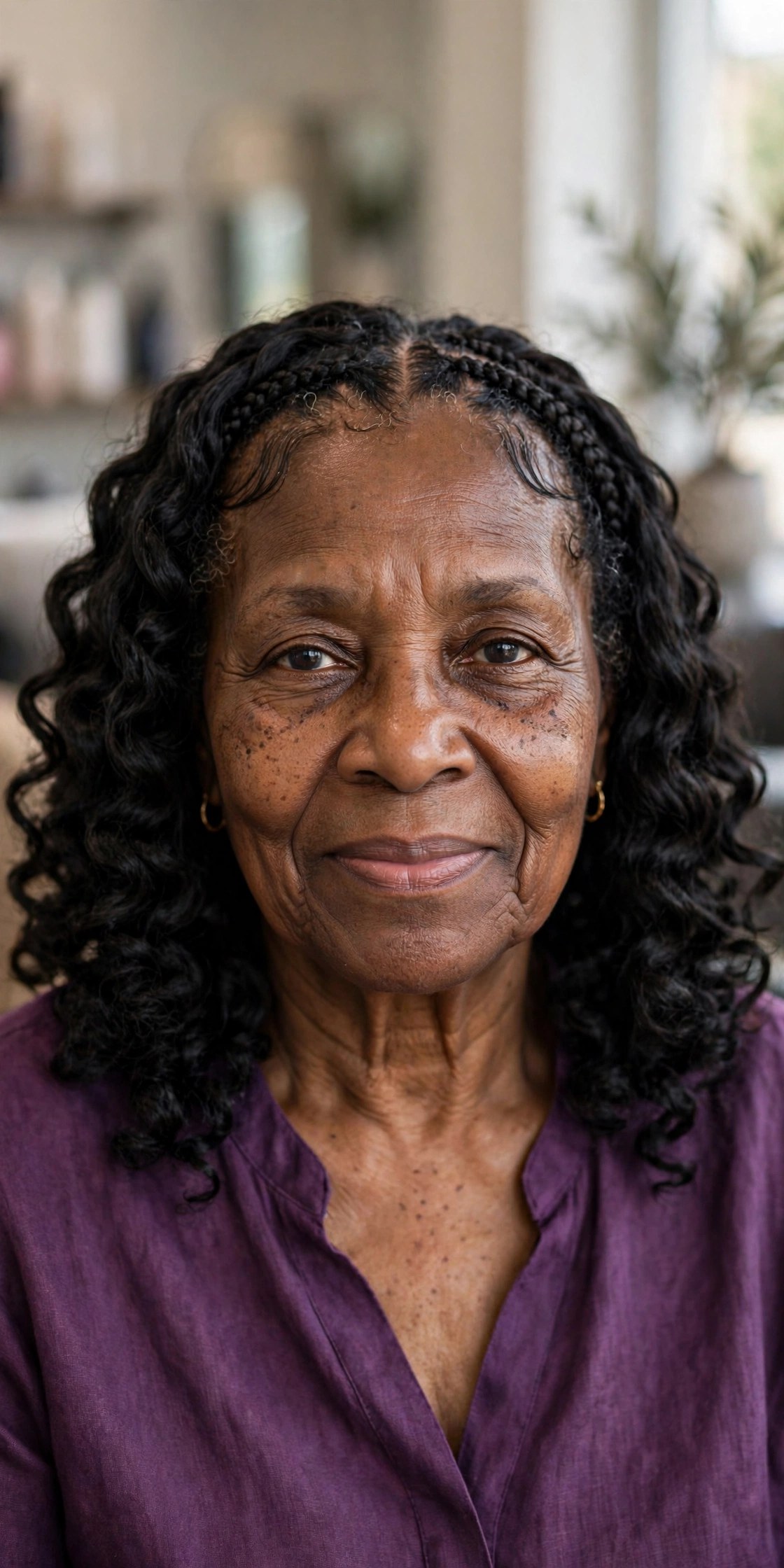
Crochet is the speed-and-comfort champion of this list. Your own hair rests in flat cornrows underneath while pre-curled hair is looped through with a latch hook — no hours of individual braiding, very little tension, and a soft, voluminous curly finish that frames the face gently.
Because the cornrow base is hidden, it can be braided with a deliberately light touch; tell your stylist the base is about security, not tightness. Choose a moderate volume and shoulder length so the style stays light on the base rows. Separate the curls with your fingers in the morning, keep a light leave-in on the lengths, and plan on four to six weeks before the base needs to come down.

9. Feed-In Braids with a Soft, Gradual Start
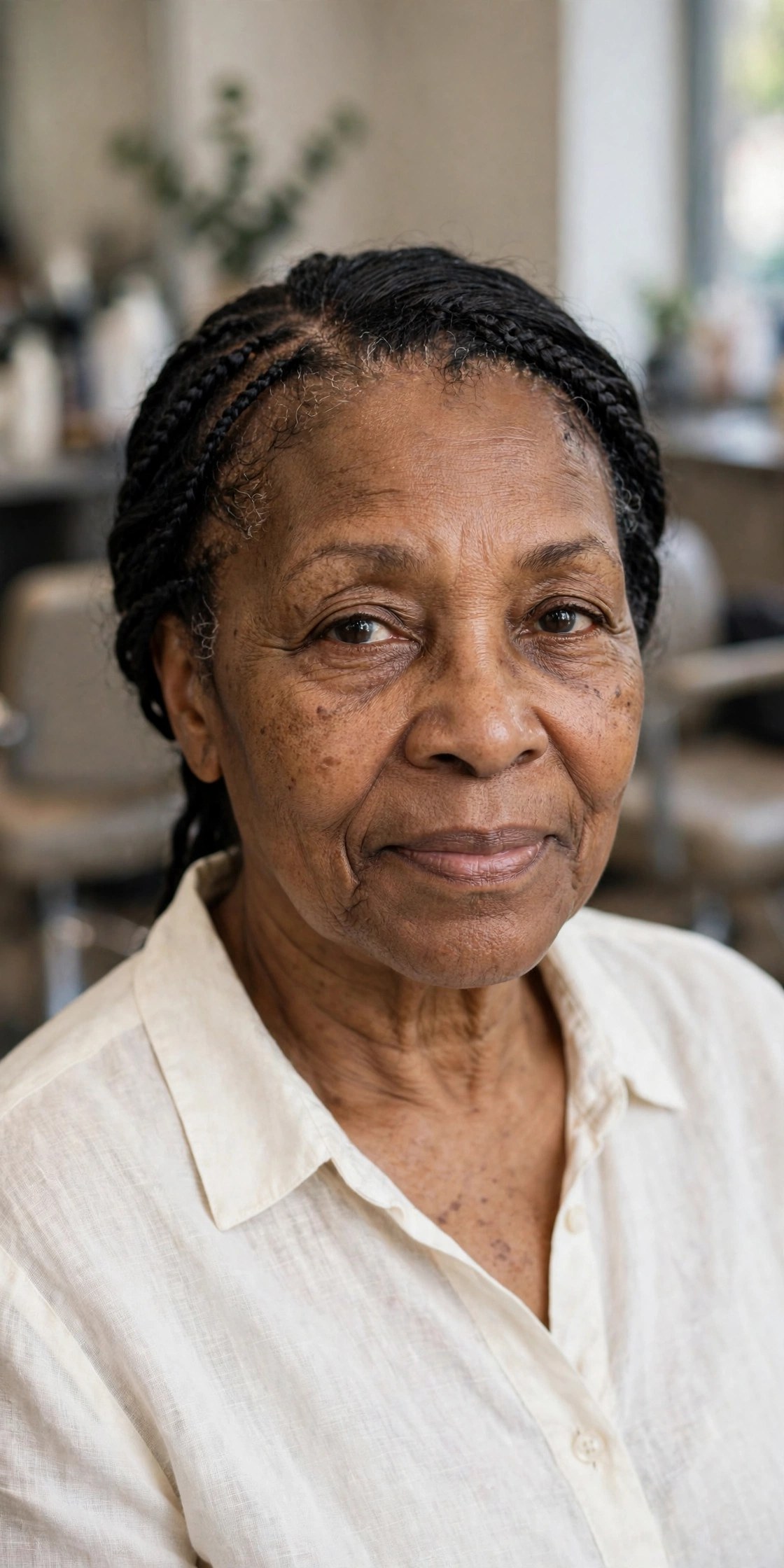
Feed-in braids earn their gentle reputation at the hairline: instead of a visible, bulky knot, small amounts of extension hair are fed in stitch by stitch, so the braid grows gradually from your own hair. The front looks smooth and natural, and — more importantly — no single point at the edge takes the full pull of the finished braid.
They are a beautiful choice if you love a sleek, swept-back finish but have stepped away from traditional cornrows because of tenderness at the front. Keep the braids medium in size, resist ultra-fine stitch patterns at the temples, and give the style three to four weeks. If any braid throbs or leaves bumps after the first day or two, that is information, not something to endure — have it loosened or removed.
10. Side-Swept Cornrows into a Low Bun
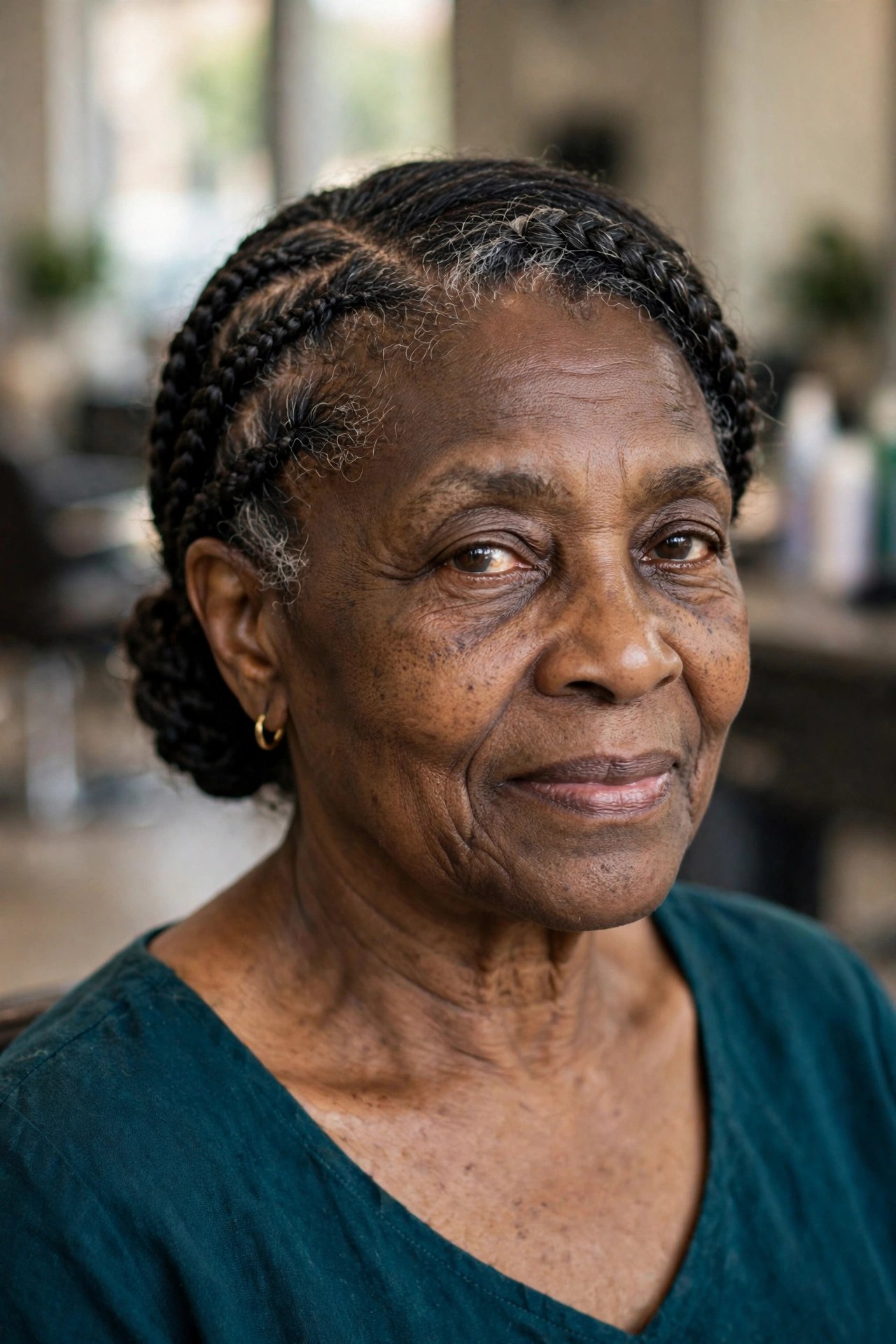
Sweeping cornrows diagonally to one side and gathering them into a low bun changes both the look and the physics: the asymmetry softens the face, and the weight settles at the nape instead of pulling back from the hairline all day. It is polished enough for any occasion and practical enough for every day.
A side design is also a clever kindness if one side of your hairline is stronger than the other — your braider can build the pattern so the more delicate side carries less. Keep the bun loose rather than wound tight, secure it with soft pins or a gentle clip, and let it down at night so no single direction of pull becomes a habit for your edges.

11. Low Braided Bun from Medium Box Braids
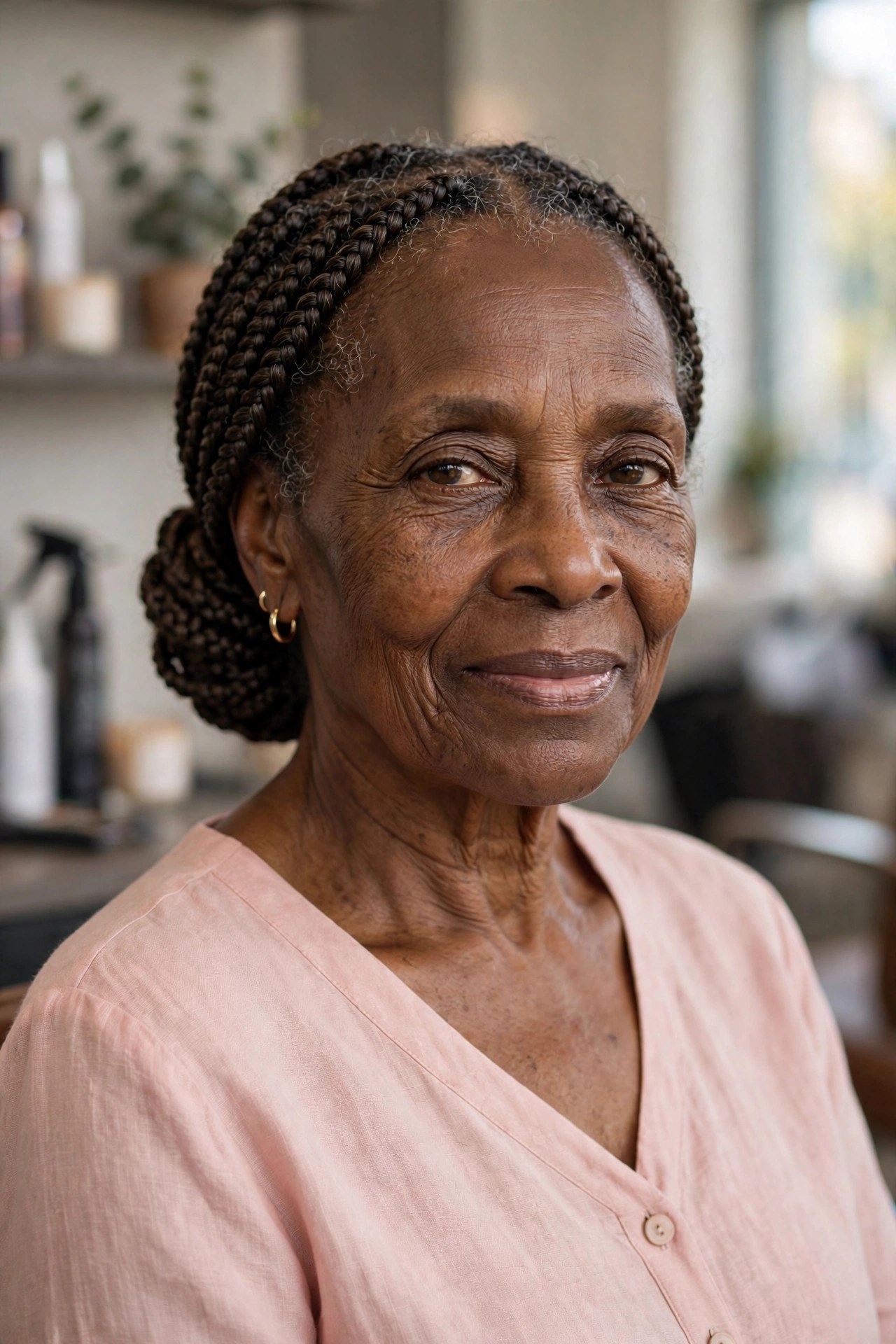
This is less a separate install than a way of wearing one beautifully: medium box braids gathered into a low, softly wound bun at the nape. Low placement is the gentlest place a bun can live — gravity works with it rather than against your front hairline, the way a high, tight bun works against it.
Wind the braids, do not twist them hard, and pin rather than band them where you can; if you use a band, choose a soft one and never sleep in a taut bun. Readers comparing this with our earlier protective braids and twists guide for women over 50 will notice the same principle carried further here: after 60, where the weight sits matters as much as the style itself.
12. Salt-and-Pepper Box Braids
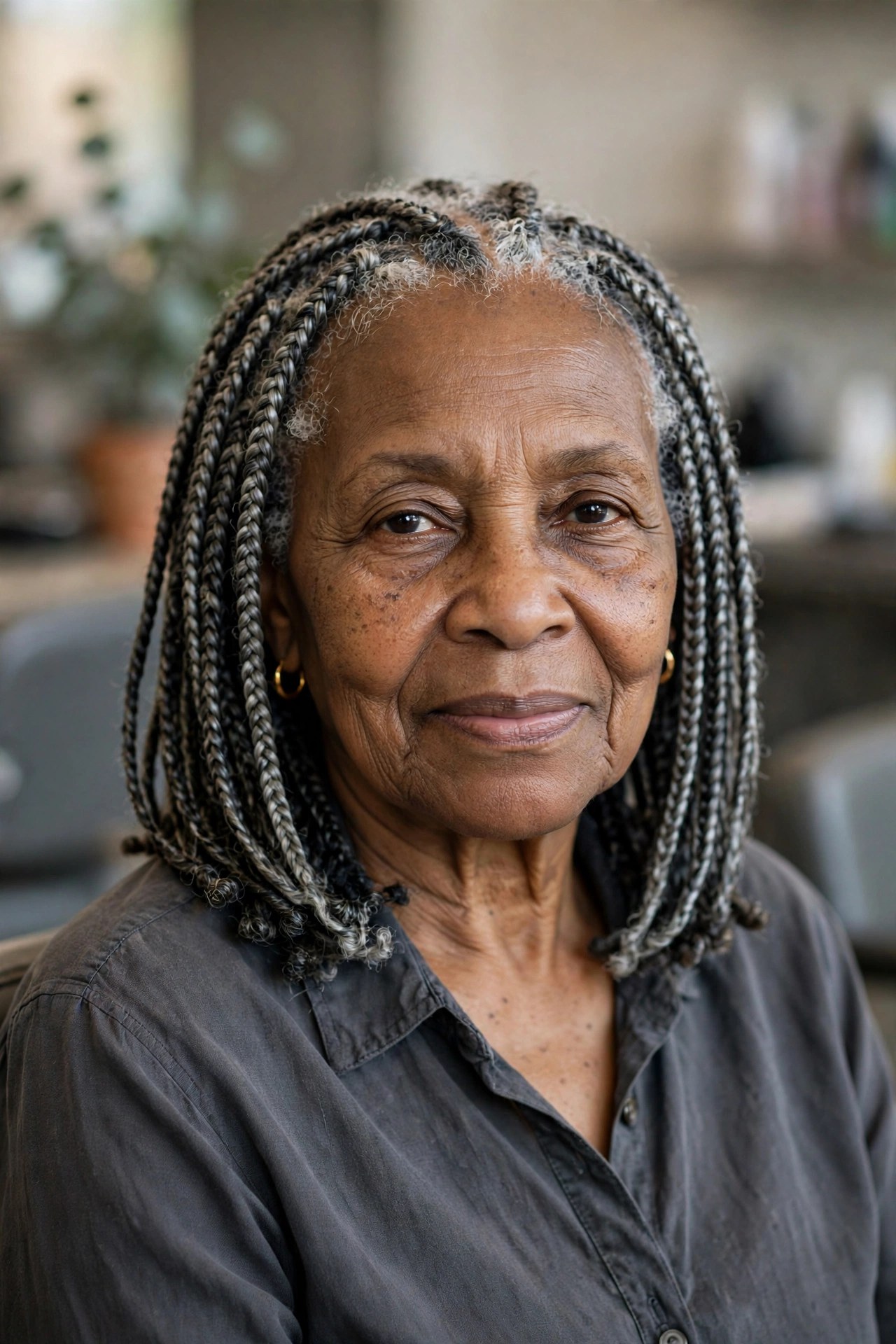
Where the all-silver look of idea 3 makes a statement, salt-and-pepper blending makes a transition. Black and gray extension hair mixed braid by braid — or even within a braid — mirrors how gray actually grows in, so your own new growth melts into the style instead of announcing itself at the part.
Medium box braids keep this comfortable and versatile, and the mixed color is remarkably forgiving between appointments. If you are exploring gray more broadly, our short haircuts for Black women over 50 with gray hair is a useful companion for the seasons you are not braided. Moisturize the scalp lightly between parts and let the blend do the flattering.
13. Medium Senegalese Rope Twists
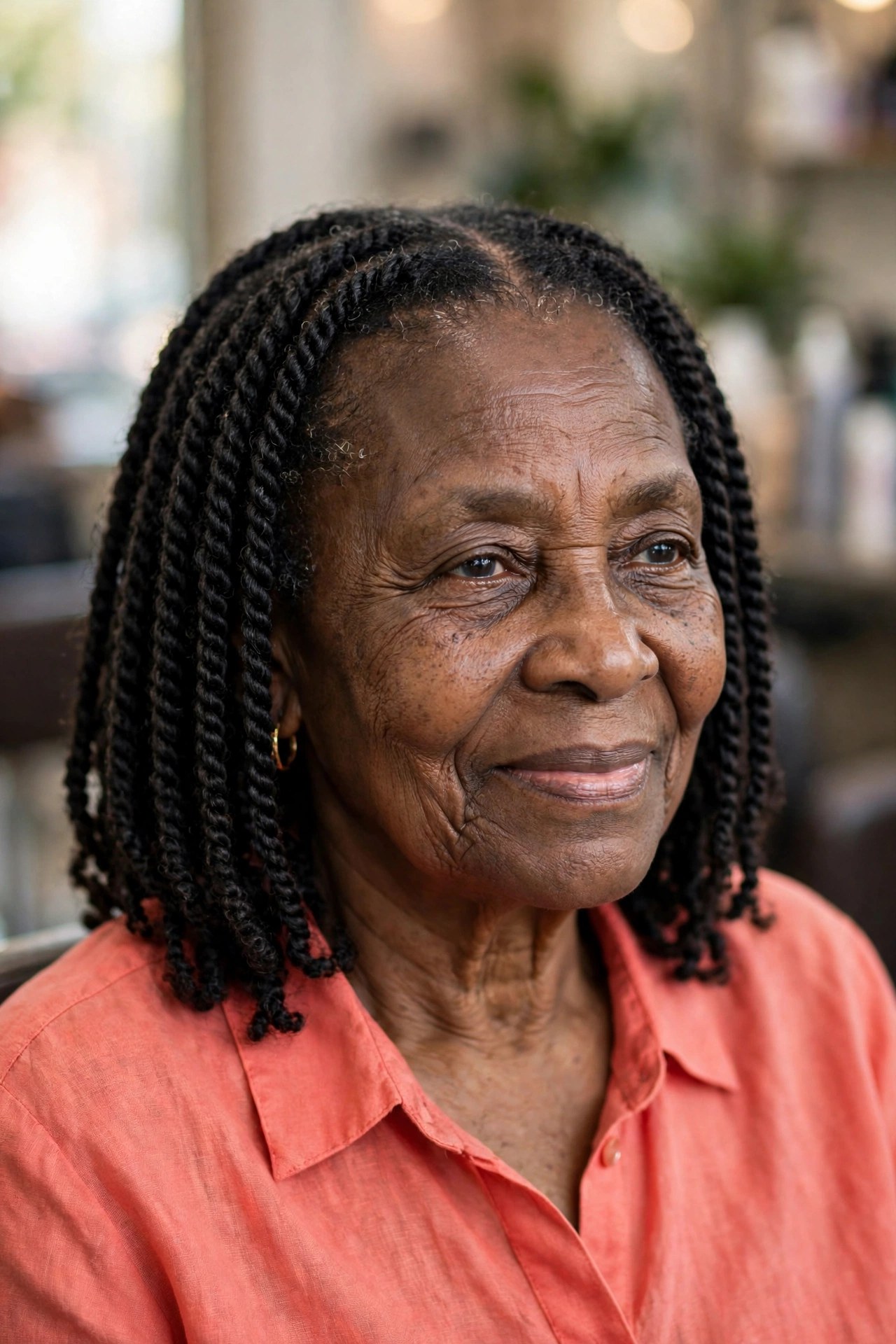
The medium version of the rope twist is the classic all-rounder: neat, swishy, professional, and light for its polished finish. Because each twist is made of two strands rather than a three-strand braid, many women find the base sits softer, and medium sections strike the balance between a full look and a sensible load on finer hair.
Shoulder length is the sweet spot — long enough for a low ponytail or half-up style, short enough to stay comfortable for four to six weeks. Refresh the perimeter twists at the halfway point if you like a crisper finish, keep heavy oils off the scalp (they weigh twists down and build up at the base), and remove them on schedule even if they still look good.

14. Large Goddess Braids with Loose Curly Ends
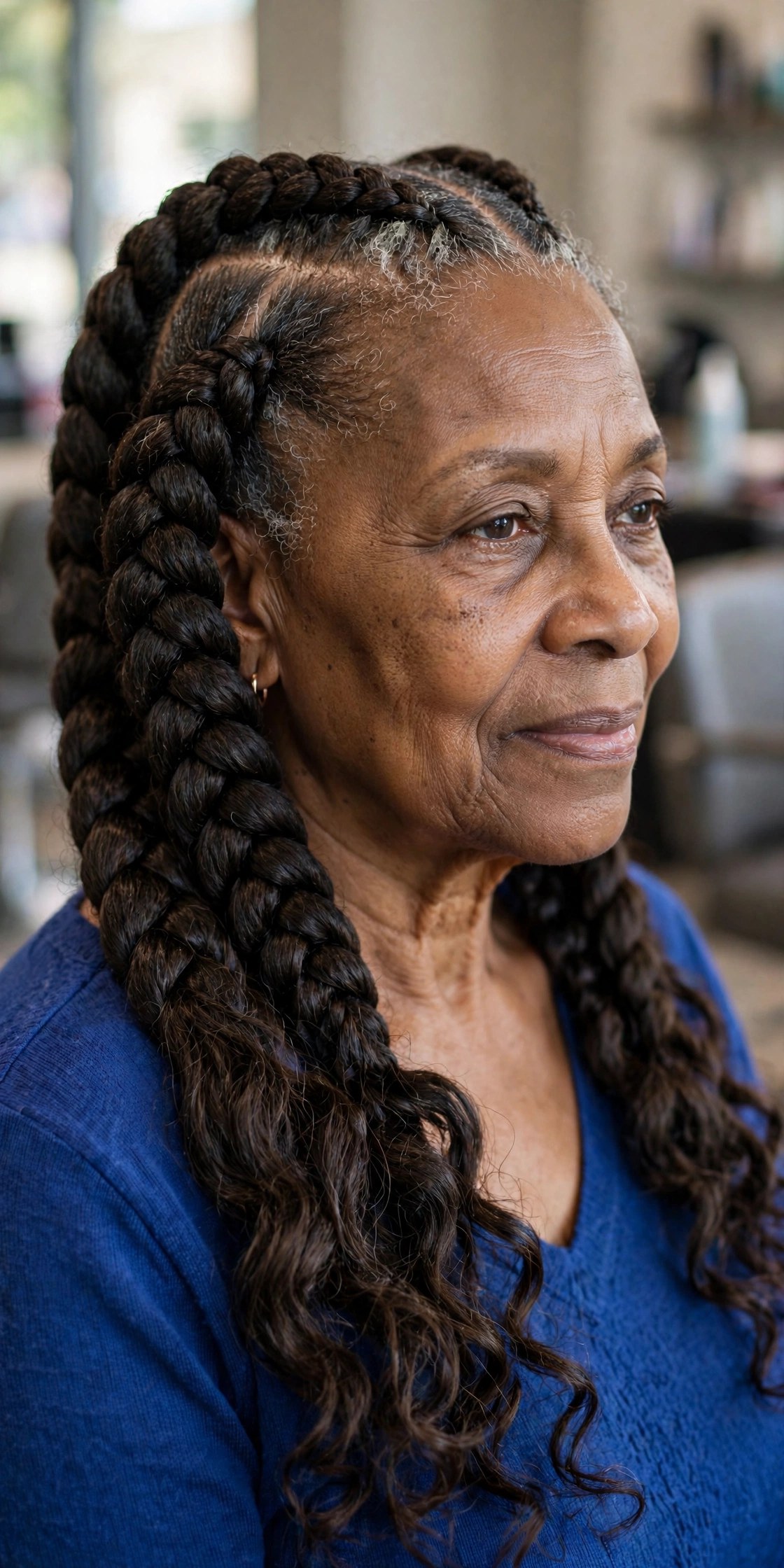
Goddess braids take a few large, soft braids and let loose curly pieces flow from and between them. With only a handful of braids, the install is shorter, the parts are wide and forgiving, and the finish — structured at the top, romantic at the ends — is flattering in photographs and kind in real life.
The loose pieces are the only real maintenance: a light leave-in and gentle finger-separation each morning keeps them soft instead of tangled, and a bonnet at night is non-negotiable with this style. Because there are so few braids, each one matters — if one feels tight, have that single braid redone rather than waiting it out.
15. Braided Top-Knot Bun in Black and Silver
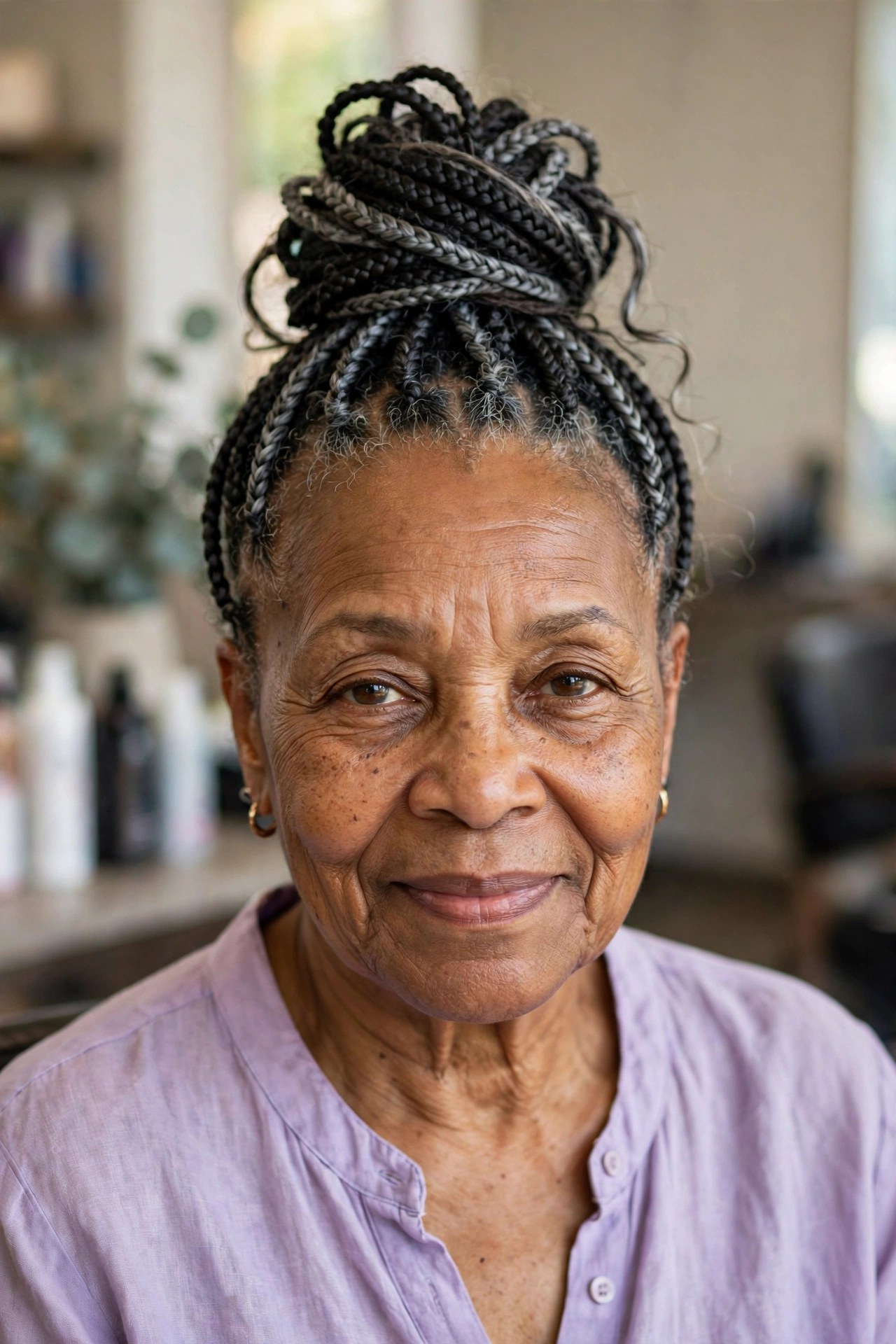
A top knot made of your own box braids — black woven with silver — is joyful, face-lifting, and entirely achievable without any extra tension, as long as it is built loosely. The braids are gathered with a soft band and wrapped, not hauled, into the knot; worn for an outing rather than as an all-week default, it is a style that celebrates exactly where you are in life.
Two comfort rules: keep the bun positioned slightly back from the hairline rather than directly above it, and take it down at night, every night. Sleeping in a top knot concentrates pull on the same front edges for hours. Alternate top-knot days with wearing your braids loose or in the low bun of idea 11, and your edges will never carry the same load twice in a row.
16. Chin-Length Braided Bob with a Center Part
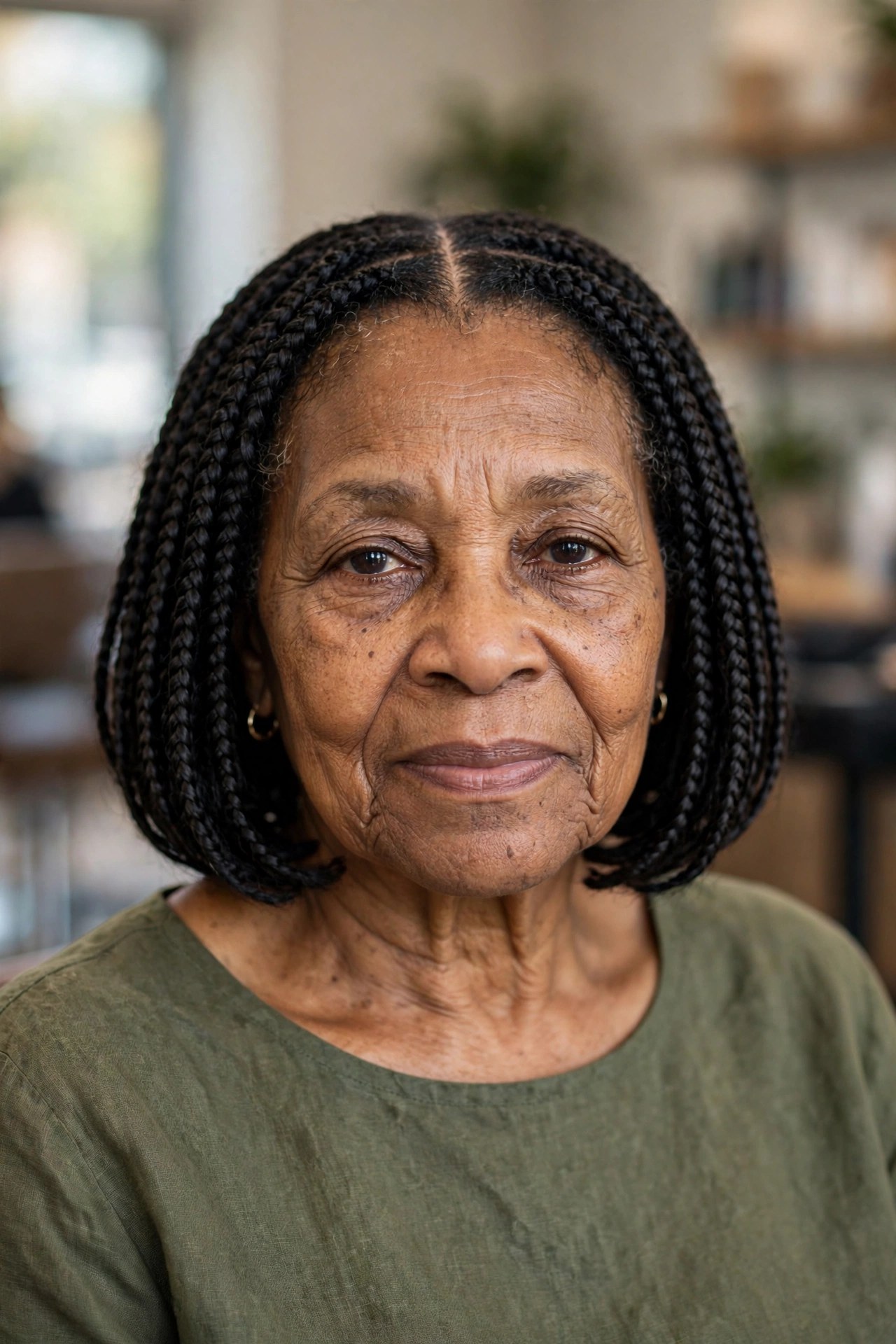
Shorter still than the braided bob of idea 7, the chin-length version is the lightest individual-braid style on this list — and for women whose hair has thinned noticeably, that lightness is the whole point. The center part and face-framing length give it a modern, symmetrical polish that works beautifully with glasses and statement earrings.
Short braids mean less extension hair per braid, a faster install, and a takedown you can do in an afternoon without fatigue. Ask for medium-small braids at most, knotless at the front, and resist adding length ‘while you are at it’ — the charm and the comfort of this style are the same thing: restraint.
17. Shoulder-Length Passion Twists
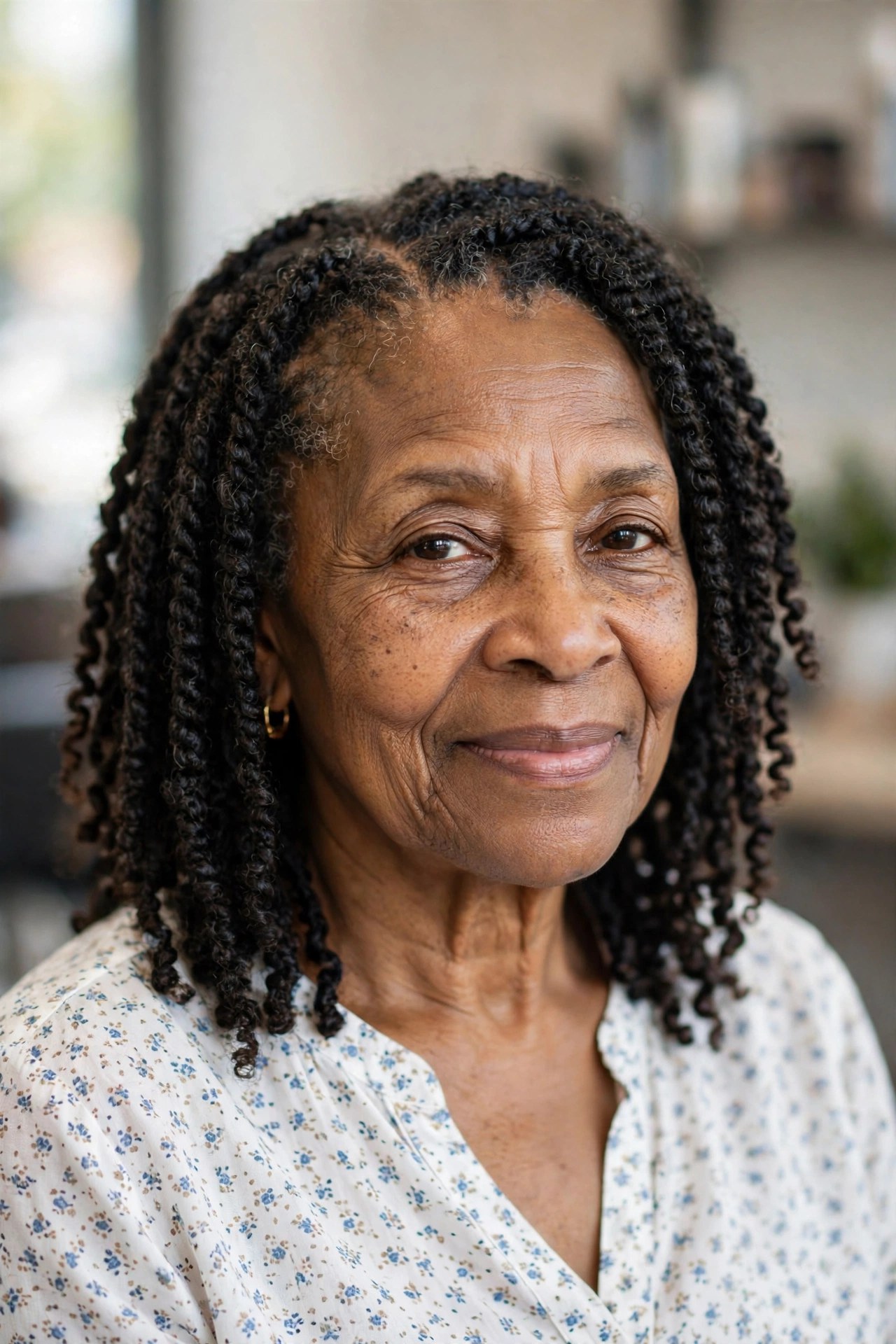
Passion twists use springy, wavy twisting hair to create soft, bohemian coils that move like natural curls. The hair itself is famously light, the texture is forgiving as it ages, and the slightly undone finish frames the face softly — a gentle look in every sense, and one that suits silver threaded through at the roots especially well.
Because the texture is light and airy, passion twists ask very little of your roots, but they do tangle if neglected: smooth a little curl cream or leave-in over them with your palms every few days, separate them gently, and never pile them into a tight high ponytail for days on end. Four to six weeks is a comfortable run.
18. Cornrow Ponytail with a Loose, Comfortable Base
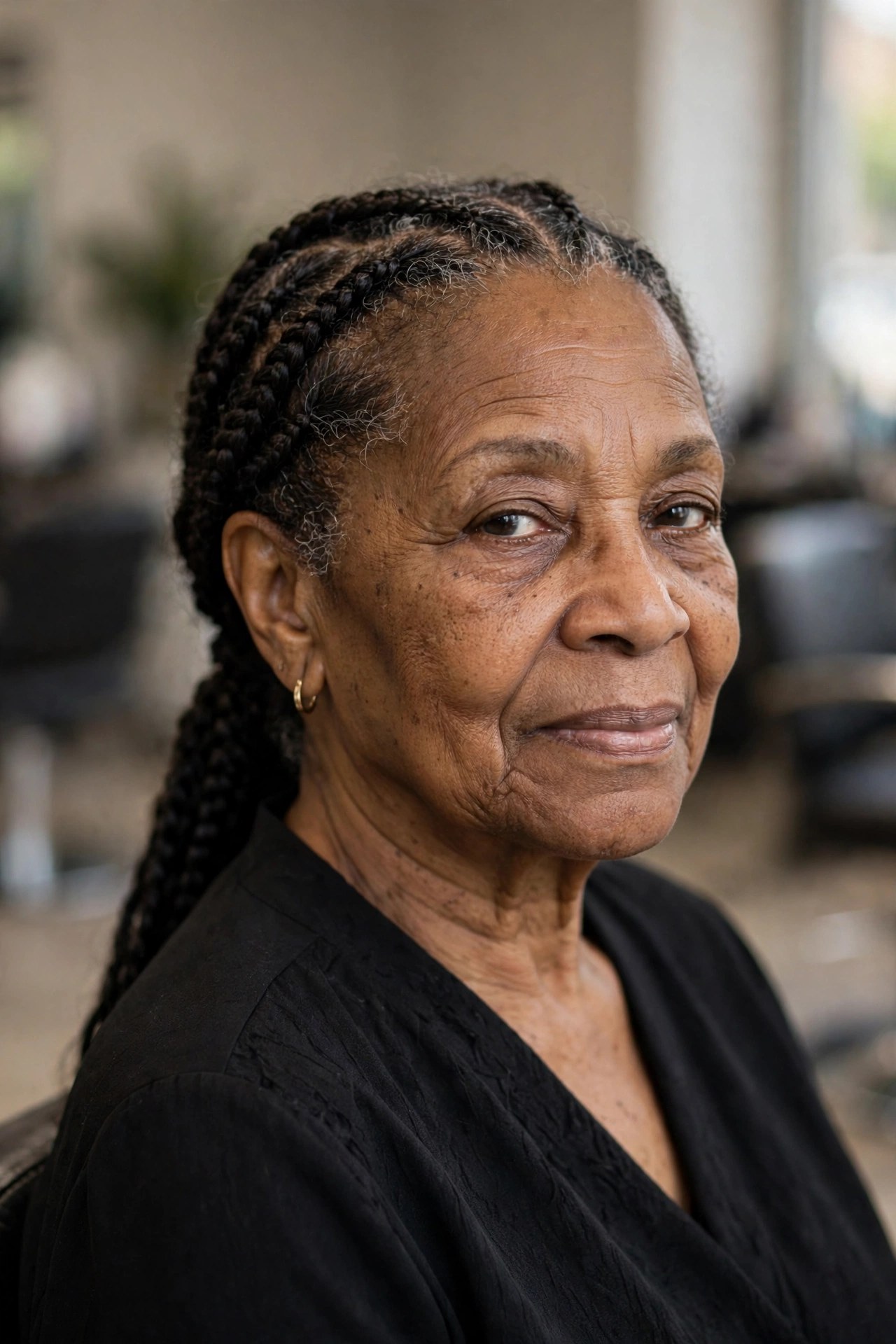
Cornrows gathered into one long braided ponytail give you a striking, off-the-face style whose weight is distributed across rows instead of hanging from a single elastic at the hairline — a far kinder arrangement. Worn at a natural, mid height, it reads elegant rather than severe and keeps hair completely off the neck.
The base decides everything: the first rows at the front should be braided with a deliberately soft hand, and your finest front edges can be left out of the pattern entirely and smoothed instead. Wear the ponytail down or loosened in the evening, and if you love this silhouette, rotate it with looser styles week to week rather than making it a permanent default.
19. Fulani-Inspired Braids with Soft Parts
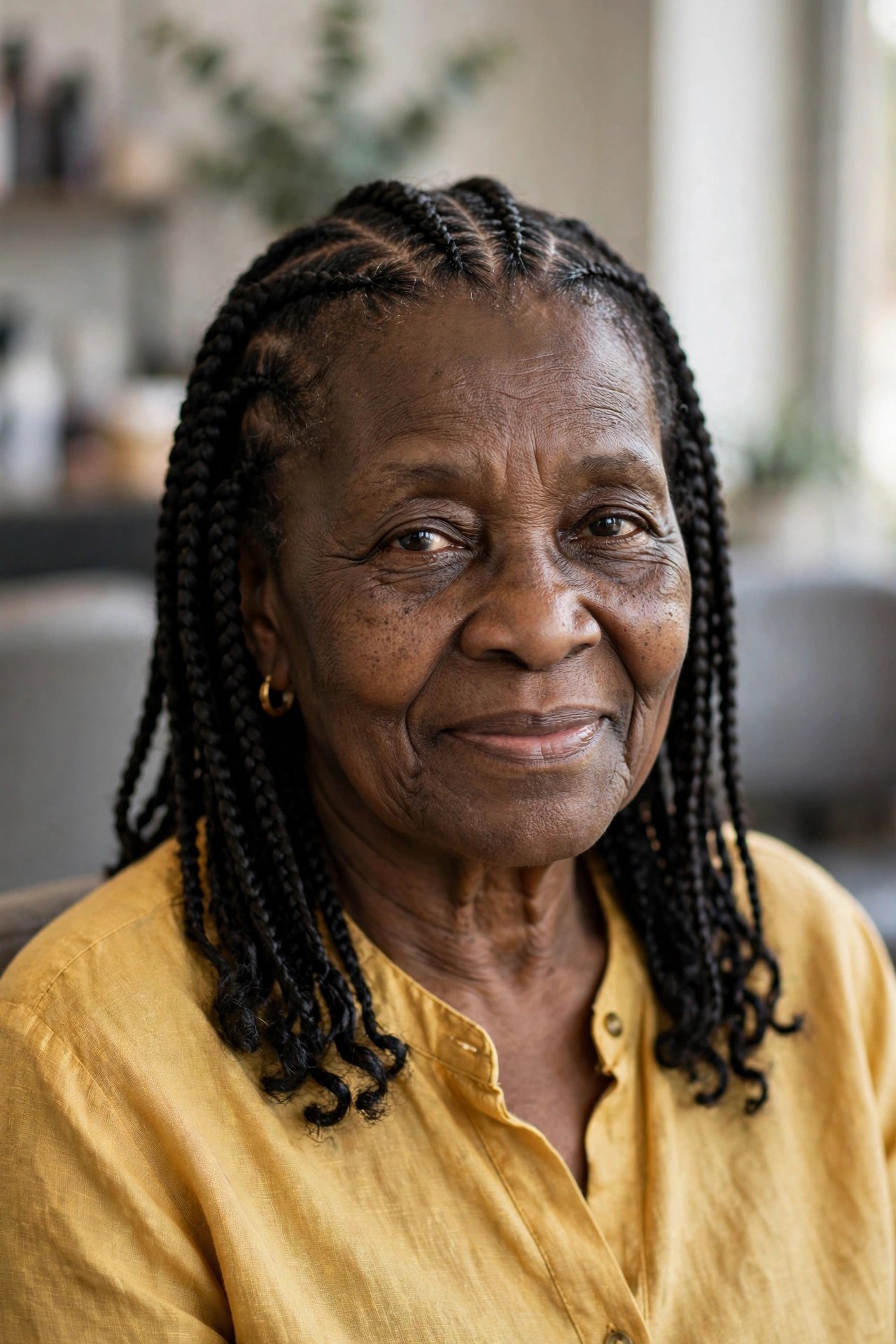
Fulani-inspired braids — cornrows at the front flowing into free-hanging braids, often with a center braid — carry real heritage and unmistakable grace. The gentle interpretation keeps the pattern simpler, the side braids medium, and the parts soft, so the artistry is in the design rather than in how much hair each row can hold.
Keep any adornment minimal and feather-light, or skip it altogether; heavy beads and cuffs are a quiet source of strain on mature hair. Worn loose, swept to one side, or half gathered, this style has presence without severity. As with every cornrow-based look here, three to four weeks is the kind limit — beauty and a firm end date go together.
20. Two Gentle Silver French Braids
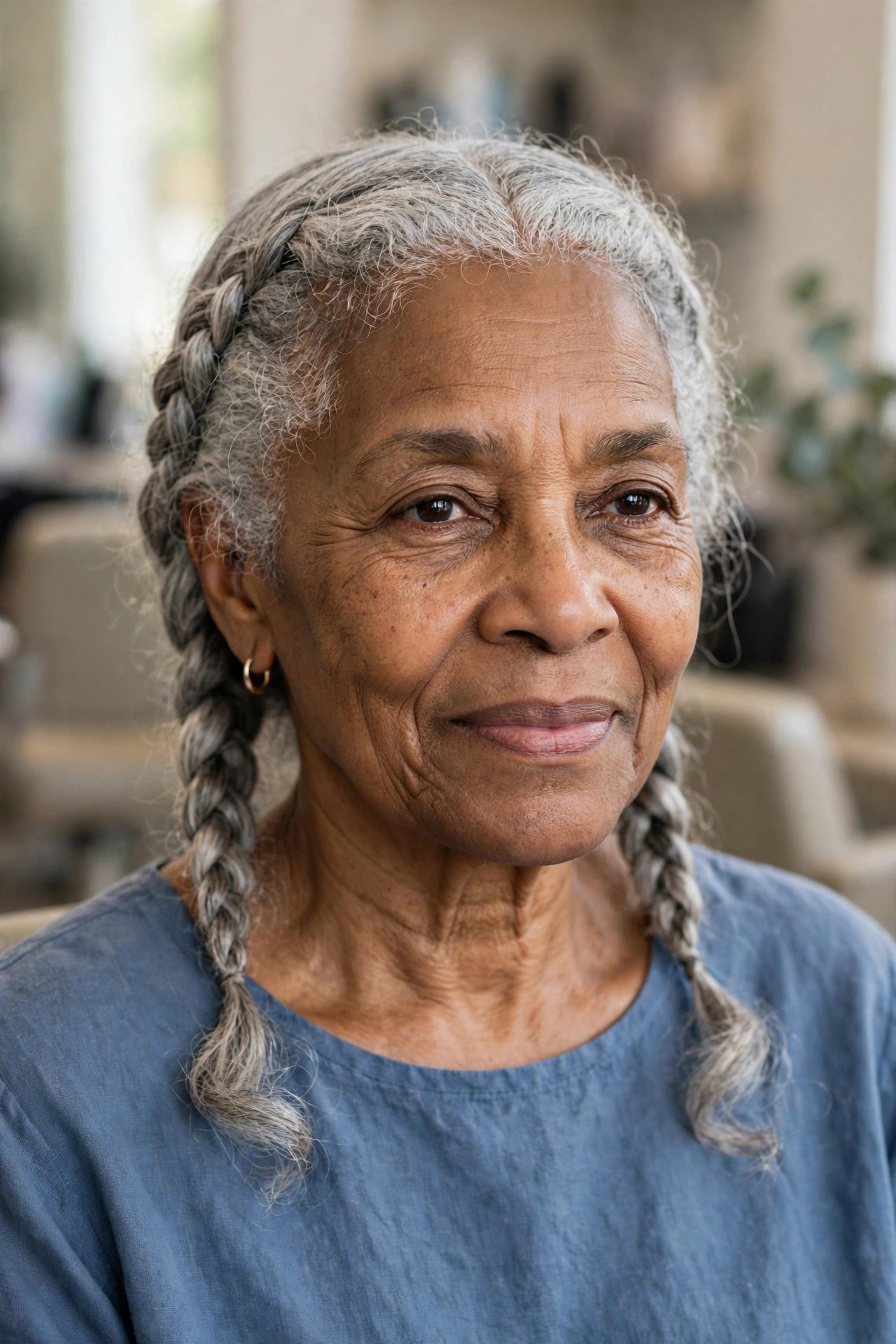
Finally, the simplest style on the list — and for many women over 60, the one worn most often. Two loose French braids in your own silver hair need no extensions, no appointment, and no added weight at all. Done softly, they keep hair tidy, cool, and completely rested, and the braid pattern shows off every shade of gray like woven ribbon.
Technique is the gentleness here: gather hair in large sections, cross under or over without cinching each pass tight, and secure the ends with soft bands. If your hair is on the shorter or finer side, a touch of leave-in gives the braid grip so it does not need tension to hold. This is also the perfect style for the weeks between extension installs, when your hair and scalp get to simply breathe.
Recommended Products
Braided styles stay gentle only if the hair and scalp underneath stay clean and moisturized, and the braids themselves are protected at night. These are the five products from this guide that do the most work: a co-wash that cleanses without stripping, two leave-ins for moisture at the parts and lengths, and satin protection for every single night.
Gentle Braid Care: The Checklist That Protects Your Hair
- Speak up at the appointment: say you want medium or larger parts, no tight edges, and comfort over crispness — before the first braid, not after the tenth.
- The two-day rule: mild snugness on day one is common; pain, throbbing, bumps, or a headache on day two means a braid needs loosening or removing. Never endure it.
- Cleanse weekly: work diluted shampoo or a co-wash along the parts with your fingertips every 7–10 days, rinse thoroughly, and let braids dry completely before tying them up.
- Moisturize lightly: a small amount of leave-in at the parts and along your own hair every few days — heavy oils and butters build up at the base and make takedown harder.
- Protect every night: a satin bonnet or satin pillowcase, every night, no exceptions — cotton pulls moisture out and roughs braids up while you sleep.
- Respect the end date: four to six weeks for most braids here, two to four for cornrow-based styles. New growth left too long mats at the base and turns takedown into breakage.
- Take down with patience: work one braid at a time, detangle each section with fingers and leave-in as you go, and never rush a takedown when you are tired.
- Rest between installs: give your hair at least a week — ideally two — of loose, moisturized styles like idea 20 before the next set of braids.
Frequently Asked Questions
Are braids safe for Black women over 60 with thinning edges?
Yes — with the right choices. Thinning edges call for knotless or feed-in starts, medium or larger parts, shorter and lighter styles, and a braider who will leave your finest front hairs out of tight patterns. What is not safe at any age is a style that hurts: pain, bumps, or a headache that lasts beyond the first day is a sign to have braids loosened or removed, not endured.
What is the difference between knotless and traditional box braids?
Traditional box braids begin with your own hair and the extension hair knotted together at the root, which concentrates tension at one point. Knotless braids start with your own hair and feed extension hair in gradually, so the braid builds weight slowly and sits flatter and more comfortably. For finer or more delicate hair after 60, knotless is almost always the kinder choice.
How long should I keep braids in after 60?
Four to six weeks is the honest range for most individual braids and twists in this guide, and two to four weeks for cornrow-based styles. Braids can look fine for longer, but past about six weeks new growth begins to mat at the base, takedown gets rougher, and the style quietly stops being protective. Put the removal date in your calendar on install day.
How do I care for my scalp while my hair is braided?
Cleanse along the parts every 7–10 days with a diluted shampoo or a co-wash, using your fingertips rather than your nails, rinse well, and let the braids dry fully. Between washes, moisturize the parts lightly with a leave-in and resist heavy oils, which build up at the base. Sleep in a satin bonnet or on a satin pillowcase every night to cut friction and hold moisture in.
How do I take braids down without breakage?
Slowly, and section by section. Undo one braid at a time, then immediately detangle that section of your own hair with your fingers and a little leave-in before moving on — shed hair that built up over the weeks needs to come out gently, not be combed through all at once at the end. Budget a full afternoon, take breaks, and follow with a proper wash and deep condition.
Can I wear gray or silver braiding hair?
Absolutely — it is one of the most flattering choices after 60. Silver and salt-and-pepper extension hair blends with your own new growth instead of fighting it, so the style stays intentional-looking for its whole wear time and there is no dye upkeep at all. Ask your braider to mix two or three gray tones for the most natural result.
The gentlest braid is not a specific style — it is a set of decisions: a start that does not pull, parts that share the load, a weight your hair can honestly carry, and an end date you actually keep. Choose any style on this list with those decisions in place and braids remain what they have always been at their best: a beautiful way to let your hair rest, grow, and be admired at every age. Silver, edges, and all.