Hairstyles for Women Over 60 With Glasses That Frame the Face
This post contains affiliate links. As an Amazon associate, I earn from qualifying purchases. I only recommend products that are of high quality and that I would use myself.
Glasses change the geometry of your face — and a good haircut should be designed around them, not in spite of them. The problems are familiar to every woman over 60 who wears frames full-time: hair trapped under the temple arms, fringes colliding with the top rim, sides so bulky the glasses ride up and slide down, and cuts that look fine in the salon mirror until the frames go back on and the whole balance shifts.
Every one of the 20 hairstyles below was chosen to solve one or more of those problems — lengths kept clear of the temples, fringes that stop above the frames or sweep around them, and face-framing pieces placed to work with the frame line rather than against it. Our Over-50 readers started this conversation in our guide to hairstyles for women over 50 who wear glasses; this is the over-60 edition, written fresh for silver hair, finer textures, and the frames you actually wear now.
One rule before the ideas: always take your glasses to the salon, and ask to have the front layers and fringe checked with them ON. A fringe measured against a bare forehead is a guess — and with frames in the picture, a quarter of an inch is the difference between perfect and annoying.
Table of Contents
- 1. Classic Chin-Length Bob with a Deep Side Part
- 2. Long Sweeping Fringe Pixie
- 3. Feathered Layered Shag
- 4. Sleek Blunt Silver Bob
- 5. Textured Crop with Tapered Sides
- 6. Shoulder-Length Lob with Face-Framing Layers
- 7. Bob with Wispy Bangs Above the Frames
- 8. Asymmetrical Bob
- 9. Curly Bob Above the Shoulders
- 10. Voluminous Blowout Layers
- 11. Short Stacked Bob
- 12. Pixie-Bob with a Side-Swept Fringe
- 13. Wavy Lob with a Deep Side Part
- 14. Soft Tapered Silver Pixie
- 15. Layered Shag with Feathered Ends
- 16. Chin-Length French Bob with a Mini Fringe
- 17. Long-Top Pixie with a Lifted Crown
- 18. Medium Layers with Curtain Bangs
- 19. Angled Inverted Bob
- 20. Soft Shoulder Waves with Bright Face-Framing Highlights
- Recommended Products
- FAQs
- Bold acetate frames? Keep the hair out of their way — the sweeping fringe pixie (idea 2), textured crop (idea 5), or asymmetrical bob (idea 8).
- Rimless or fine metal frames? Let sleek hair do the framing — the blunt silver bob (idea 4) or tapered silver pixie (idea 14).
- You love your fringe? Cut it above the frames (idea 7), mini-French style (idea 16), or as a curtain that flows around them (idea 18).
- Hair always caught in the temples? Tapered sides are the fix (ideas 5 and 14), or lengths that tuck fully behind the ear (idea 13).
- Round face? Angled and inverted shapes slim and lengthen (ideas 8 and 19).
- Curly hair? Keep curls above the shoulders and off the lenses (idea 9).
- Five minutes, maximum? Ideas 5, 14 and 15 are wash, pinch, and go.
1. Classic Chin-Length Bob with a Deep Side Part

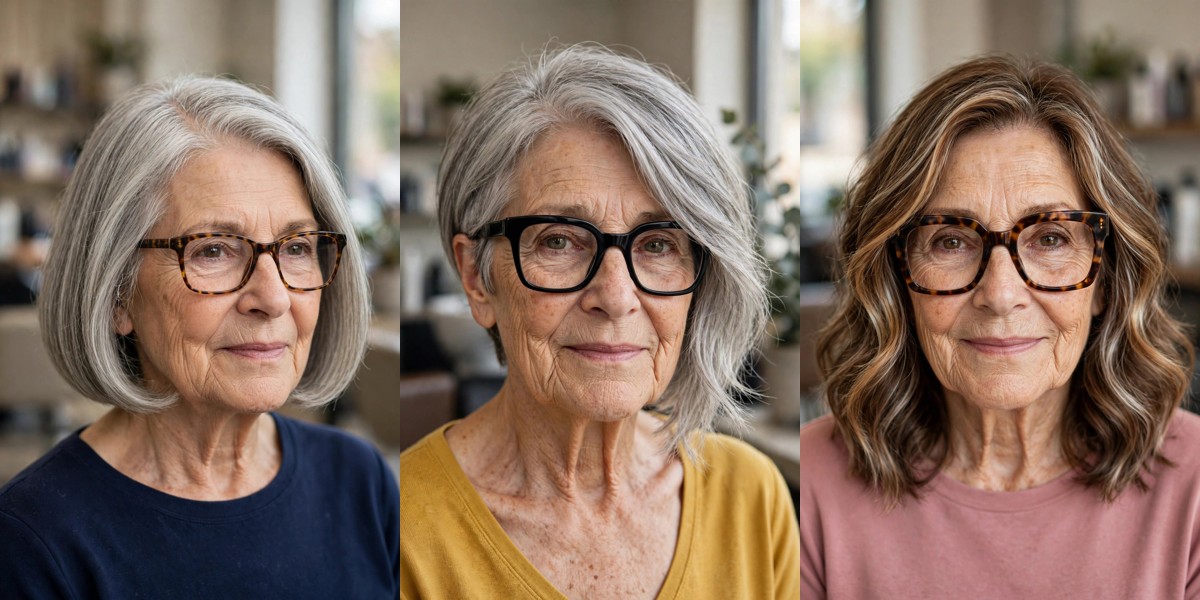
The chin-length bob is the natural partner for glasses because it draws a second, softer frame around the first one. Cut to end right at the jaw, with the front corners curving slightly forward, it echoes the line of your frames without competing with them — and the deep side part does the quiet structural work, sweeping hair diagonally across the forehead so the top edge of the frames never sits under a heavy, straight curtain of hair.
This is the safest first move if you are new to wearing glasses full-time, and it suits tortoiseshell and metal frames equally. Ask for the sides to be cut just clear of the temple arms so the hair falls in front of or behind them cleanly, never half over. A round-brush blow-dry that rolls the front pieces forward keeps the shape polished in about five minutes.


2. Long Sweeping Fringe Pixie
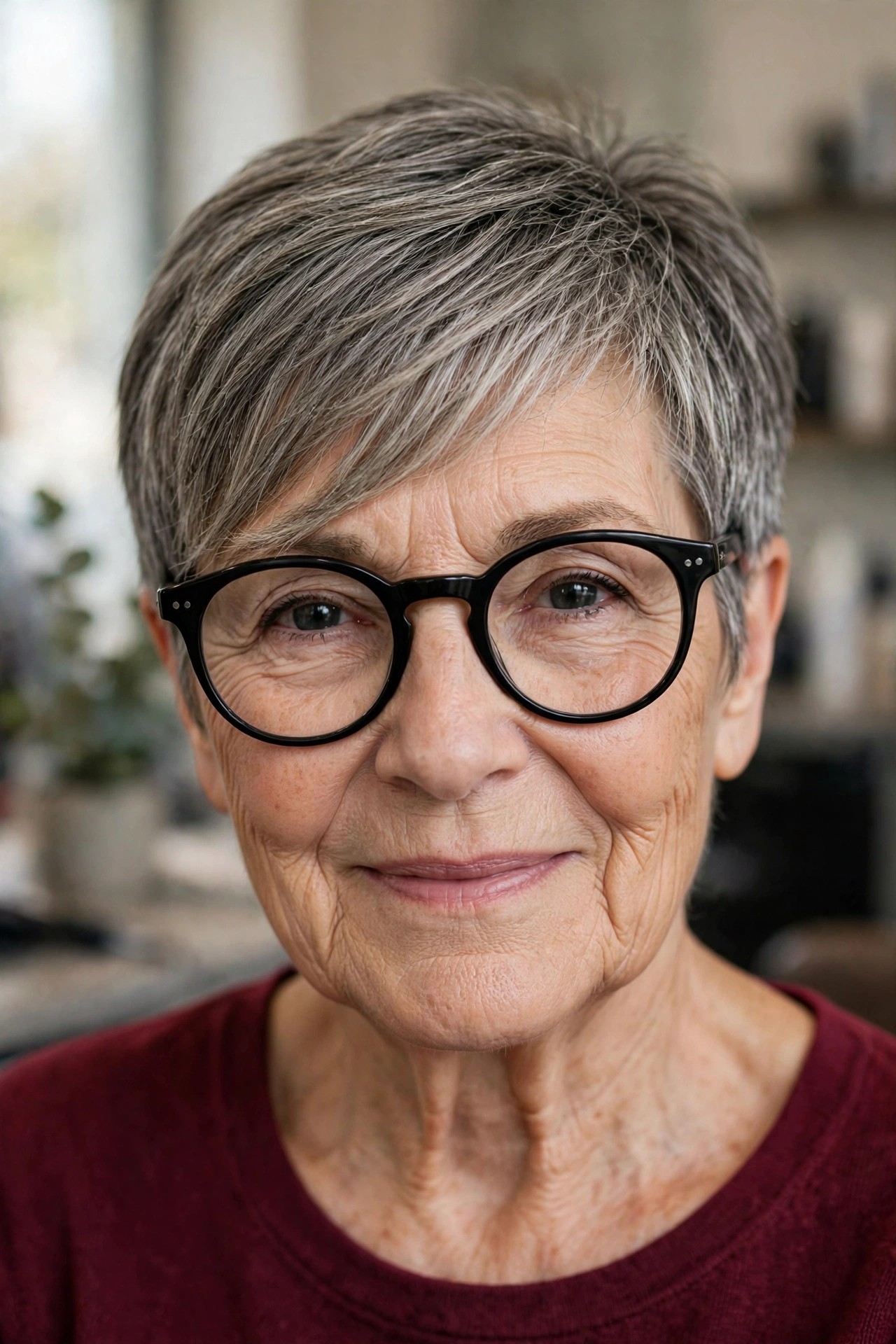
A pixie can absolutely work with glasses — the trick is keeping length where it counts. Here the sides and back are short and neat, but the top is left long enough to sweep diagonally across the forehead as a fringe that finishes well above the top rim of the frames. That diagonal is flattering twice over: it softens the forehead, and it stops the fringe and the frame from stacking into two straight horizontal lines.
Bold acetate frames, like the black pair pictured, love this cut because the hair stays completely out of their way. Keep the sides tapered tight around the ears so the temple arms sit flat and never push the hair out into little wings. A pea-sized amount of texturizing putty pinched through the fringe keeps the sweep in place all day.


3. Feathered Layered Shag

Feathering brushes fine layers back and away from the face, which makes it one of the kindest cuts for glasses: nothing hangs forward to get trapped behind the lenses or tangle with the temples. At jaw-to-neck length, the flicked layers build soft volume at the sides of the head — exactly where a frame’s temple arm visually cuts the silhouette — so the hairstyle and the glasses read as one continuous shape.
This suits straight to slightly wavy hair that falls flat by midday, because the feathered layers hold their direction. Blow-dry with a round brush, directing everything up and back, and let delicate metal frames do the fine detail work against the fuller hair. Brown hair with gray blending shows feathering beautifully, since each layer catches the light differently.


4. Sleek Blunt Silver Bob

When the hair is this silver and this glossy, minimal frames are the elegant choice — and this cut is built for them. The bob is cut blunt at chin length with a clean center part, so the bright hair forms two smooth curtains that frame both the face and the rimless glasses inside it. There is no fringe to fight the lenses and no layer to catch on the nose pads.
Silver this bright needs its tone protected: brassiness is what turns a striking cut ordinary, so a weekly purple shampoo is maintenance, not a luxury. Keep the finish sleek with one slow, heat-protected pass of an iron if needed. If you are building a whole silver wardrobe of cuts, our gray pixie cuts for women over 60 show the short end of the same idea.


5. Textured Crop with Tapered Sides
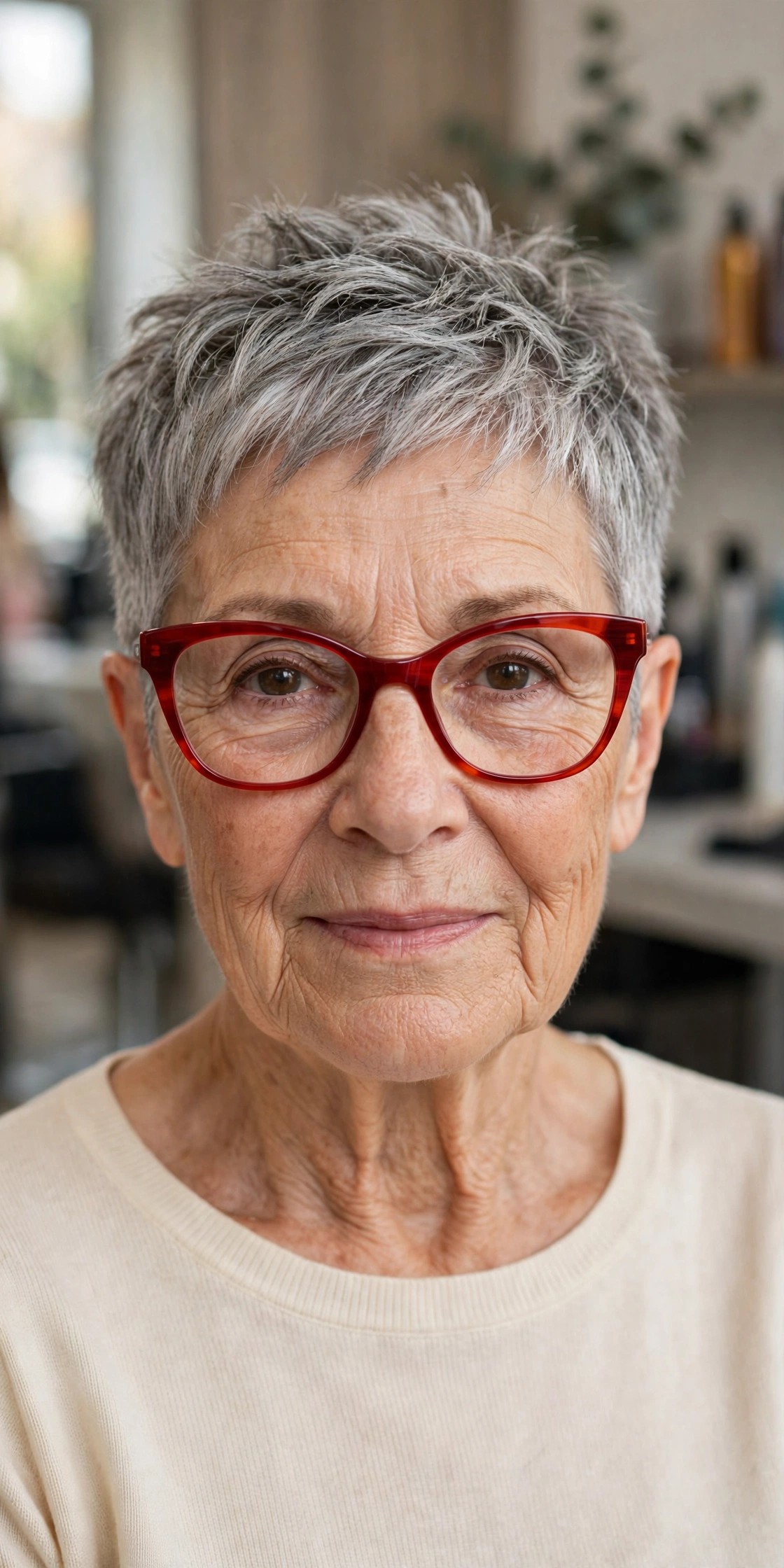
The textured crop solves the most annoying glasses problem of all: hair constantly caught under the temple arms. The sides are tapered short and clean around the ears, so there is simply nothing for the arms to trap, while the top keeps choppy, piecey texture that you can push forward, up, or to the side depending on the day. It is a confident, low-fuss shape that puts all the focus on the frames and the eyes behind them.
That makes it the perfect vehicle for a statement pair — a red cat-eye, as pictured, becomes the whole outfit. Styling is a thirty-second job: work a little putty through dry hair and pinch the top into pieces. Crops need trims every four to five weeks to keep the taper crisp around the ears, but the daily effort is close to zero.
6. Shoulder-Length Lob with Face-Framing Layers

If you want length and glasses, the lob with face-framing layers is the balanced answer. The perimeter rests at the shoulders — long enough to feel feminine, short enough not to swamp the frames — while the front layers start at the cheekbones and step down past the chin. Those front pieces do the framing work in the title: they curve inward just below where the frames end, guiding the eye to the jaw and softening everything along the way.
Ask your stylist to cut the first face-framing layer with your glasses ON, so its starting point is set against the actual bottom rim of your frames rather than guessed. The natural silver streaks at the front, as here, brighten the face exactly where the layers fall. A large round brush or a hot-air styler gives the front pieces their inward curve in minutes.

7. Bob with Wispy Bangs Above the Frames
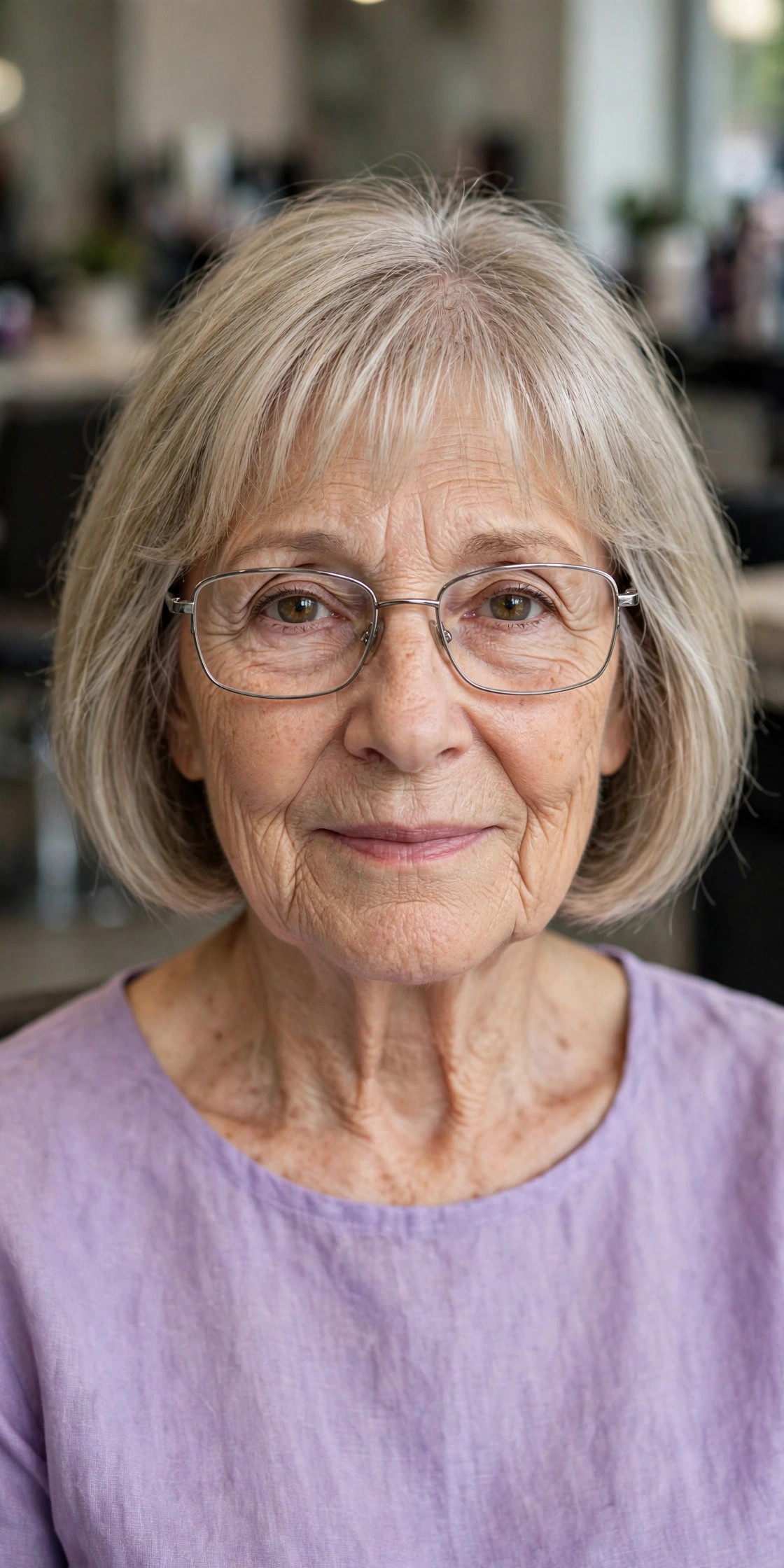
Bangs and glasses fail when they collide — so this version simply refuses to. The fringe is cut wispy and sheer, and it is deliberately finished a good centimeter above the top rim of the frames, so the two never touch, tangle, or grease each other up. What you get is all the forehead-softening benefit of a fringe with none of the constant pushing-aside, and the clear gap between bang and frame actually makes both look more intentional.
Thin metal frames, as pictured, are the natural match because their lightness echoes the sheer fringe. For the full playbook on this pairing, our guide to bangs and glasses covers fringe lengths frame by frame. Dry the bangs first, sweeping side to side, and expect a trim every three weeks — short fringes are cheap to keep because the appointment is tiny.
8. Asymmetrical Bob

Asymmetry is a secret weapon with glasses, because frames are perfectly symmetrical — a diagonal hairline stops the whole look from feeling boxy. One side of this silver bob is tucked shorter behind the ear while the other sweeps down to the jaw, so the eye travels across the face instead of stopping at the frame line. It reads modern and deliberate at any age, and it is especially good if one of your frames’ temples tends to disappear into your hair.
Wear it with bold square frames, as pictured, and the contrast between the straight frame geometry and the diagonal hair does the styling for you. The tucked side also solves a real problem: the temple arm sits completely clear, so the glasses never ride up on a cushion of hair. Keep the long side glossy with a light serum worked through the ends only.
9. Curly Bob Above the Shoulders

Curly hair and glasses get along beautifully once the curls are kept off the lenses — and that is a length decision. This bob sits just above the shoulders with rounded layers, so the curls spring up and out around the cheeks and jaw instead of falling forward over the frames. Round tortoiseshell frames mirror the round curl pattern, which is why this pairing always looks so harmonious in photos.
Ask for the front curls to be cut while dry and with your glasses on, so your stylist can see exactly where each curl lands against the frame. Gray curls are thirstier than pigmented ones, so a rich curl cream worked through wet hair matters more than hold products. For more texture-first ideas, our medium-length hairstyles for women over 60 include several curl-friendly shapes.


10. Voluminous Blowout Layers

Big, bouncy layers are the glamorous counterpoint to glasses: where the frames are neat and defined, the hair is all soft movement. Long layers through the mid-lengths and a proper round-brush blowout build the kind of crown volume that balances fuller acetate frames, so neither the hair nor the glasses overwhelm the face. The ends flick outward below the chin, keeping the whole silhouette wide at the bottom and lifted at the top.
Oversized warm-brown frames, as pictured, hold their own against this much hair — very fine metal frames can get lost in it. Build the volume at the roots with mousse before you dry, and finish with a brushable spray rather than a stiff one: this style should still move when you do. A root-boosting hot brush is the fastest route to the same shape on busy mornings.


11. Short Stacked Bob
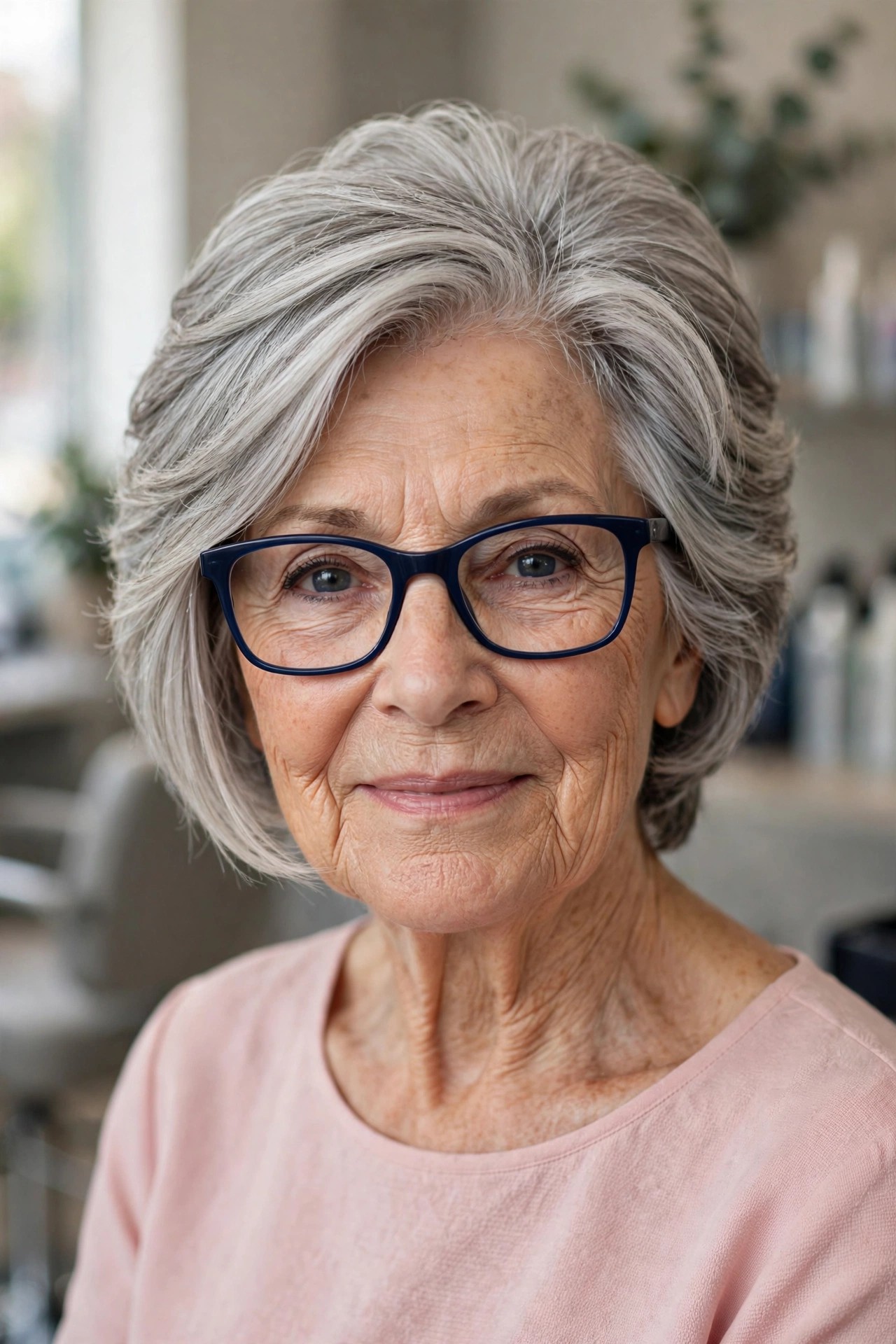
The stacked bob earns its name at the back, where short graduated layers pile up to create a rounded, lifted crown — but its glasses benefit is at the front. The sides angle forward and finish right at the chin, clean and close to the head, so the temple arms sit flat against a smooth surface instead of a bulky one. Glasses stay where the optician put them, and your profile keeps that lovely forward sweep.
Navy frames, pictured here, are a softer alternative to black against silver hair and worth trying if black feels harsh. This shape grows out in an orderly way, though the stack loses its spring after about six weeks — that is your trim signal. Our timeless bob hairstyles for women over 60 compare this with the classic and graduated versions side by side.
12. Pixie-Bob with a Side-Swept Fringe

The pixie-bob — longer than a pixie, shorter than a bob — is the in-between cut that flatters glasses wearers who found a true pixie too exposed. The top sweeps into a soft side fringe that ends above the frames, and the sides keep cheek length, so there is hair to frame the face on both sides of the lenses. Round metal frames, as pictured, soften the whole effect and suit the gentle lines of the cut.
It is also a forgiving grow-out shape: the fringe simply becomes face-framing layers as it lengthens. Style by drying the fringe across and then letting it fall, and tuck the shorter side behind the ear to show the temple arm cleanly. A little volumizing foam at the crown stops the longer top from lying flat against the head by afternoon.
13. Wavy Lob with a Deep Side Part

Loose waves at collarbone length frame the face in the softest way there is — nothing is straight, nothing is sharp, and the glasses get to be the one defined element. The deep side part matters: it lifts the crown on the heavy side and sends the waves cascading diagonally, so they never hang in two flat curtains on either side of the frames. Pictured in profile, you can see how the hair tucks completely clear behind the ear, leaving the clear acetate frame fully visible.
Translucent frames are a lovely choice with gray-blonde hair because they add structure without adding color. Enhance the wave with sea-salt spray scrunched into damp hair and either air-dry or diffuse on low — and hands off while it dries, which is how waves stay defined instead of frizzing around the lenses.


14. Soft Tapered Silver Pixie

This is the minimalist end of the glasses-hair partnership: a soft tapered pixie in bright silver, with the sides kept close around the ears and just enough length on top to brush forward. With almost no hair near the face, rimless glasses become a genuine feature rather than an accessory fighting for space — and there is nothing to tuck, pin, or push back all day long.
The maintenance trade is honest: almost no daily styling, but a shape-up every four weeks to keep the taper clean around the ears and neckline. Keep the silver bright with a weekly purple shampoo, since short hair shows tone over its whole length. If your frames are rimless or very fine metal, this is arguably the most elegant cut on the list.
15. Layered Shag with Feathered Ends

The shag’s choppy layers, starting high at the crown, do something clever around glasses: they break the hair into so many soft pieces that the frame line stops being the most noticeable horizontal on the face. Large round tortoiseshell frames nestle into the texture rather than sitting on top of it, and the wispy feathered ends keep the bottom of the cut light instead of heavy around the jaw.
Salt-and-pepper hair shows this layering off best, because the mixed tones trace every layer. The shag is styled by being left mostly alone — scrunch, rough-dry, resist the urge to smooth it — which makes it a genuine wash-and-wear option. One caution: if your hair is very fine, ask for the layers longer and fewer, or the ends can turn too sheer.
16. Chin-Length French Bob with a Mini Fringe
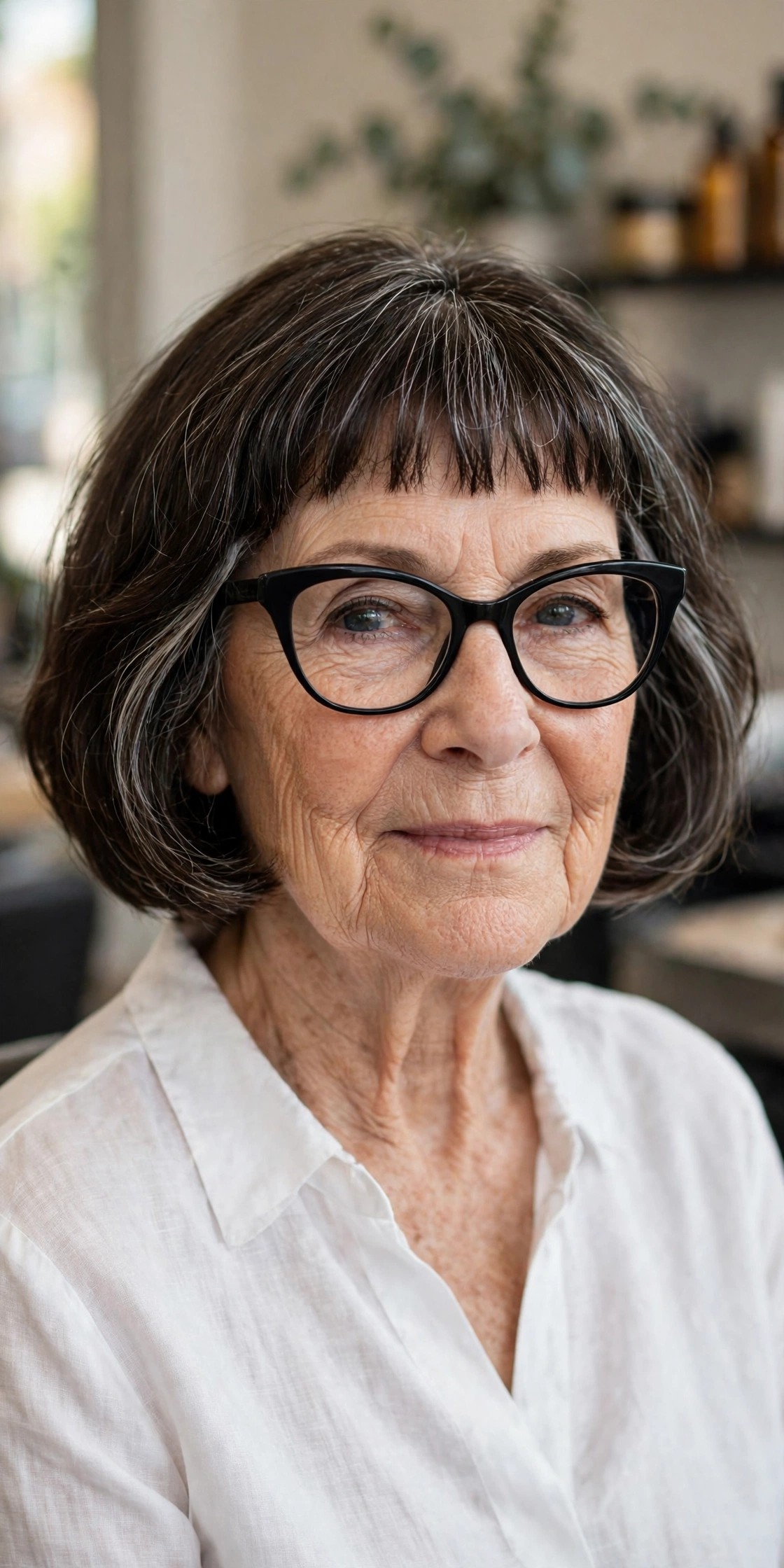
The French bob is the chic, deliberate version of the bob-and-bangs idea: blunt chin-length ends with a slight natural wave, and a short mini fringe that ends high on the forehead, well clear of the frames. That visible strip of forehead between fringe and frame is exactly what makes the combination look designed rather than accidental — and it is why this cut photographs so well with strong cat-eye frames.
Black cat-eyes, as pictured, are the classic pairing; the fringe draws a straight line above them and the bob curves below. It does ask for commitment — mini fringes need a tidy every two to three weeks — but the appointment is five minutes. More fringe-and-frame strategy lives in our bangs and glasses guide.

17. Long-Top Pixie with a Lifted Crown
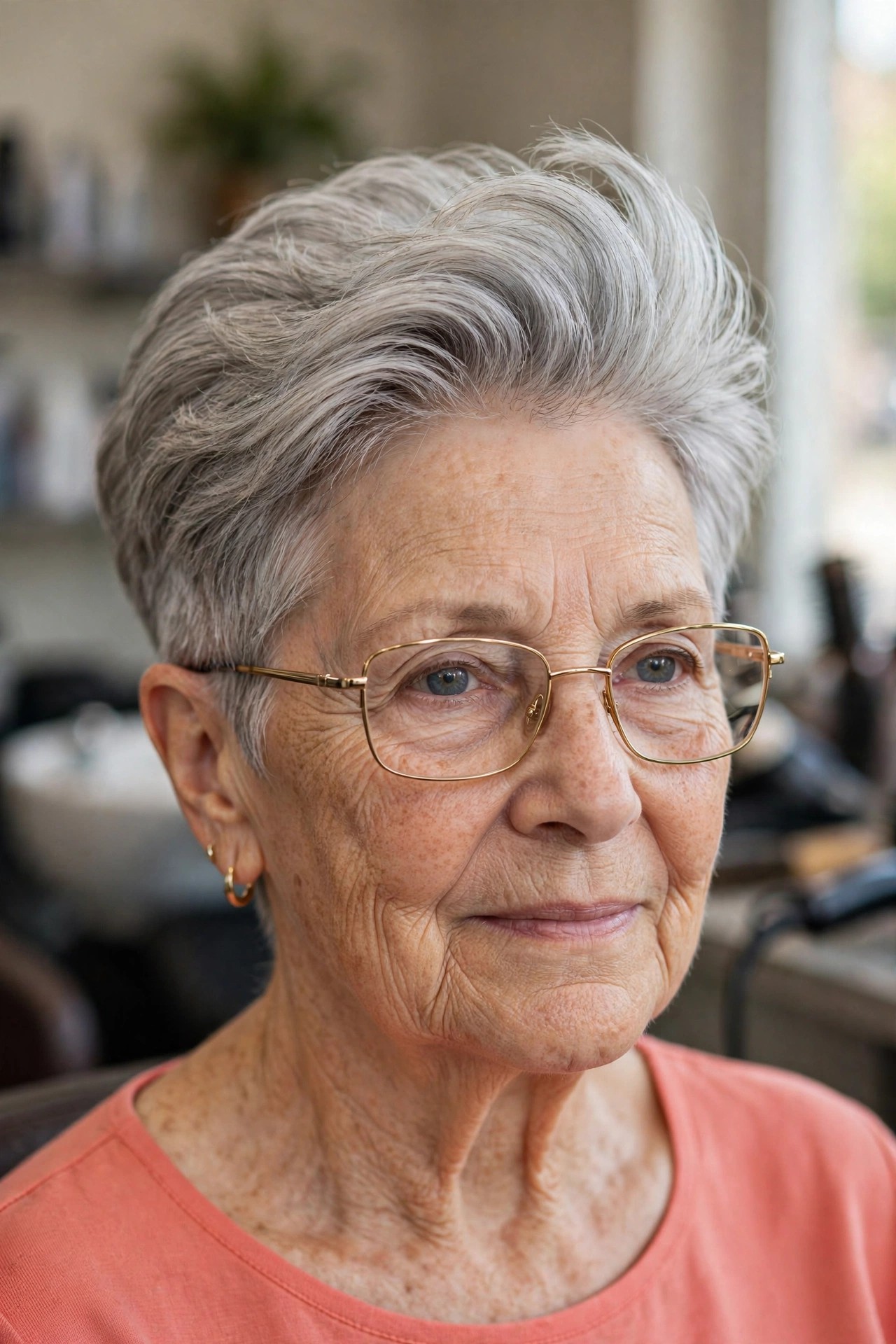
Here the drama is vertical: short, neat sides and a long top section lifted and brushed back off the face, so all the height sits at the crown. That lift rebalances glasses beautifully — frames widen the middle of the face, and crown height restores the proportions above them. With the hair swept completely back, thin gold rectangular frames get an unobstructed stage, and your eyes do the rest.
This is the cut to choose if your hair is fine at the front and you are tired of it falling into your lenses. Dry the top up and back with a small round brush or root booster, and set it while it cools. A light mousse at the roots is enough; heavy products collapse the lift that is the entire point of the style.

18. Medium Layers with Curtain Bangs

Curtain bangs were practically designed for glasses wearers: parted in the middle, they sweep out and down to the cheekbones, passing either side of the frames instead of across them. Where a straight fringe must stop short or collide, the curtain simply flows around the obstacle, and its longest points merge into the medium layers below. Burgundy frames, as pictured, pick up the warmth in chestnut hair beautifully.
Dry the curtain first — forward, then swept to each side — before the rest of the hair sets, or it will dry straight down the middle of your lenses. The shape is kind to a higher forehead and to anyone growing out a fringe. Keep the layers glossy with an occasional in-shower silver gloss if your gray is blending through, as here.

19. Angled Inverted Bob
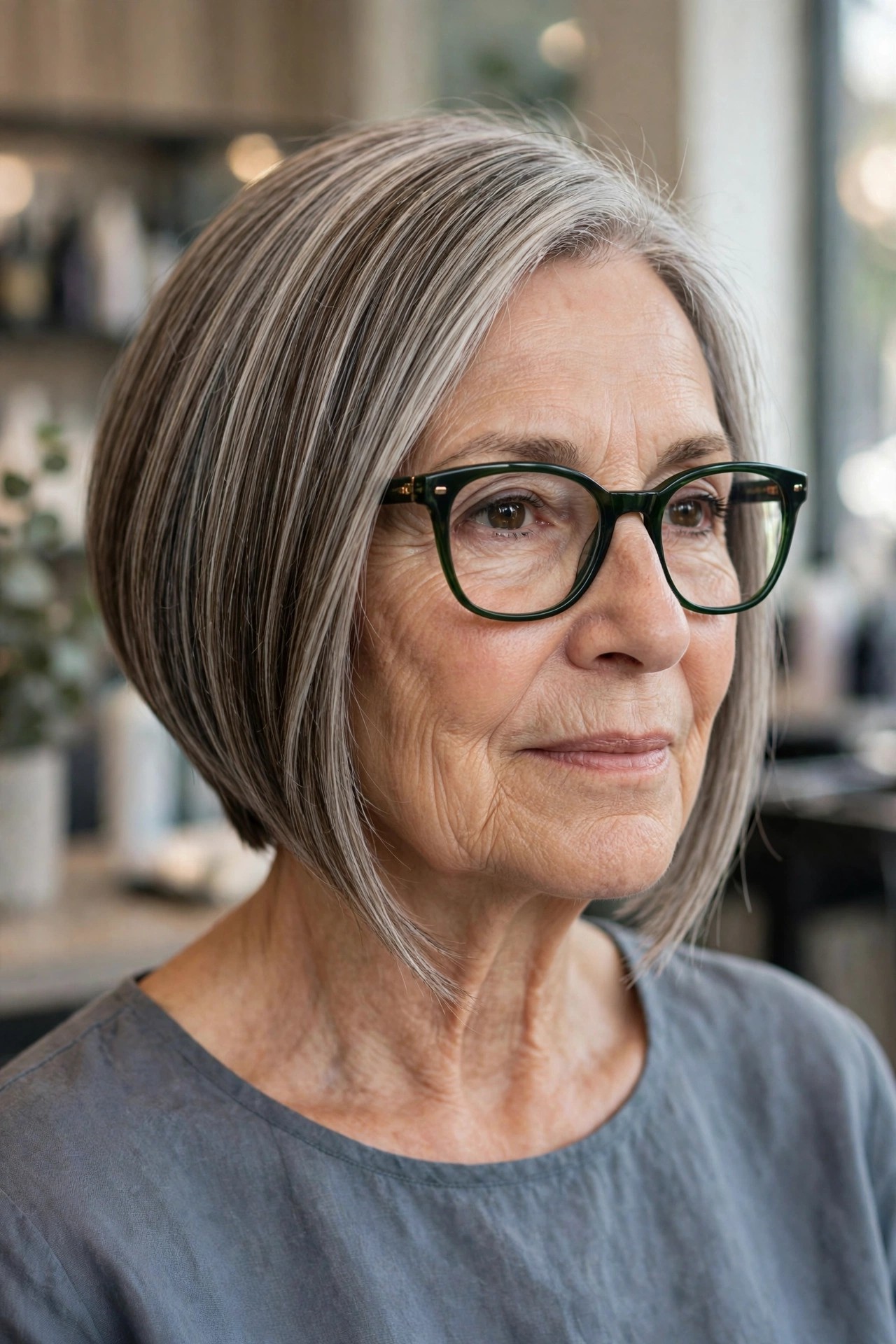
The inverted bob angles from short at the nape down to longer points below the chin, and that forward rush of length is a gift with glasses: the longest pieces land below and in front of the frames, lengthening the face and drawing the eye down past the jaw. Worn sleek, as pictured, the silver-brown hair becomes a smooth frame-within-a-frame around the dark green lenses.
Because the front points are the whole design, keep them sharp: a protected flat-iron pass on the front sections only, and trims that restore the angle before the back catches up. This is a strong choice for round faces, since the diagonal and the length both slim. If black frames feel severe on you, deep green or navy acetate softens the same geometry.


20. Soft Shoulder Waves with Bright Face-Framing Highlights

We finish where the title promises: framing, done with color as well as cut. Soft waves fall to the shoulders while bright silver and caramel pieces are woven only around the face, so the lightest hair sits right beside the frames and lifts the whole complexion. Oversized tortoiseshell squares, as pictured, anchor the softness — the look needs one structured element, and the glasses provide it.
Ask your colorist for the brightness to start at the cheekbones and follow the wave pattern, keeping the back deeper for contrast. Face-framing color grows out gently because it is placed where your natural silver is brightest anyway. Protect the waves overnight on a satin pillowcase, and refresh day-two curls with a mist of water rather than re-styling from scratch.

Recommended Products
These are the workhorses behind the cuts above — root lift for the longer-top styles, gentle hold that never freezes layers in place, tone care for silver, and the tools that keep front pieces curving the right way around your frames.
- ✓ Always have fringes and front layers cut — and checked — with your glasses on.
- ✓ Keep the hair at the temples tapered, tucked, or long enough to tuck fully; the in-between length is the one that gets trapped.
- ✓ Dry fringes first, before the rest of the hair sets, and sweep them away from the frames.
- ✓ Clean your frames’ temple arms weekly — product build-up transfers straight onto the hair beside your ears.
- ✓ Use lightweight products near the front; heavy oils make hair slide against lenses and skin.
- ✓ Book fringe trims between cuts (ideas 7 and 16 need one every 2–3 weeks) — they take minutes.
- ✓ Keep silver bright with a weekly purple shampoo so light frames and gray hair look intentional together.
- ✓ Sleep on a satin pillowcase to keep front layers smooth and lenses’ neighboring hair frizz-free.
Frequently Asked Questions
What is the best hairstyle for a woman over 60 who wears glasses?
The most reliable choices keep the temples clear and the fringe under control: a chin-length bob with a side part, a pixie with a sweeping fringe that ends above the frames, or a lob with face-framing layers cut while wearing your glasses. The right answer depends on your frame size — bold frames pair best with cleaner, shorter shapes, while delicate frames suit sleek bobs and longer layers.
Can I wear bangs with glasses after 60?
Yes — as long as the fringe and the frames never compete for the same space. Cut the bangs to finish clearly above the top rim (ideas 7 and 16), sweep them diagonally across (idea 2), or wear curtain bangs that part in the middle and flow around the frames (idea 18). Always have the length set with your glasses on.
How do I stop my hair getting caught in my glasses?
The trapped-hair zone is the few centimeters beside the ears. Solve it structurally: taper the sides short (ideas 5 and 14), keep them smooth and close as in the stacked bob (idea 11), or grow the sides long enough to tuck completely behind the ear (idea 13). The awkward in-between length is what catches, so commit to one side of it.
Do glasses make short hair or long hair look better over 60?
Both work; the proportions matter more than the length. Short cuts (pixies, crops, stacked bobs) keep everything clear of the frames and put the focus on your eyes. Longer cuts (lobs, shoulder waves) frame the face below the frames and soften the jaw. What fails at any length is bulk sitting exactly at frame height, pushing the glasses out of alignment.
Which frame shapes suit gray and silver hair?
Silver hair is a neutral, so it flatters almost every frame color. Tortoiseshell adds warmth, navy and burgundy soften black’s contrast, deep green is an elegant surprise, and rimless or fine metal frames keep the focus on bright silver hair. If your hair is salt-and-pepper, a frame that echoes either the dark or the light tone will always look coordinated.
How often do glasses-friendly cuts need trimming?
Bobs and lobs hold their frame-friendly shape for six to eight weeks. Pixies, crops, and tapered sides need four to five weeks to stay clear of the temples, and short fringes worn above the frames need a five-minute tidy every two to three weeks — most salons do these cheaply between full appointments.
Glasses are not an obstacle to a great haircut — they are half of the design. Choose the cut that respects your frames, have the front cut with them on, and the two will frame your face together better than either could alone. Short on time? Start with ideas 1, 5, or 6 — the bob, the crop, and the lob are the three shapes our readers come back to most.