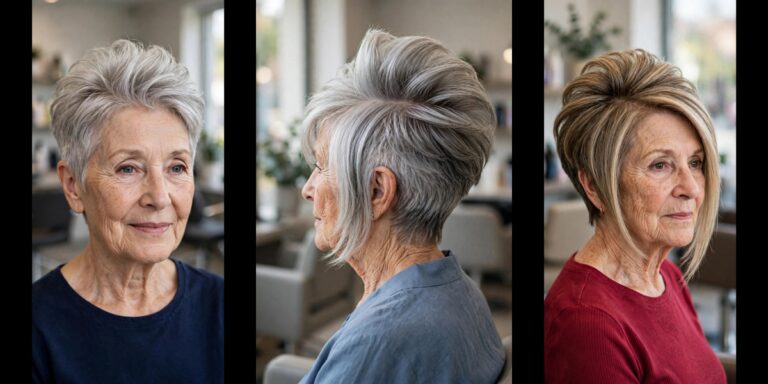
Hairstyles With Bangs for Women Over 60 That Soften Fine Lines
This post contains affiliate links. As an Amazon associate, I earn from qualifying purchases. I only recommend products that are of high quality and that I would use myself.
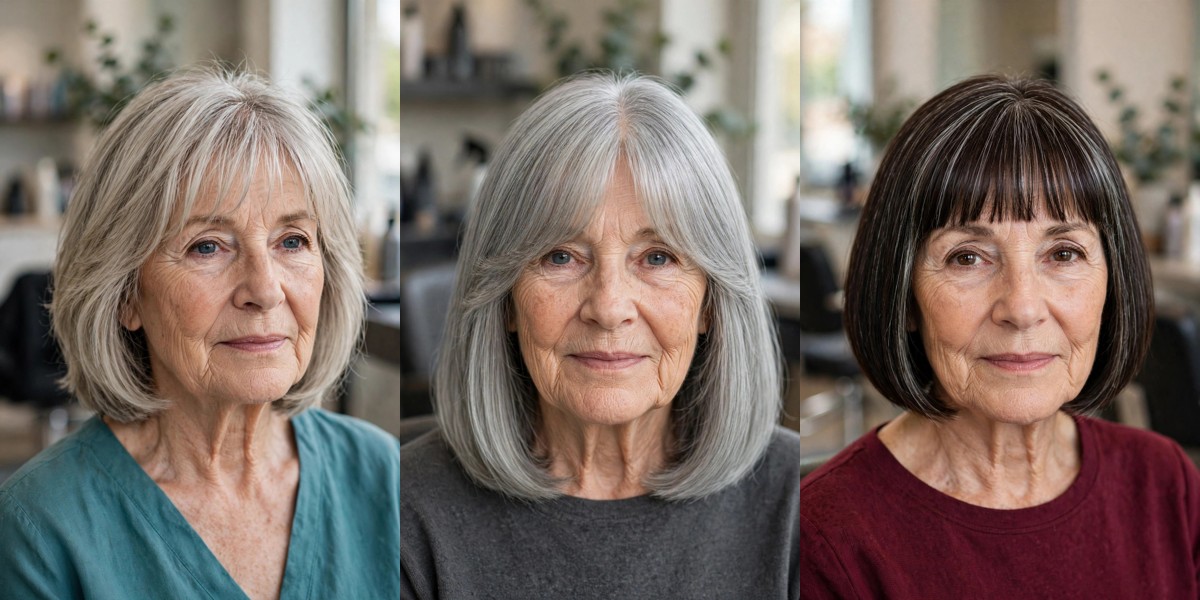
Bangs are the single fastest way to soften fine lines after 60 — faster than a new color, and considerably cheaper than anything sold in a jar. A well-cut fringe veils the forehead where lines run deepest, redirects attention to your eyes, and adds a soft frame at exactly the place where a fully exposed hairline can look harsh. The catch is that the wrong fringe does the opposite: a heavy, straight, too-short bang can sit on the forehead like a line of its own and make everything underneath it look more defined by comparison.
Below are 20 hairstyles with bangs for women over 60, organized by fringe type — wispy, curtain, side-swept, blunt, feathered, choppy, arched, and more — each with the cut it pairs with, who it suits, and how to keep it looking soft rather than severe. If you are still comparing across age guides, our Over-50 bangs guide covers the same fringe families from a slightly younger angle.
Table of Contents
- 1. Wispy See-Through Bangs with a Layered Bob
- 2. Curtain Bangs with Shoulder-Length Layers
- 3. Long Side-Swept Bangs with a Silver Pixie
- 4. Soft Blunt Bangs with a Classic Chin Bob
- 5. Feathered Bangs with a Modern Shag
- 6. Wispy Bangs with a Short White Crop
- 7. Curtain Bangs with a Silver Lob
- 8. Side-Swept Bangs with a Wavy Bob
- 9. Arched Bangs with a Sleek Chestnut Bob
- 10. Choppy Piecey Bangs with a Textured Pixie
- 11. Long Face-Framing Bangs with Medium Layers
- 12. Bottleneck Bangs with Soft Waves
- 13. Wispy Bangs with a Curly Gray Bob
- 14. Straight-Across Bangs with a Short Gray Pixie
- 15. Asymmetric Bangs with an Edgy Short Cut
- 16. Brow-Grazing Bangs with Feathered Layers
- 17. Parted Wispy Bangs with Voluminous Layers
- 18. Soft Bangs with a Wash-and-Go Gray Crop
- 19. Wispy Bangs with Long Layered Hair
- 20. Gentle Side Bangs with a French Bob
- Recommended Products
- FAQs
- Deep forehead lines? Brow-grazing feathered bangs (idea 16) or soft blunt bangs (idea 4) — the fullest coverage.
- First fringe, low commitment? Wispy bangs (idea 1) or long face-framing bangs (idea 11) — both grow out invisibly.
- Fine or thinning front hairline? Wispy and choppy fringes (ideas 1, 6, 10) — sheer edges never expose how fine the hair is.
- Round face? Side-swept or asymmetric bangs (ideas 3, 8, 15) — the diagonal slims.
- Natural gray or silver? Ideas 3, 7, 13, and 14 place the fringe where silver catches the most light.
- No daily styling? The wash-and-go crop (idea 18) or the modern shag (idea 5).
- Curly hair? Wispy curly bangs (idea 13), cut dry, curl by curl.
1. Wispy See-Through Bangs with a Layered Bob
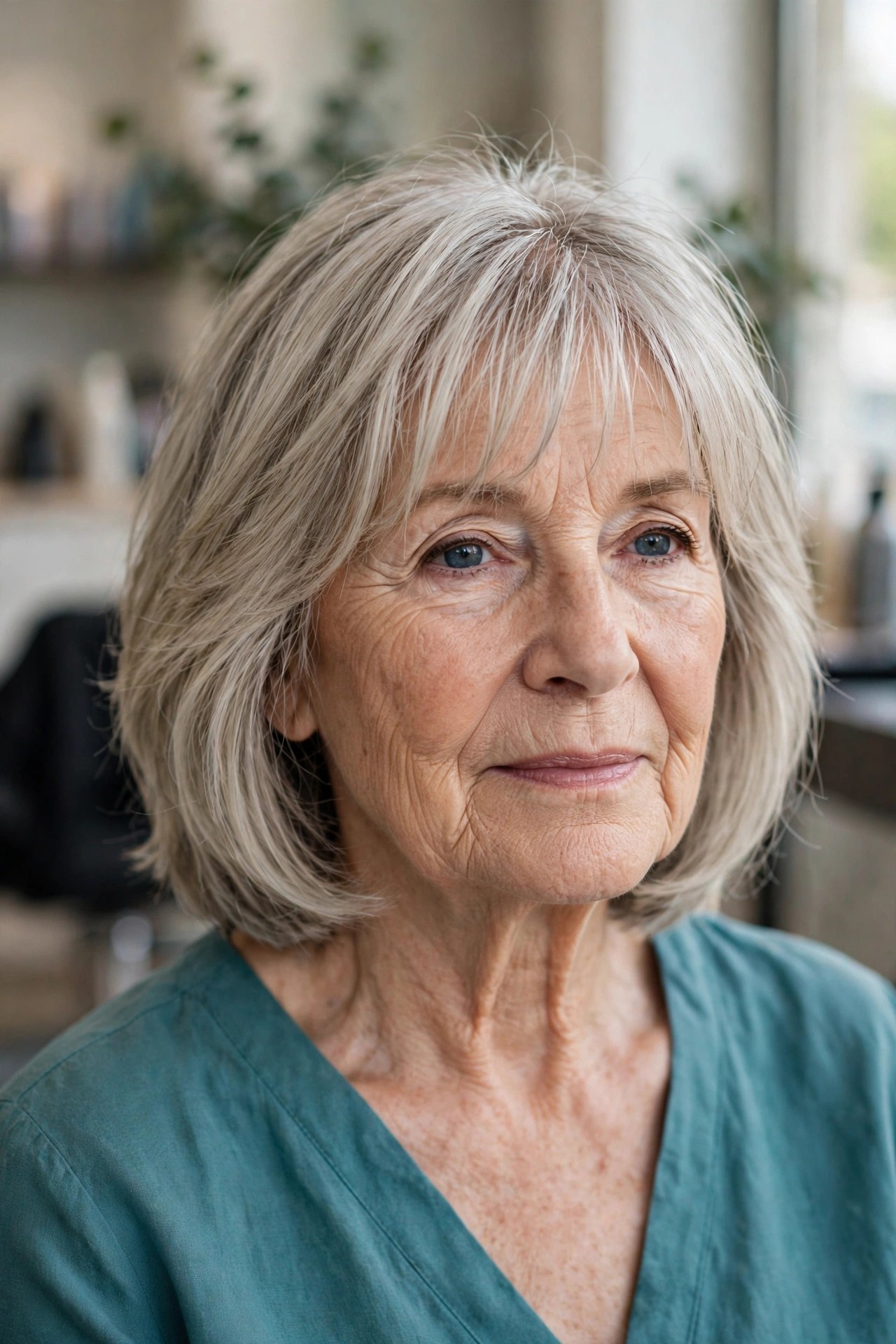
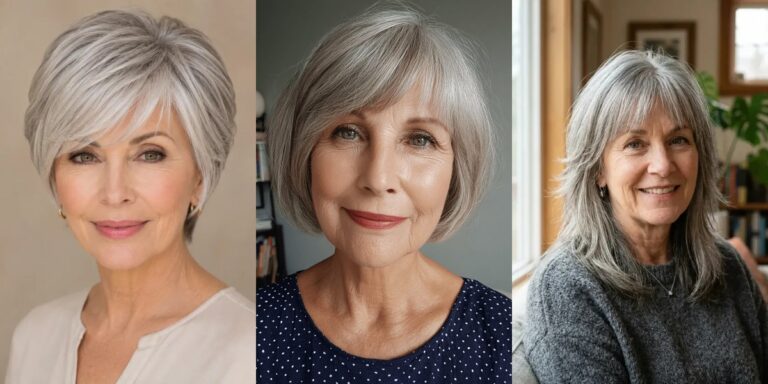
If you try one fringe first, make it this one. Wispy bangs are point-cut so sheer that skin shows through them in places, which is exactly why they soften forehead lines instead of drawing a hard line underneath them. Paired with a layered bob that ends between the chin and shoulders, the whole front of the cut stays light and airy, and attention lands on your eyes rather than on the forehead above them.
Ask your stylist to cut the fringe dry and to start longer than you think you want — wispy bangs can always be shortened at the next visit, and they shrink slightly as they settle. At home, dry the bangs first with a round brush while the rest of the hair is still damp, because a fringe that air-dries in the wrong direction rarely recovers. A pea-sized amount of mousse at the roots keeps the bob’s layers from falling flat by midday.


2. Curtain Bangs with Shoulder-Length Layers
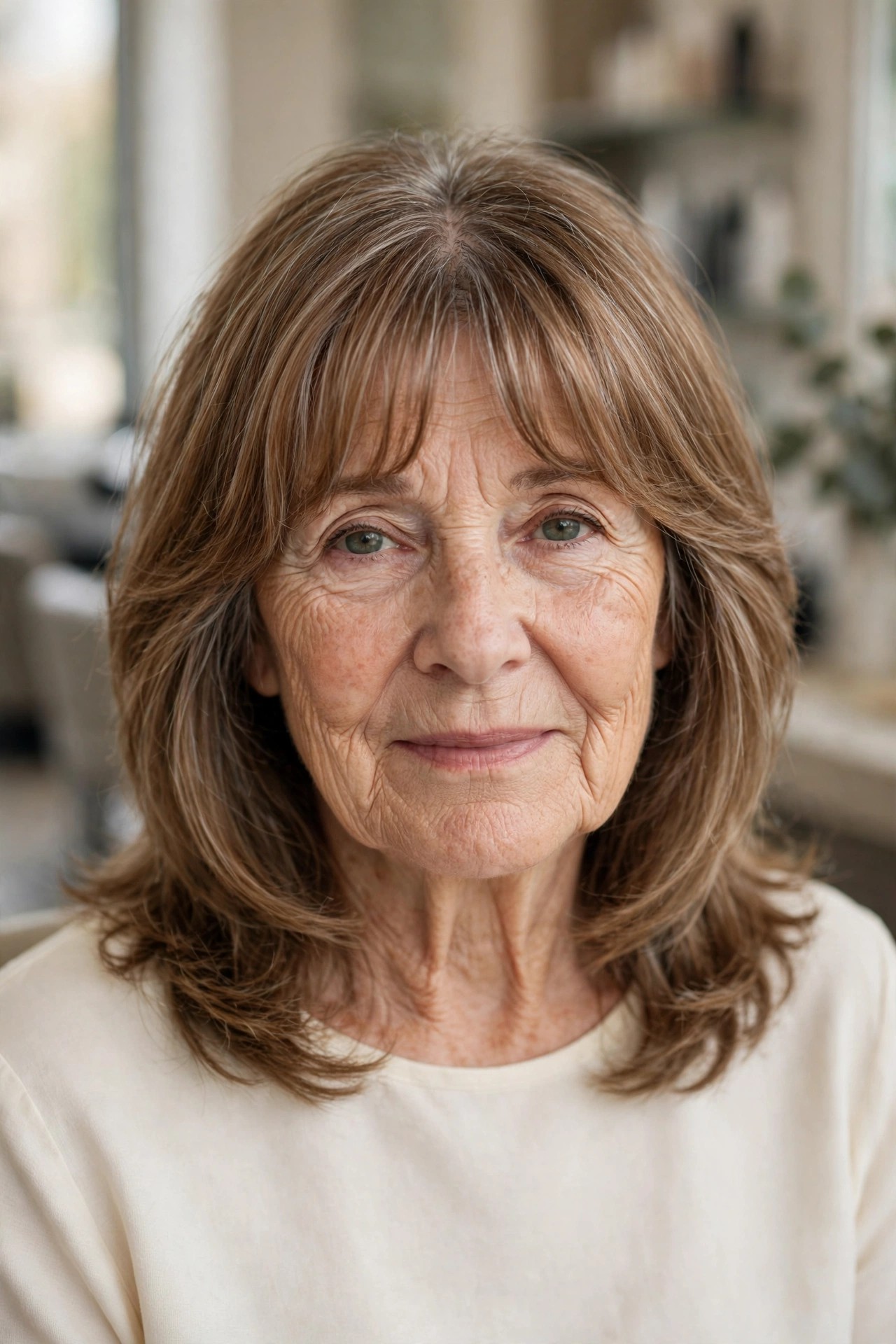
Curtain bangs part in the center and open to each side like drapes, framing the eyes and cheekbones while leaving the middle of the forehead softly covered at the edges. On shoulder-length layered hair they solve two problems at once: the fringe breaks up the forehead so lines read fainter, and the long sides of the curtain melt into the layers so there is no obvious starting point where the bangs end and the cut begins.
The styling habit is specific and quick: dry the curtain forward first, then sweep each side out and back with a round brush or a hot-air styler, and set it with a cool shot. If you want the deeper dive on this fringe family first, our curtain bangs guide walks through the face shapes it flatters most. Trims matter more here than with any other bang — once the shortest center pieces pass the nose, the curtain stops opening properly.


3. Long Side-Swept Bangs with a Silver Pixie
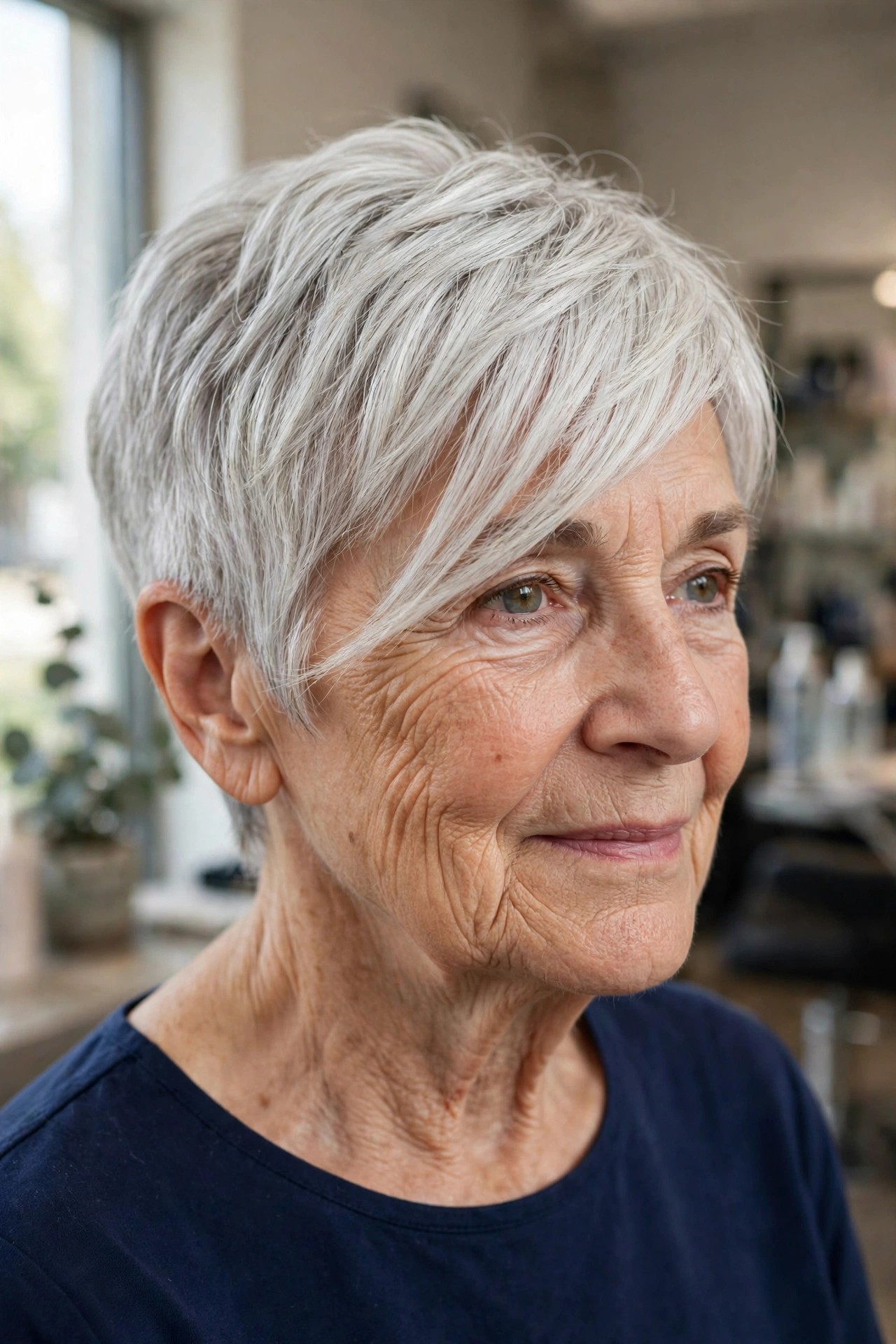
A pixie can look severe when the forehead is fully exposed; a long side-swept fringe is what keeps it soft. The bangs are left long enough to sweep diagonally from a deep side part across the brow, covering most of the forehead at an angle. That diagonal is the softening trick — the eye follows the sweep instead of settling on horizontal lines, and on silver hair the sweep catches light in one smooth ribbon.
This pairs naturally with the cropped, tapered back of a classic pixie, so if you are comparing short options, our elegant pixie guide for over 60 shows the back and crown shapes that work best with a long fringe. Keep the sweep glossy with a weekly purple shampoo, and train it while damp: mature hair tends to keep the direction it dries in, so five seconds of dryer placement beats five minutes of later correction.


4. Soft Blunt Bangs with a Classic Chin Bob
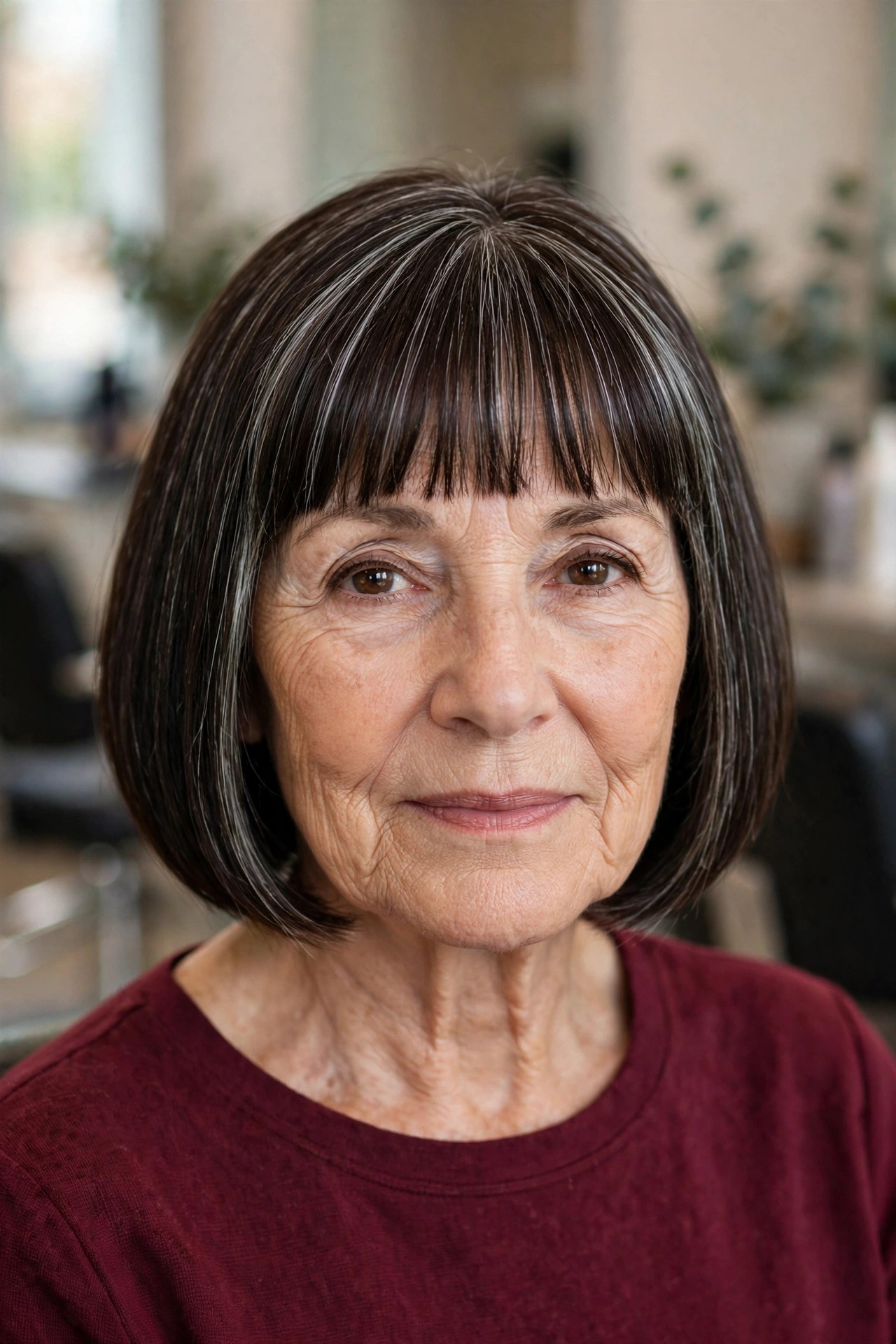
Blunt bangs have a reputation for being harsh, but the over-60 version is blunt in shape only — the edge is softened with light point-cutting so it rests on the forehead instead of sitting on it like a shelf. Cut just above the brows and paired with a chin-length bob, it gives the most complete forehead coverage in this guide, which is why it remains the classic choice for deeper forehead lines and a higher forehead.
Density is the deciding factor: this fringe needs enough hair at the front hairline to look intentional, so very fine or receding hairlines usually do better with the wispy version in idea 1. Keep the bob itself mostly one-length with the ends tucked slightly under — the clean outline is what makes the soft blunt edge read polished rather than severe. Our timeless bob guide covers the bob lengths that balance a fuller fringe best.

5. Feathered Bangs with a Modern Shag
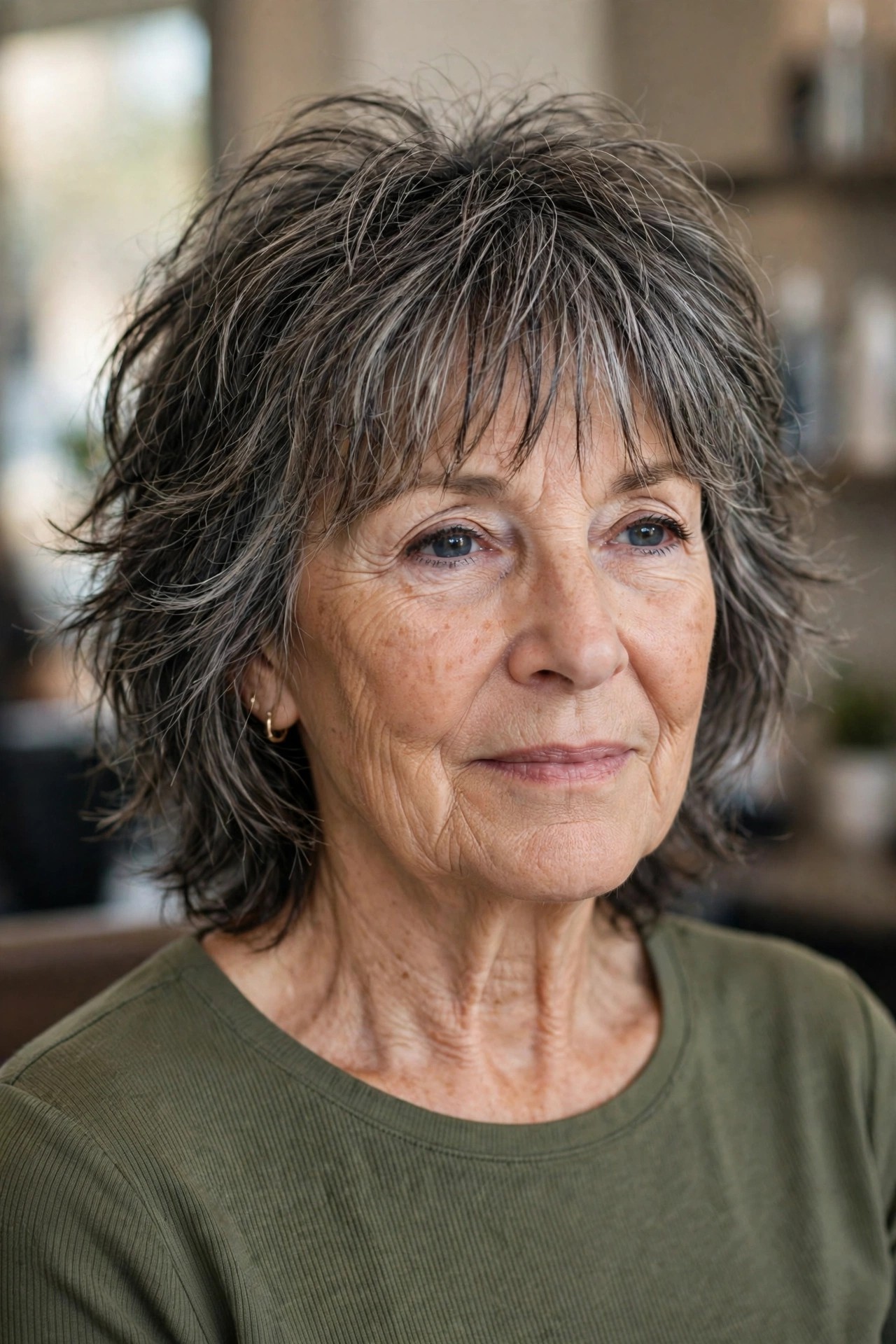
The shag was practically designed for this brief. Its bangs are feathered — many fine layers brushed forward and slightly apart — so the fringe moves, separates, and never forms a solid block over the forehead. Through the rest of the cut, choppy layers add crown height and broken texture that disguises wiry gray strands and thin patches far better than a smooth, precise style ever could.
Feathering rewards a light hand with product. Work texture spray or a pinch of putty through dry hair and push the bangs gently apart with your fingertips; sleek serums flatten the very separation that makes this fringe flattering. The shag also grows out the kindest of any cut here, because its uneven edges still look deliberate at week eight — a real consideration if salon visits are spaced out.

Fringes flatter by proportion: curtain bangs love a longer face, side sweeps slim a round one, and a soft blunt edge balances a heart shape. Try our free Face Shape Finder to discover your face shape in under a minute, then match it to the ideas above.
6. Wispy Bangs with a Short White Crop
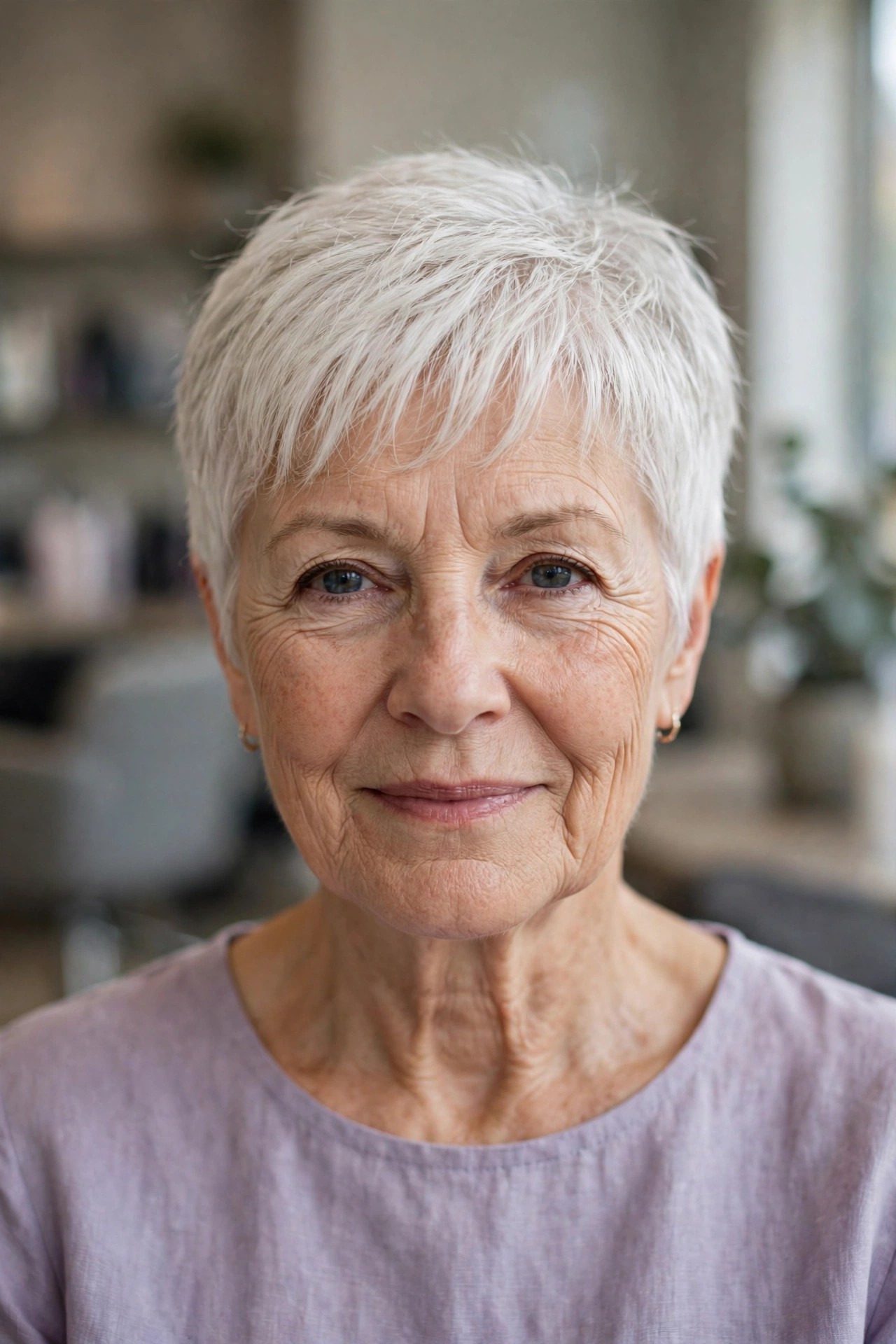
Short hair plus a wispy fringe is the lowest-maintenance pairing in this guide, and on white hair it looks strikingly fresh. The crop keeps the sides and back close and neat, while the fringe is left sheer and slightly longer on top, brushed forward to veil the forehead. Because the bangs are the newest, finest hair at the front, they tend to look softer than the rest of the cut — a built-in brightener right at the face.
White and very pale hair shows oil faster than pigmented hair, and a wispy fringe will look stringy a day before the rest of the crop does. A light dusting of dry shampoo at the fringe roots on the second morning separates the strands again in seconds. Keep the crop on a four-to-five-week trim cycle; the fringe can be tidied between full cuts, and many stylists will do that small tidy free of charge.


7. Curtain Bangs with a Silver Lob
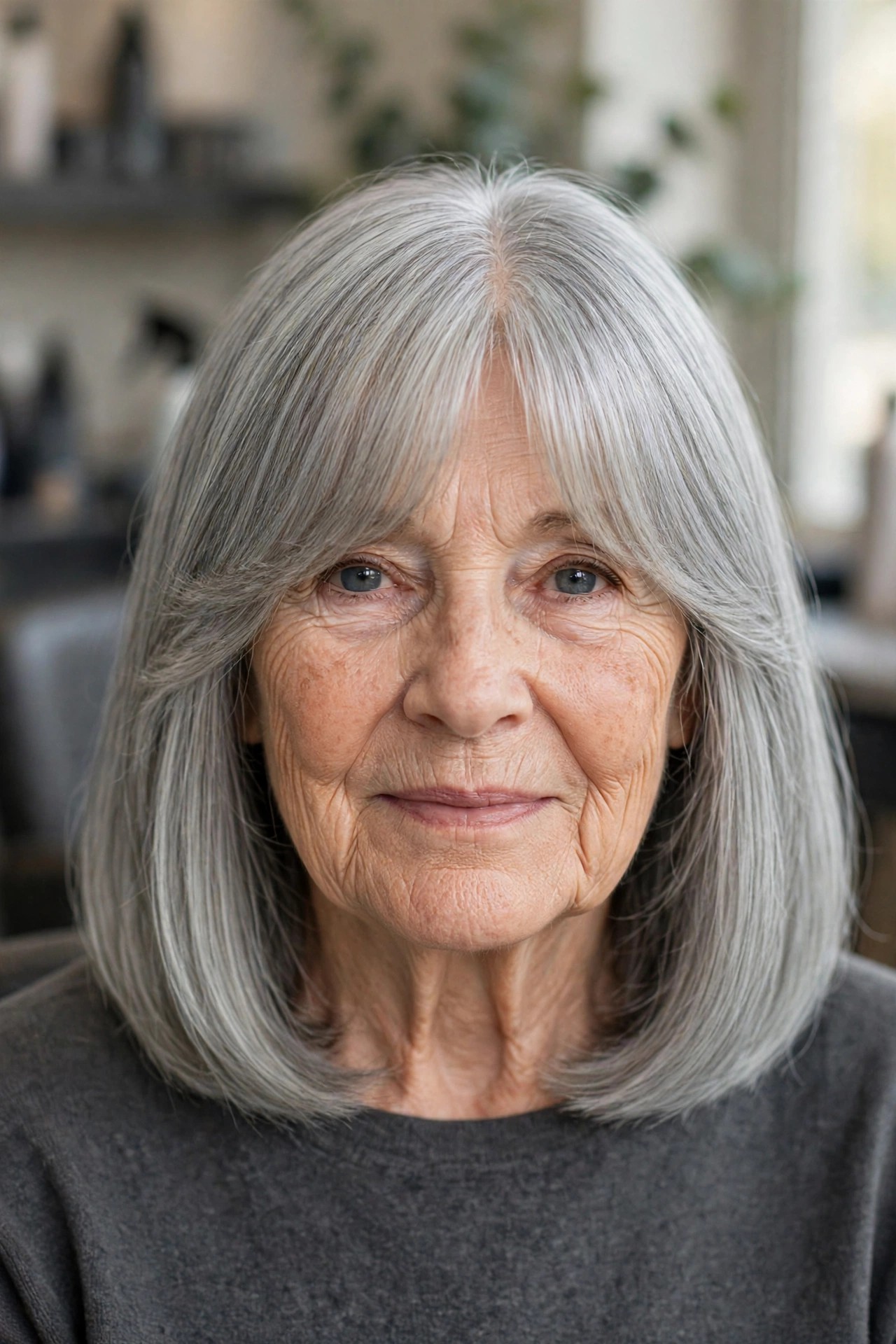
The lob — a long bob ending at the collarbone — is the gentlest home for curtain bangs on silver hair. The fringe opens at the center and lengthens gradually until it joins the lob’s front corners, so the whole outline becomes one continuous frame around the face. Silver does something special here: each side of the curtain reflects light at a slightly different angle, which softens the shadows that make lines beside the eyes look deeper.
Silver’s one non-negotiable is brass control. A purple shampoo once a week keeps the curtain bright rather than yellowed, and an in-shower gloss every few weeks restores the shine that makes the framing effect work. For more ways to make natural gray the feature rather than the compromise, see our guide to sophisticated gray hairstyles. Dry the curtain before the lengths, always — it is the part of the cut everyone sees first.

8. Side-Swept Bangs with a Wavy Bob
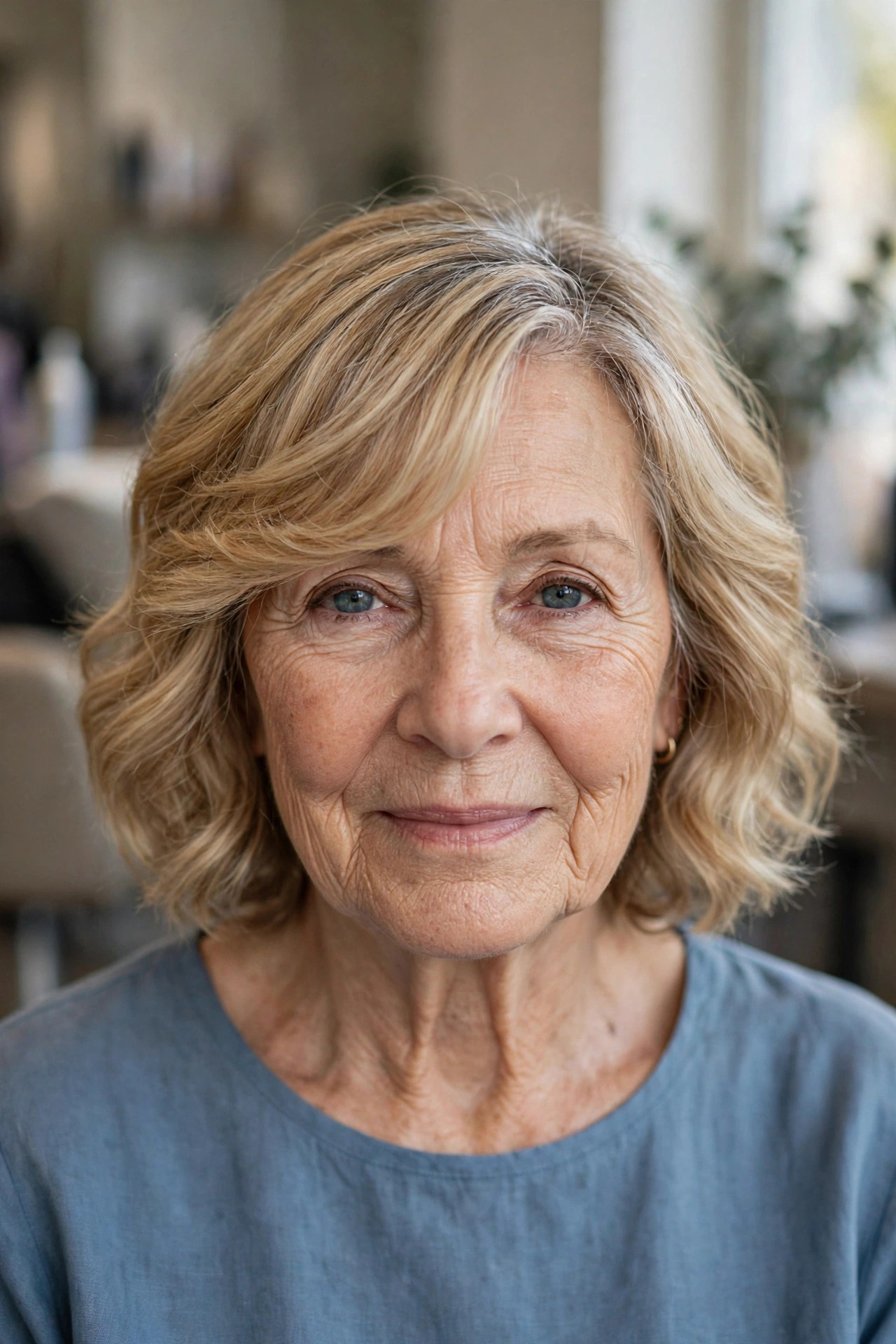
Waves forgive everything, including a fringe that will not sit perfectly flat — which is why the side-swept bang on a wavy bob is such a reliable combination. The bangs are cut long, swept to one side, and allowed to keep a bend that matches the rest of the hair, so they look like the natural beginning of the waves rather than a separate piece pasted on top. The soft diagonal across the forehead breaks up lines while the waves add the width and movement that fine, aging hair often loses.
Cut this fringe longer than a straight one: waves spring up as they dry, and bangs cut to brow length when wet can sit an inch higher by the afternoon. Scrunch texture spray into damp hair and let the fringe dry in its sweep, held loosely in place with a clip for the first ten minutes if your hairline has a strong natural part. More fringe-and-length combinations are covered in our side-swept bangs guide.

9. Arched Bangs with a Sleek Chestnut Bob
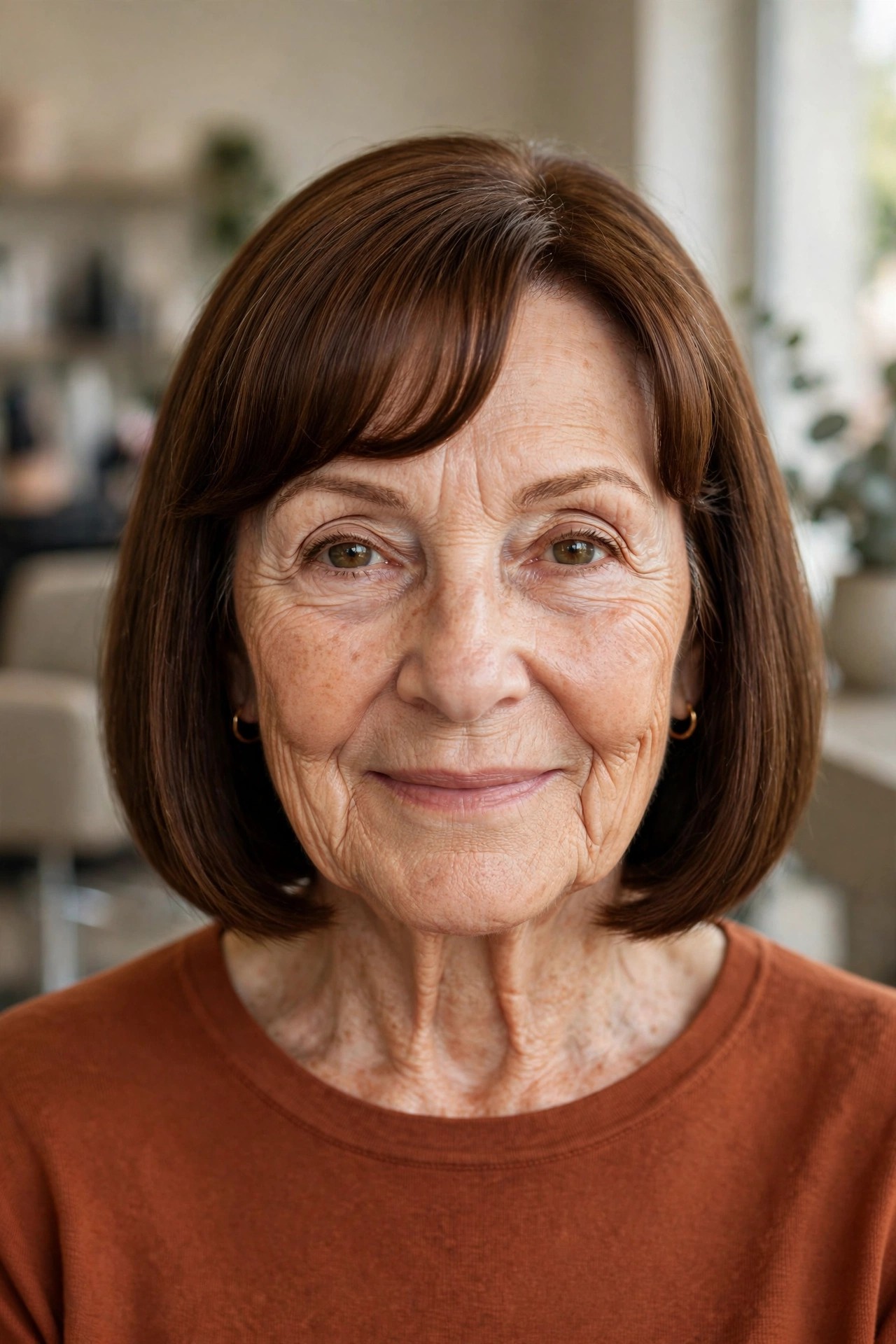
Arched bangs follow the curve of the brow bone: slightly longer at the outer corners and a touch shorter in the very center, forming a soft rainbow over the forehead. That curve is what separates this fringe from a straight-across cut — it mirrors the natural arch of the eyebrows, so the whole eye area looks lifted and framed rather than cut off. On a sleek chin-length bob in a rich chestnut, the effect is neat, deliberate, and quietly glamorous.
Precision is the price. An arch only reads as an arch when the curve is clean, so expect a fringe trim every three to four weeks, and keep the bob itself smooth — frizz at the ends competes with the neatness at the front. A flat iron on the bob’s surface only, always over heat protection and on a moderate setting, is enough; the bangs themselves should be dried with a brush, never ironed flat, or the arch collapses into a straight line.


10. Choppy Piecey Bangs with a Textured Pixie
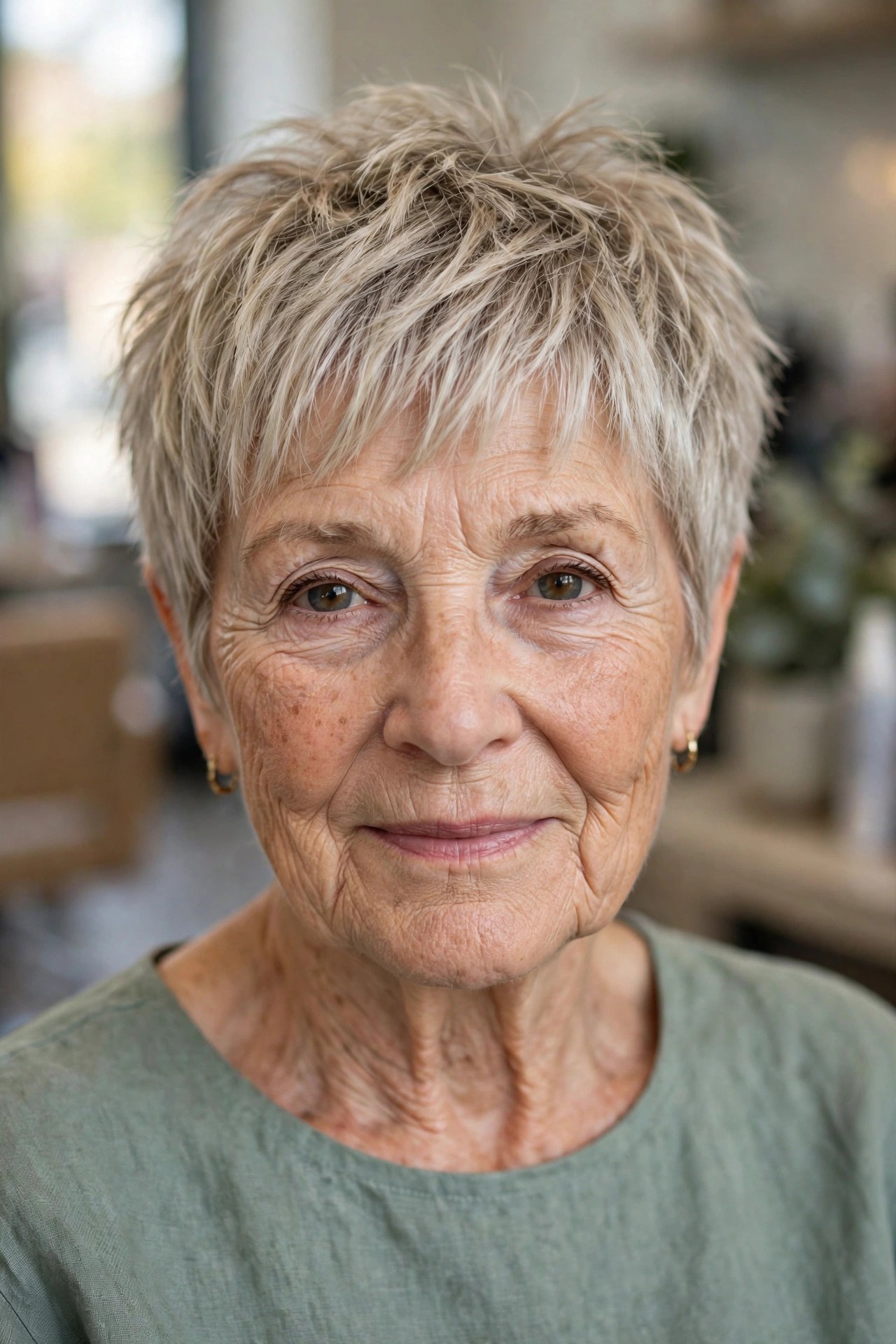
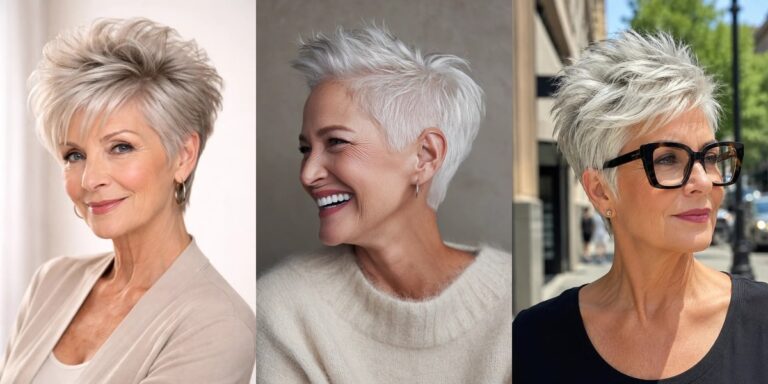
Choppy bangs are point-cut at uneven depths so the edge breaks into distinct little pieces instead of one continuous line. On a textured pixie, that broken edge is the softest possible cover for the forehead: there is no straight line for the eye to compare the lines of the forehead against, and the pieces can be pushed forward, apart, or slightly to one side depending on the day. It is also the most youthful-feeling fringe in this guide, in the best sense — energetic rather than trying hard.
This is the fringe for women whose hair refuses to lie flat anyway, because choppiness turns cowlicks and wiry front strands into part of the design. Style it by pinching a tiny amount of texturizing putty between fingertip and thumb and defining a few pieces at the front; the rest of the pixie needs almost nothing. Flat roots on day two respond better to dry shampoo than to re-wetting, which just resets the cowlicks.
11. Long Face-Framing Bangs with Medium Layers
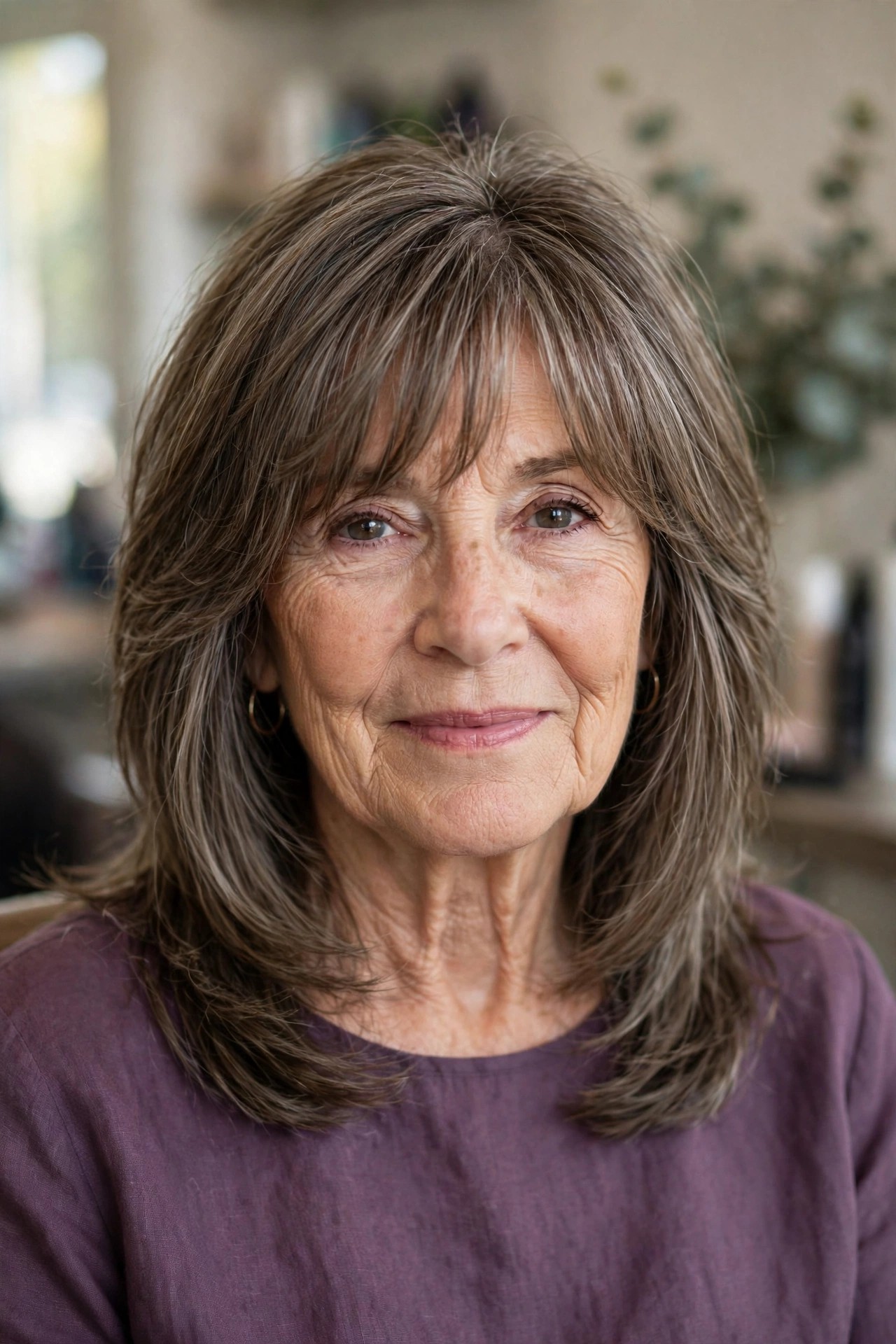
Not every fringe has to cross the forehead. Long face-framing bangs start at the center front and angle down past the cheekbones, joining medium layers that continue around the head. The forehead stays partly open, but its edges are veiled, the temples are softened, and the longest framing pieces draw a gentle vertical on each side of the face that makes features look narrower and lines beside the mouth less pronounced.
This is the safest first step if you have not worn bangs in decades, because it grows out into ordinary layers with no awkward in-between stage and can be clipped back completely on days you want your forehead clear. Ask for the shortest framing piece to land at cheekbone height — shorter reads as true bangs, longer reads as layers, and cheekbone is the sweet spot that flatters the widest range of face shapes after 60.
12. Bottleneck Bangs with Soft Waves
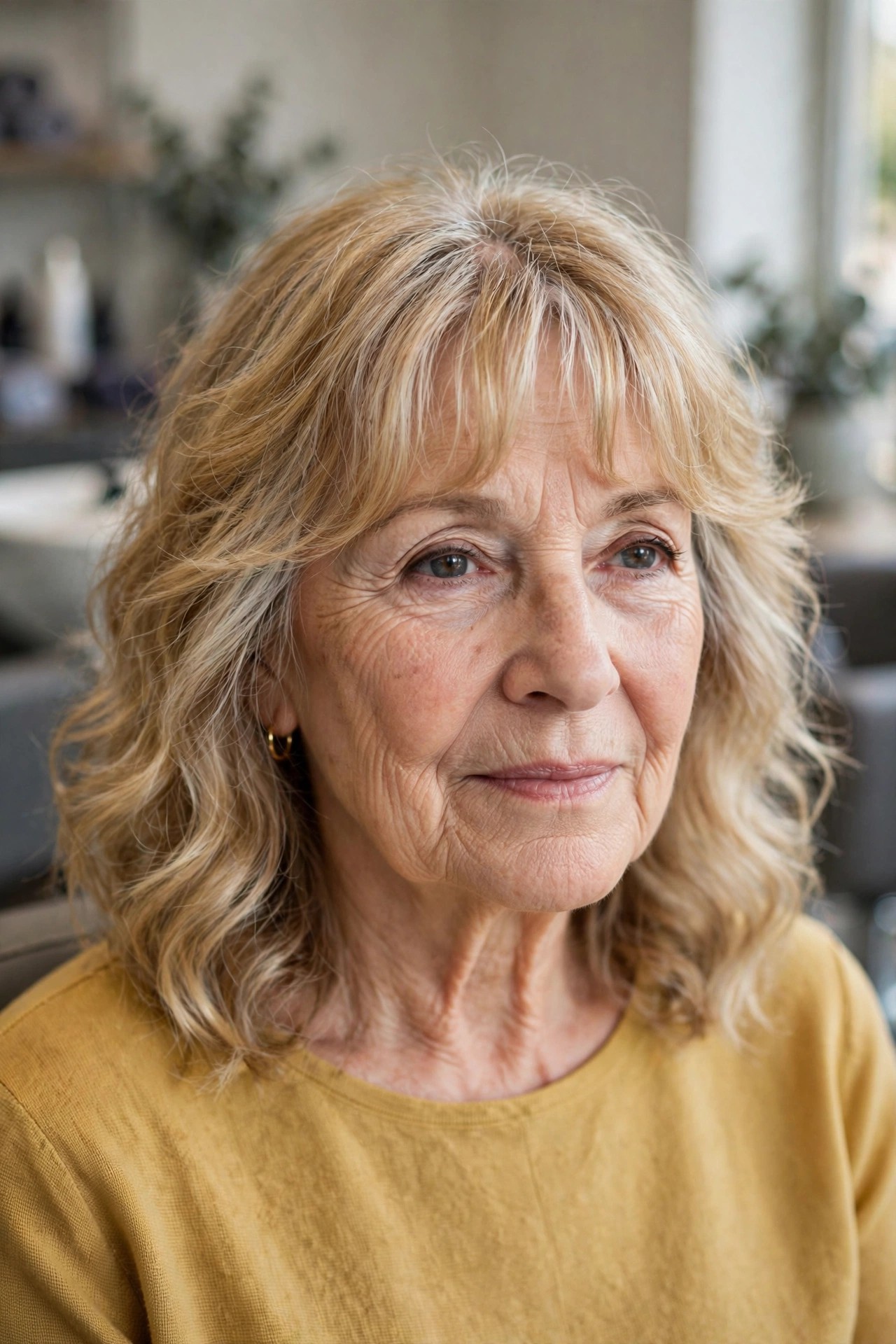
Bottleneck bangs borrow their shape from a bottle’s silhouette: narrower and shorter at the center top, then widening and lengthening as they curve out toward the cheekbones. In practice they behave like a hybrid — the center gives you real forehead coverage where lines are usually deepest, while the long outer corners blend into soft waves so the fringe never looks heavy or squared off. On wavy, highlighted hair the transition is almost invisible.
Because the shape depends on that gradual lengthening, bottleneck bangs should be cut by a stylist who has done them before — ask directly, and bring a photo. At home they need the least daily work of any shaped fringe here: dry the center section forward, let the long corners fall where they will, and let the waves do the blending. If the center grows out faster than the sides start to annoy you, that is normal; the center is simply the shortest part.
13. Wispy Bangs with a Curly Gray Bob
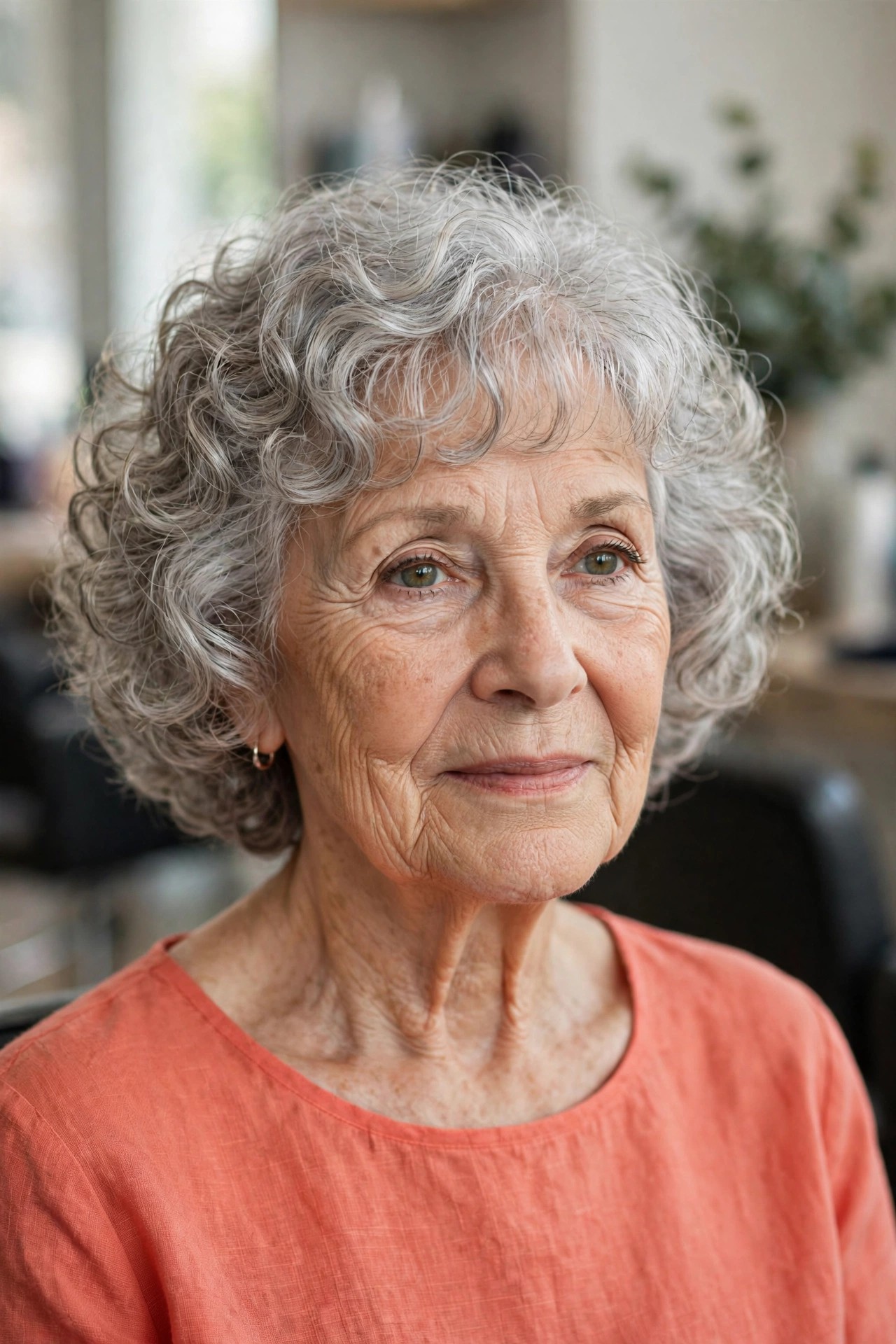
Curly bangs were considered risky for years, and the modern curly fringe proves that caution outdated — provided it is cut dry, curl by curl. On a curly gray bob, wispy curly bangs form a soft halo across the forehead, each curl veiling a little of the brow line without any straight edge at all. The fringe and the bob share the same texture, so the whole style reads as one soft shape that diffuses lines at the forehead and beside the eyes simultaneously.
Two rules protect curly bangs. First, length: cut them longer than you want them to sit, because a curl’s spring can lift the fringe an inch or more as it dries. Second, moisture over hold: gray curls are drier than pigmented ones, and a curl cream worked through wet hair, followed by completely hands-off drying, keeps the fringe defined instead of frizzy. A satin pillowcase preserves the curl pattern overnight so the fringe wakes up close to how it went to sleep.


14. Straight-Across Bangs with a Short Gray Pixie
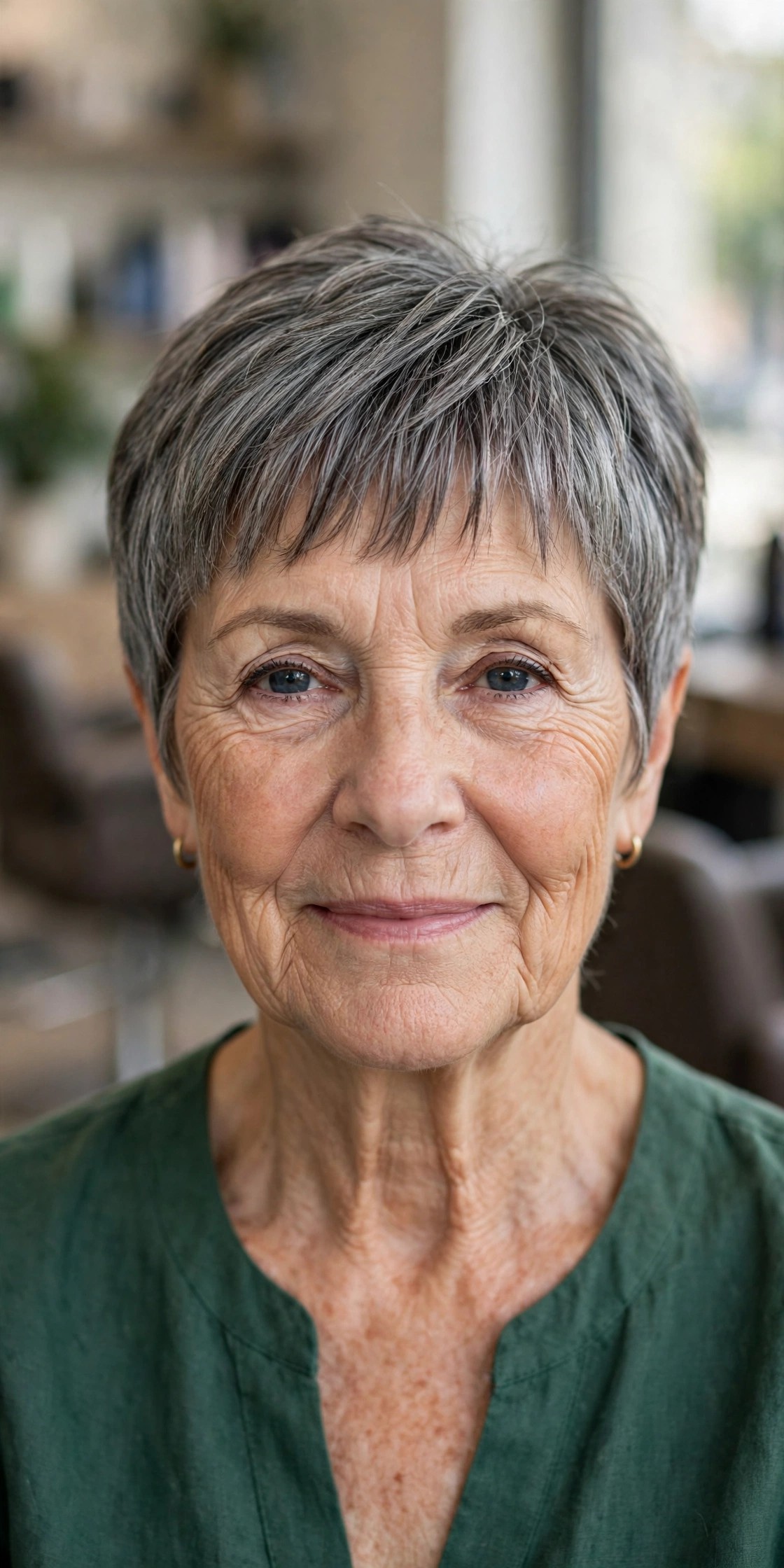
Here the fringe is the statement: a clean straight-across cut, kept soft at the corners, over a short gray pixie that is neat at the sides and back. The contrast is what makes it work — the precision at the front gives the whole short cut intention and polish, and with the forehead fully and evenly covered, deeper lines simply leave the conversation. On salt-and-pepper hair the fringe also shows off the natural pattern of dark and silver beautifully.
Short cuts expose the hairline, so be honest with your stylist about recession at the temples: a straight fringe can begin slightly behind the front edge, using hair from a little further back, which both thickens the fringe and covers a softening hairline. Keep the edge trimmed every three weeks to hold the line, and use light, brushable spray rather than gel — gel on a fine gray fringe separates it into strings and undoes the clean effect.
15. Asymmetric Bangs with an Edgy Short Cut
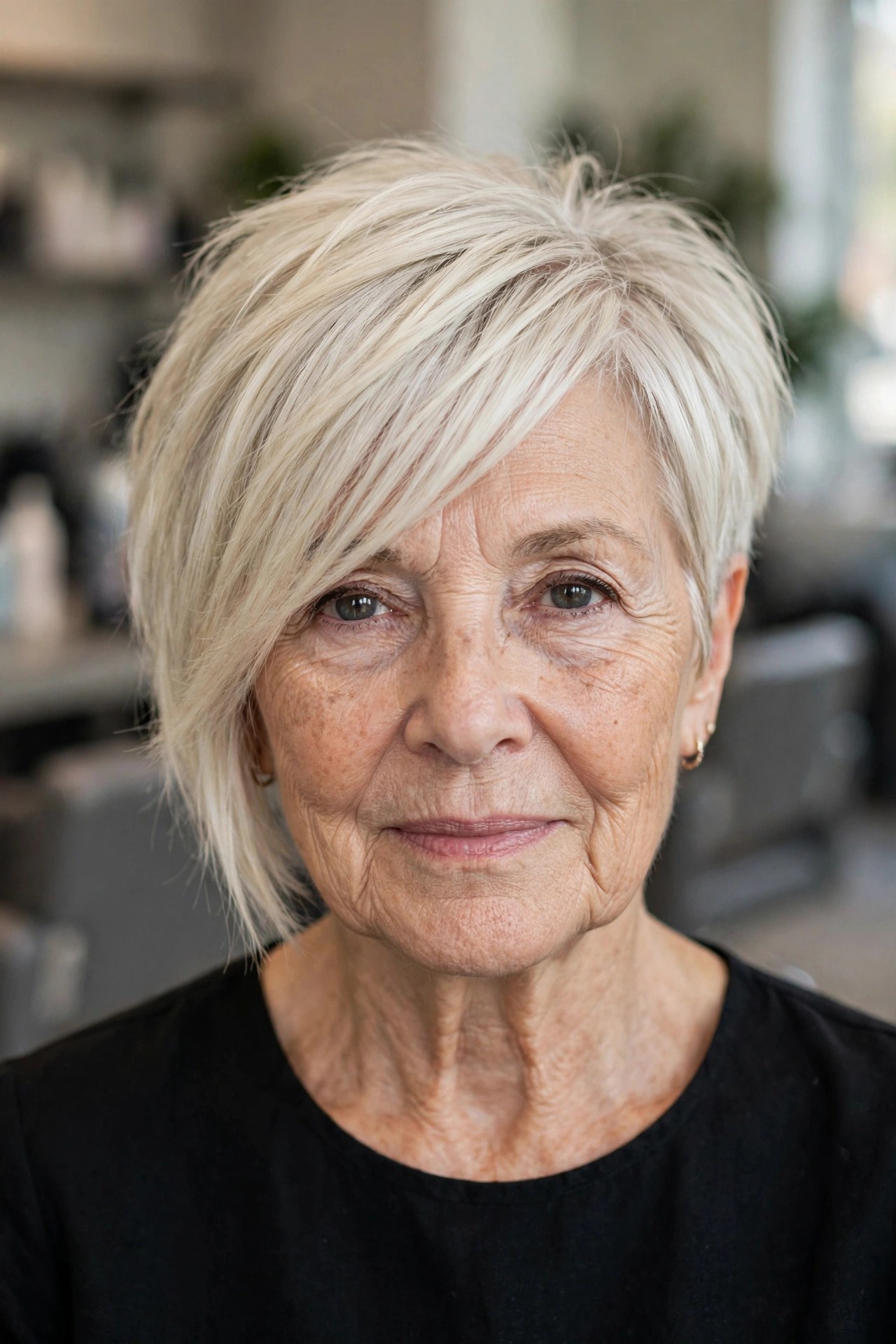
Asymmetry softens by distraction. When the fringe crosses the forehead on a clear diagonal — longer on one side, cropped shorter on the other, matching a cut that is longer on one side too — the eye keeps moving along the diagonal and never settles into the horizontal scanning that makes forehead lines the focus. It is the boldest option in this guide, and on platinum or pale blonde hair it looks unmistakably deliberate and modern.
This cut lives on its proportions, so it is not a grow-it-out-and-see style: plan on trims every four weeks, and keep the longer side’s weight checked so it sweeps rather than hangs. A mini flat iron is the right finishing tool for the long diagonal piece — one protected pass to direct it — rather than heat over the whole head. If you wear glasses, bring them to the appointment; the diagonal should be planned around your frames, not despite them.


16. Brow-Grazing Bangs with Feathered Layers
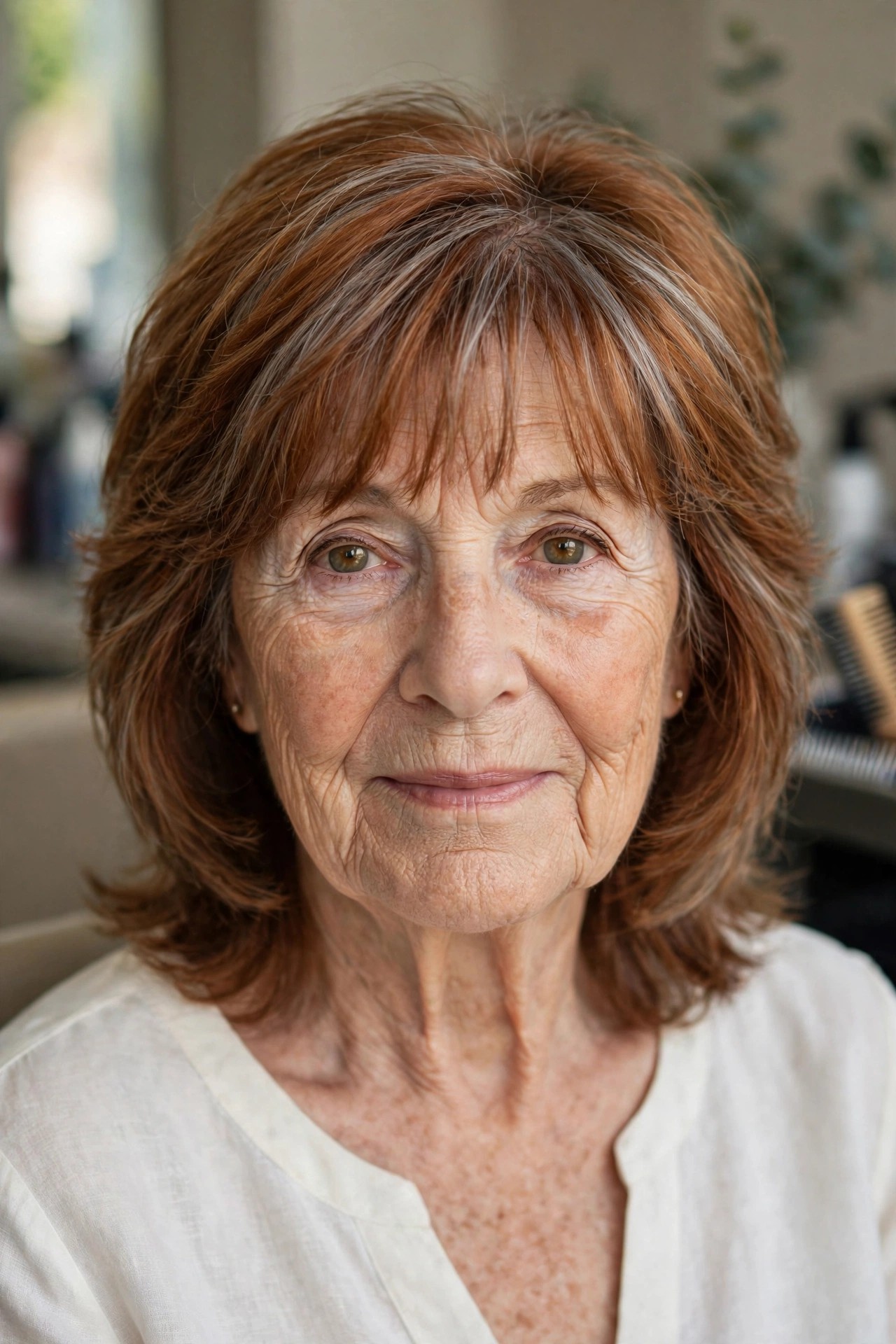
Length is the whole point here: the bangs are left long enough to just touch the eyebrows, and the layers around them are feathered so the fringe’s lower edge blurs into the skin rather than ending in a line. A brow-grazing fringe covers the forehead completely at its longest point, which is why stylists reach for it when forehead lines are the main concern — yet the feathered edge keeps it from ever looking like a heavy curtain dropped over the face.
Brow length means brow maintenance. Expect the fringe to need a tidy every three weeks, and learn the safe way to ask: never let a well-meaning trim take it above the brows to ‘make it last longer,’ because that single change turns soft and grazing into short and severe. Colored and gray-blended hair worn this long at the front benefits from gentle, bond-aware washing, since the fringe is washed, dried, and touched more than any other part of the hair.


17. Parted Wispy Bangs with Voluminous Layers
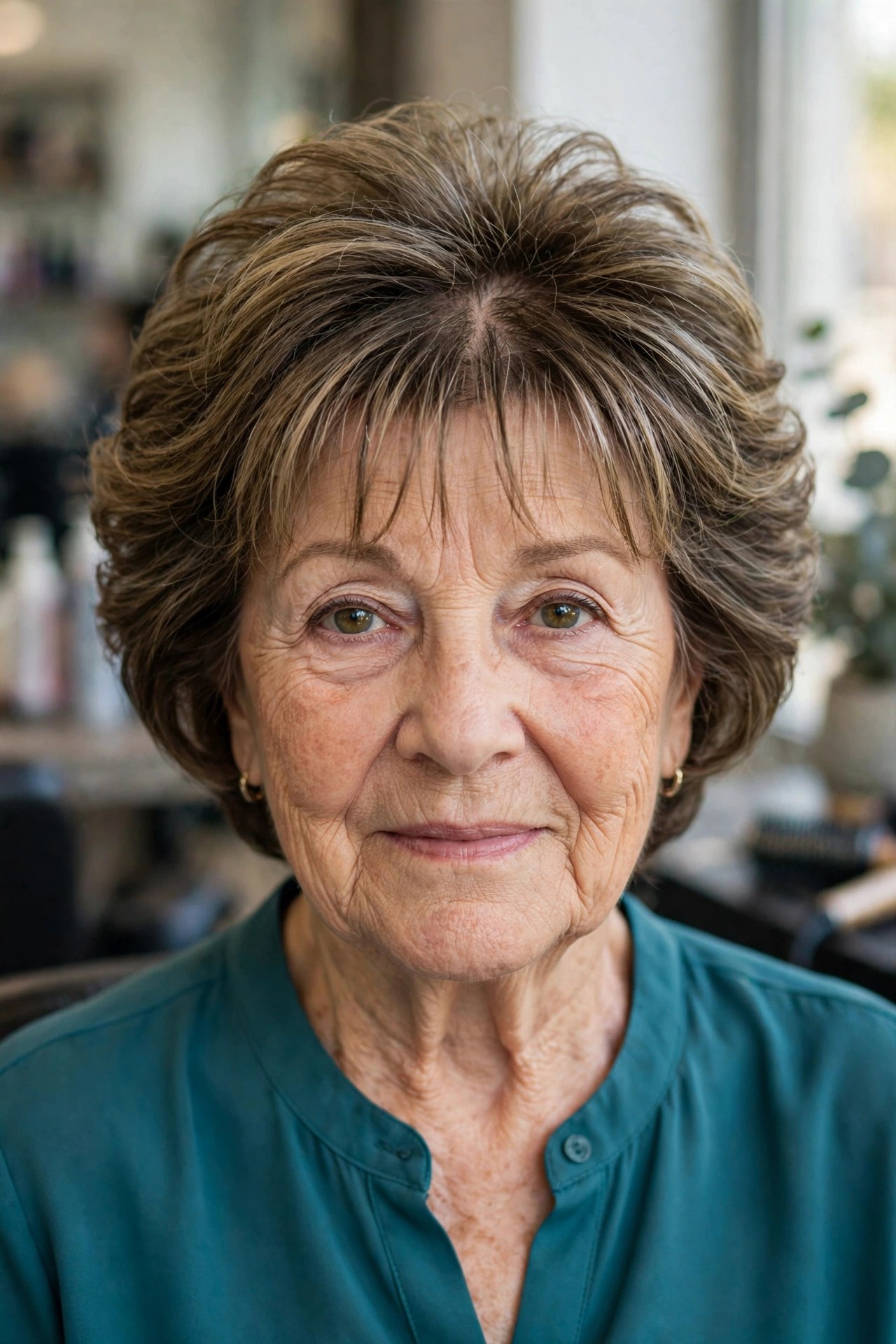
This fringe splits the difference — literally. The wispy bangs are parted softly in the middle, with the sheerest strands falling at the center of the forehead and slightly longer pieces at each side, over a full, voluminous layered cut. The small center opening keeps the look light and modern, while the strands on either side still veil the forehead where lines tend to start. It is a forgiving shape for a strong hairline or a center cowlick, because the part works with both instead of fighting them.
Volume at the crown is this style’s partner: if the top falls flat, the parted fringe reads thin, so build lift at the roots with a root-boosting brush or spray while drying, and keep conditioner off the crown area. Dry the fringe by blowing it forward first and only then opening the part with your fingers — parting it while soaking wet tends to make the center gap wider than intended by the time it dries.

18. Soft Bangs with a Wash-and-Go Gray Crop
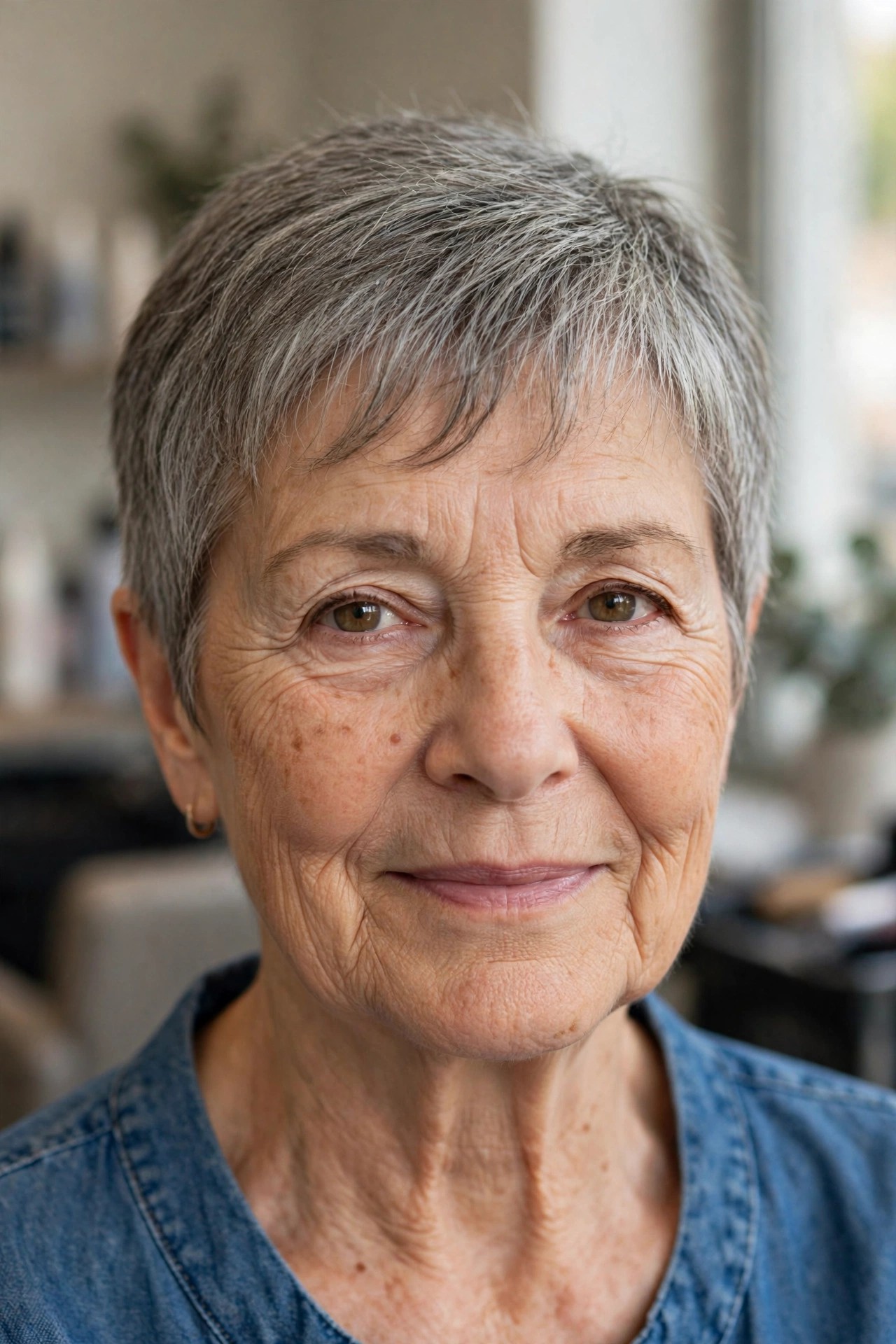
Some fringes are styled; this one is simply cut well and left alone. The crop is short, even, and shaped to follow the head, and the soft bangs fall naturally across the forehead with a slightly uneven, lived-in edge. On natural gray it is an honest, easy style: the fringe softens the forehead and frames the eyes, and because nothing is forced flat or smooth, the texture that gray hair develops with age becomes part of the charm rather than a problem to solve.
The maintenance is entirely in the cutting schedule — every five to six weeks keeps the edge of the fringe where it belongs, because a natural fringe that grows past the brows quickly starts to separate and annoy. Day to day, this cut should need nothing beyond washing, a towel, and perhaps a little dry shampoo at the front on a humid day. It is the style to choose when you want bangs’ softening effect without adopting a styling routine to go with it.

19. Wispy Bangs with Long Layered Hair
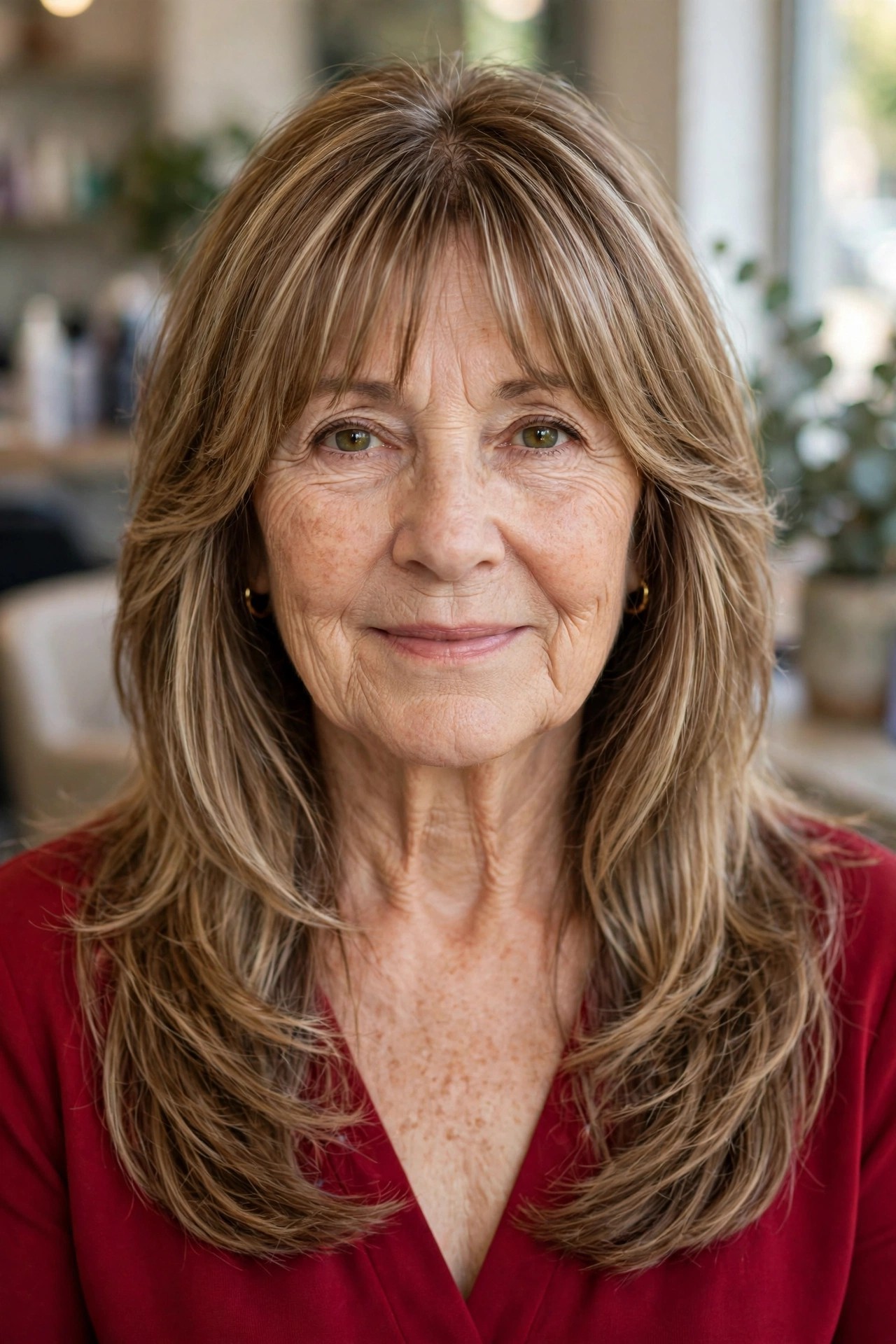
Long hair after 60 does not drag the face down when the front is handled properly, and a wispy fringe is the handling. The bangs are sheer and light — just enough to veil the forehead and reset the proportions of a longer style — while long layers through the lengths remove the heaviness that makes long hair pull features downward. The contrast between the delicate fringe and the flowing lengths is fresh rather than severe, especially with highlights woven through the front.
Keep the fringe the lightest element: if it is cut too thick, it competes with the length and the balance is lost, so ask for a small, shallow fringe section taken from close to the hairline. Long layered hair worn with bangs also benefits from silk or satin at night, since friction roughs up both the fringe and the front layers first. Trim the fringe little and often, and the layers on the standard six-to-eight-week cycle.
20. Gentle Side Bangs with a French Bob
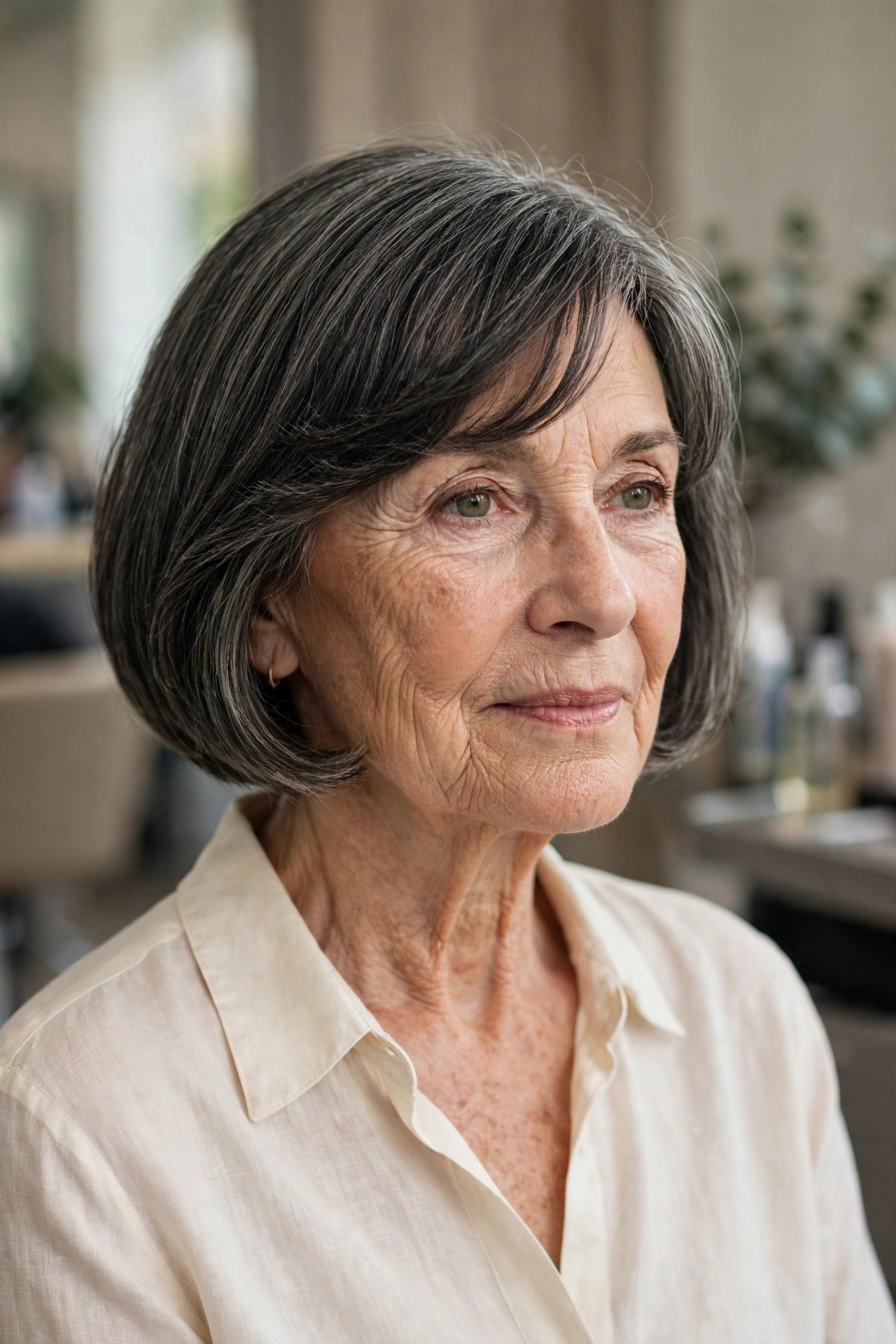
The French bob sits at the jaw, curves slightly under, and traditionally pairs with a soft fringe — here, gentle side bangs that sweep low across the forehead and tuck toward one cheek. It is the most polished silhouette in this guide: the jaw-length outline gives structure to softer jawlines, while the low sweep of the fringe covers the forehead at its widest point and leads the eye diagonally down to the cheekbone. On dark gray hair the shine of a sleek bob makes the whole effect quietly elegant.
A French bob asks for smooth hair behavior, so this is the cut to choose if your hair is naturally straight to slightly wavy; strong curl will fight the outline daily. Dry it with a round brush rolling the ends under just at the finish, and direct the side bangs across while damp so they set in the sweep. Because the outline is precise, keep trims at five to six weeks — a French bob that has grown to chin length is still pretty, but it is no longer quite the same cut.
Recommended Products
These five cover the bangs routine: a volumizing mousse that keeps fine fringes from lying flat, the round brush every swept and curved fringe is dried with, a purple shampoo to keep silver bangs bright, a texturizing putty for wispy and choppy edges, and a hot-air styler that dries a curtain fringe in one pass.
Bangs Care Tips for Women Over 60
- ✅ Dry the bangs first, always. A fringe sets within minutes of washing. Dry it in its intended direction before the rest of the hair, or spend the day fighting it.
- ✅ Trim little and often. Most fringes need a tidy every 3–4 weeks, even when the rest of the cut goes 6–8. Many stylists tidy bangs free between appointments — ask.
- ✅ Keep the edge soft. Ask for point-cut, feathered ends rather than a scissored straight line; a soft edge is what makes bangs soften lines instead of adding one.
- ✅ Use dry shampoo at the fringe roots. Bangs touch forehead skin all day and pick up oil first. A light touch on day two restores separation without a full wash.
- ✅ Go easy on heavy products at the front. Oils and rich serums collapse a fine fringe into strings. Keep rich products for the lengths and ends.
- ✅ Protect bangs from heat. Fringe hair is dried daily and scorches first. Use heat protection and moderate settings, and brush-dry rather than ironing where you can.
- ✅ Train, do not force. A fringe dried in its direction while damp will hold it all day. One dried against its natural fall will fight back by noon.
- ✅ Bring your glasses to the appointment. Fringe length and sweep should be planned around your frames, especially brow-grazing and side-swept styles.
Frequently Asked Questions
Do bangs really make women over 60 look younger?
They can, when the fringe is soft. A wispy, feathered, or side-swept bang veils forehead lines, frames the eyes, and removes the hard horizontal of a fully exposed hairline, and together those effects read as younger and softer. What ages a fringe is weight and precision: a thick, blunt, too-short bang draws its own hard line across the forehead and can emphasize the lines below it. Every style in this guide is cut with a softened edge for exactly that reason.
Which bangs are best for fine or thinning hair after 60?
Sheer ones. Wispy, choppy, and lightly feathered fringes are cut from a small, shallow section of hair, so they never demand density you do not have, and their broken edges disguise a softening hairline instead of exposing it. Avoid thick blunt fringes on fine hair — they borrow too much hair from the top of the head and can make the crown look thinner. Ideas 1, 6, and 10 are built specifically for fine front hair.
How often do bangs need trimming?
Every three to four weeks for shaped fringes such as blunt, brow-grazing, arched, and curtain bangs, whose effect depends on landing at an exact point. Wispy and long face-framing bangs forgive five to six weeks. Many stylists offer a quick fringe tidy free of charge between full appointments, so it is always worth asking — a two-minute tidy is what keeps bangs looking intentional instead of overgrown.
Can I wear bangs if I wear glasses?
Yes, with two adjustments. Keep the fringe either clearly above the frames or long enough to sweep to the side — the awkward zone is bangs that rest exactly on the frame line and get pushed around all day. Side-swept and curtain bangs are the easiest partners for glasses, and brow-grazing styles work if they are cut with your frames on. Bring the glasses you wear most to your appointment so the stylist can plan around them.
Will bangs work on curly or wavy hair over 60?
Yes, provided they are cut for your texture. Curly bangs should be cut dry, curl by curl, and left longer than the target length because curls spring up as they dry. Wavy bangs are the most forgiving of all — a long side sweep that keeps its natural bend blends straight into wavy lengths. What does not work is cutting a fringe wet and straight-hair-short on curly hair; it will dry far shorter and tighter than planned.
What if I try bangs and do not like them?
Choose a low-commitment fringe first and the risk is small. Wispy bangs blend back into front layers within a few weeks, long face-framing bangs are effectively layers from day one, and curtain bangs can be parted and pinned back while they grow. Side parts, clips, and a soft headband carry any fringe through its grow-out gracefully. Starting sheer and slightly long — ideas 1 and 11 — means you can always cut more later, which is the right direction to travel.
The right fringe after 60 is never about hiding — it is about framing. Keep the edge soft, the length deliberate, and the shape matched to your face and your hair texture, and a set of bangs will do in one appointment what no cream can: move the focus to your eyes, soften the forehead, and make the whole cut look intentional. Start sheer if you are unsure, trim little and often, and let the fringe do the quiet work it is so good at.