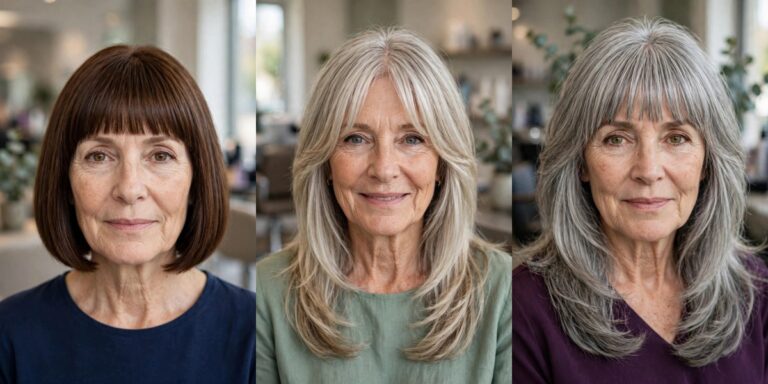
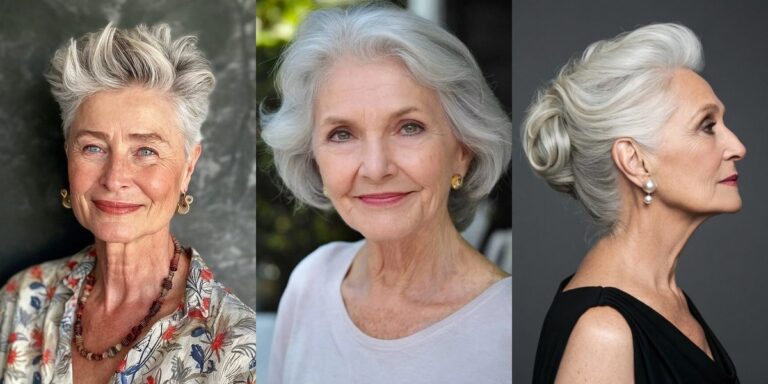
Hairstyles for Women Over 60 With Square Faces
This post contains affiliate links. As an Amazon associate, I earn from qualifying purchases. I only recommend products that are of high quality and that I would use myself.
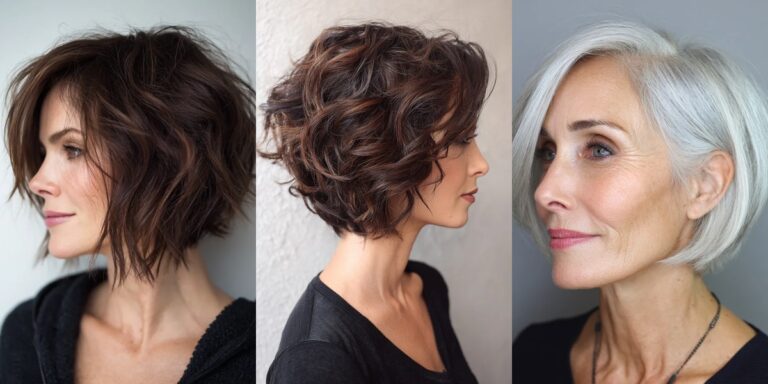
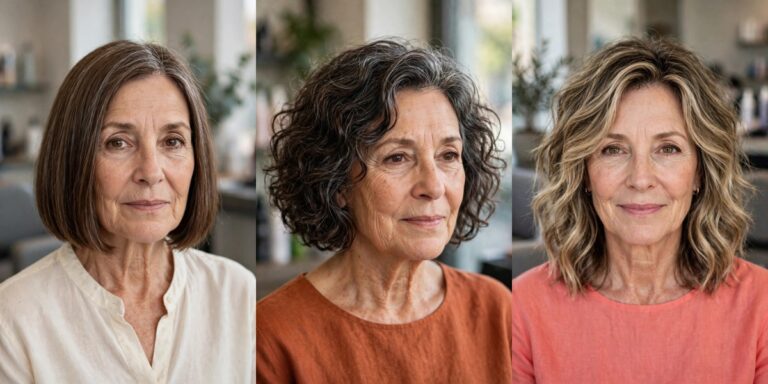
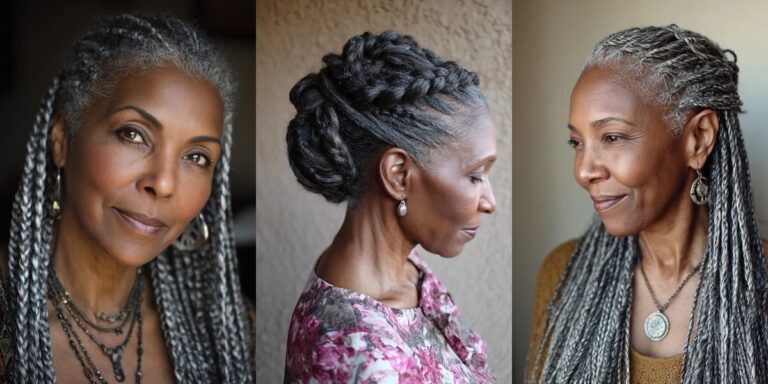
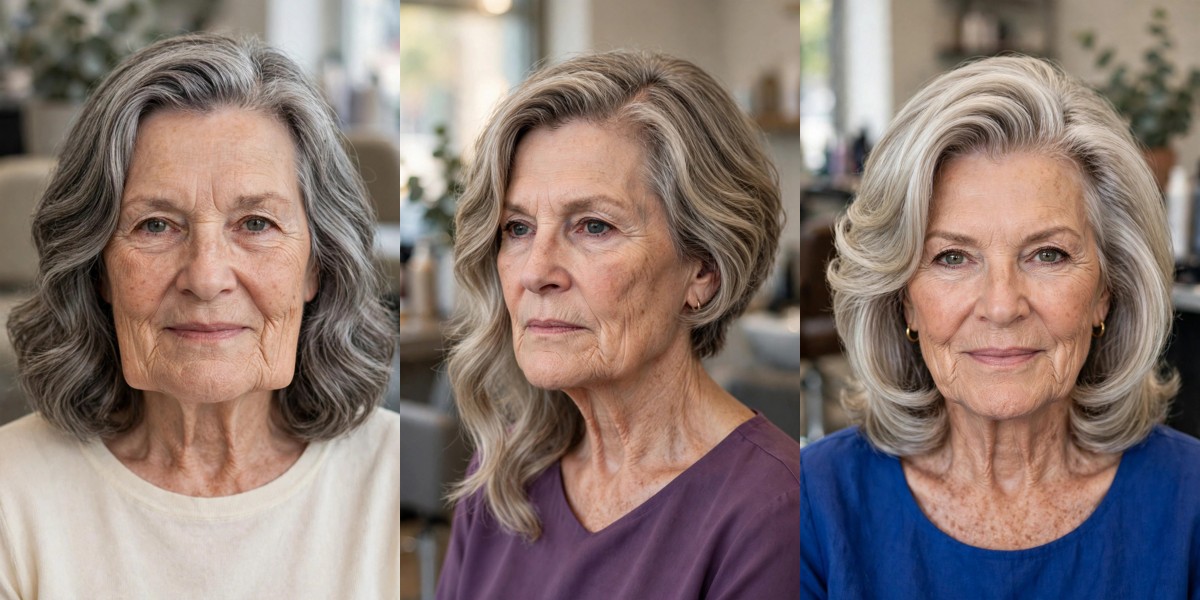
A square face is a strong face — a defined jaw, a broad forehead, and proportions that photograph with real presence. After 60, the goal is not to hide that strength but to soften its edges, and hair does that beautifully when it follows one simple rule: put curves where your face has angles. Soft waves around the jaw, layers that curve inward, side parts that draw a diagonal, and length that falls past the chin all blur the jawline just enough to make the whole face look gentler.
Below are 20 hairstyles for women over 60 with square faces, from a soft layered pixie to long waves to a polished blowout — each one explaining exactly how it softens the jaw, so you can take a principle to your stylist, not just a picture. If you are in your fifties, our sister guide to hairstyles for square faces over 50 that soften the jawline applies the same geometry at that age. And the styles to leave behind are just as clear: blunt chin-level bobs, straight-across fringes, and sleek center parts, which all draw straight lines that echo — and harden — a square jaw.
Table of Contents
- 1. Soft Layered Pixie with a Side-Swept Fringe
- 2. Wavy Lob Past the Chin with a Deep Side Part
- 3. Feathered Shoulder-Length Layers That Curve Inward
- 4. Long Layers Below the Collarbone with Curtain Bangs
- 5. Textured Crop with Crown Volume and a Wispy Fringe
- 6. Curly Bob That Falls Below the Jawline
- 7. Soft Shag with Rounded Layers and Side Bangs
- 8. Asymmetrical Wavy Bob, Longer in Front
- 9. Silver Shoulder Waves with a Side Part
- 10. Face-Framing Layers with Softly Flipped Ends
- 11. Wispy Bangs with a Layered Bob Past the Chin
- 12. Voluminous Curls at Shoulder Length
- 13. Layered Pixie-Bob with a Long Side Sweep
- 14. Long Gentle Waves with Layers Starting Below the Chin
- 15. Rounded A-Line Bob with Curved-Under Ends
- 16. Feathered Bob with Jaw-Skimming Soft Curls
- 17. Medium Shaggy Waves with a Curtain Fringe
- 18. Tapered Cut with Soft Waves and Volume on Top
- 19. Half-Up Waves with Loose Face-Framing Tendrils
- 20. Layered Blowout with Inward-Curving Ends
- Recommended Products
- FAQs
- Want short hair? Keep the interest on top — the layered pixie (idea 1), textured crop (idea 5) and tapered cut (idea 18) soften by lifting the eye away from the jaw.
- Love a bob? Only past the chin and curved — ideas 6, 11, 15 and 16. The blunt chin-level bob is the one shape to skip.
- Keeping your length? Layers must start below the chin (ideas 4 and 14) and waves do the softening.
- Broad forehead too? A side sweep or wispy fringe (ideas 1, 11 and 13) breaks the width at the top of the face.
- Curly hair? Let the curls fall below the jaw (ideas 6 and 12) — curves are your built-in softener.
- Lowest maintenance? The shag family (ideas 7 and 17) grows out kindly and styles in minutes.
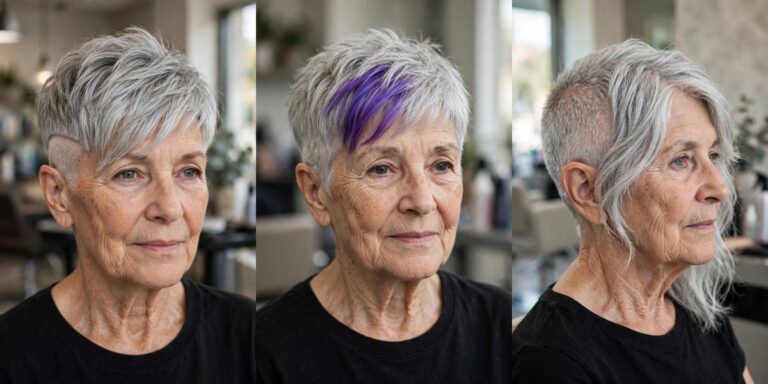
1. Soft Layered Pixie with a Side-Swept Fringe
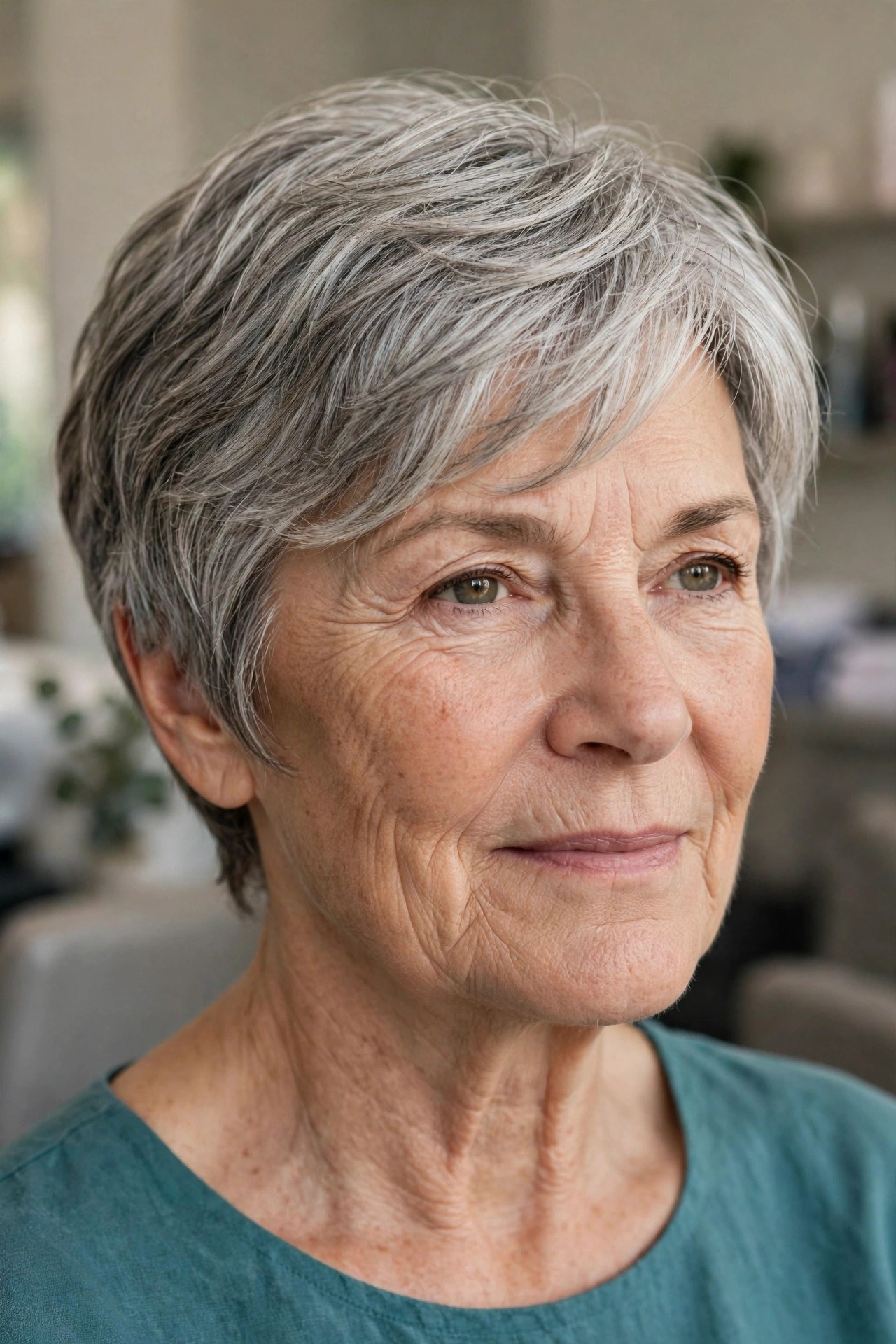
A square jaw does not rule out short hair — it rules out short hair with hard edges. This pixie keeps its layers long and soft, and the fringe is cut to sweep diagonally across the forehead rather than sit in a straight line. That diagonal matters: it breaks up the forehead’s width at the top of the face, while the feathery layers around the ears stop well above the jaw, so nothing widens the strongest part of your face.
Ask your stylist to keep the top layers piecey but not spiky, and to leave the fringe long enough to tuck behind one ear on days you want it off your face. At home, a fingertip of texturizing putty worked through dry hair is the whole routine — pinch the fringe into its sweep and let the rest fall naturally. Pixies need a tidy-up every four to five weeks to keep that softness from growing into bulk at the sides.


2. Wavy Lob Past the Chin with a Deep Side Part
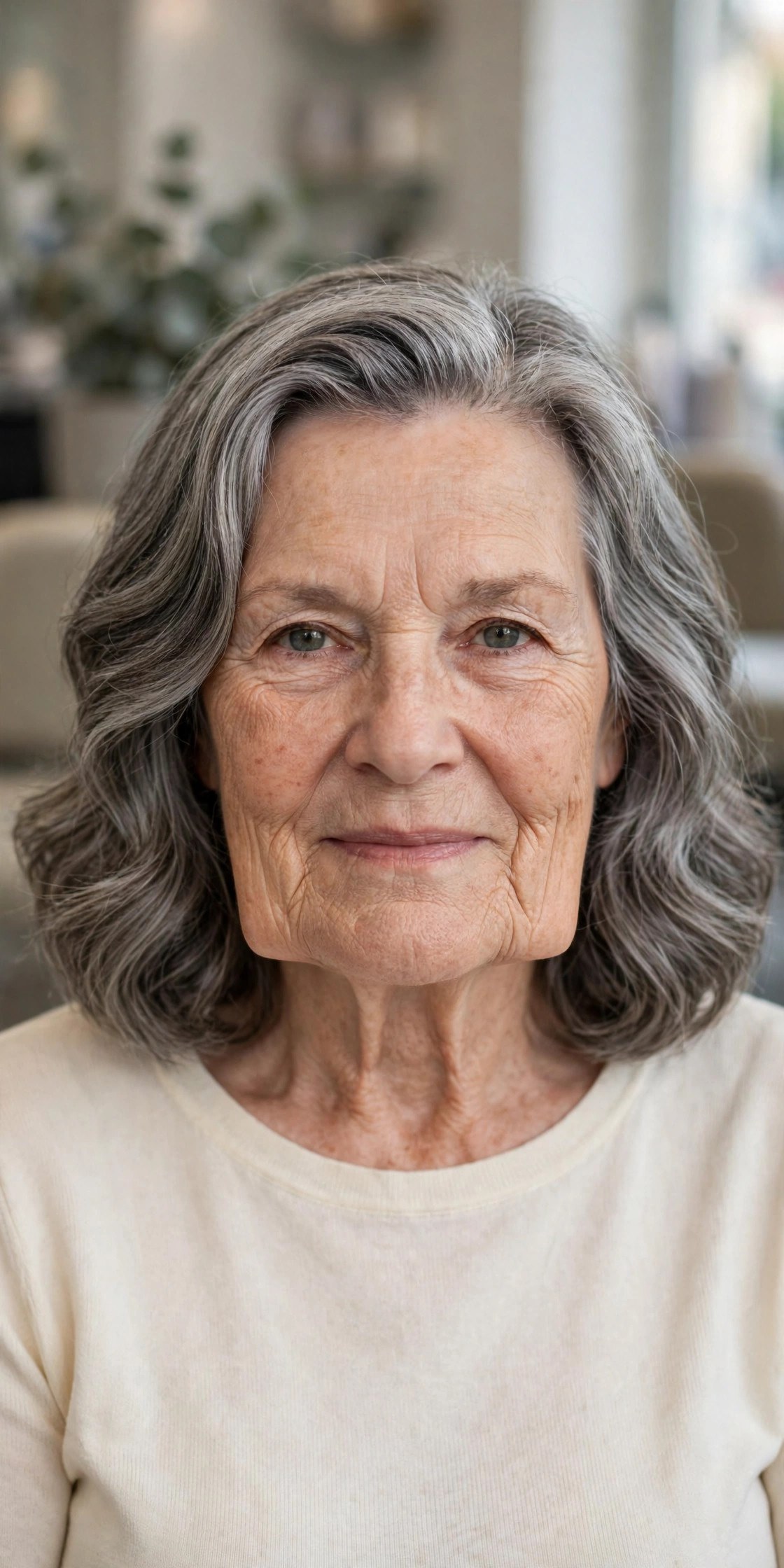
If one cut in this list deserves the word reliable, it is this one. The lob falls to the collarbone — safely past the jaw — and loose waves curve around the lower face, putting soft bends exactly where your face has straight lines. Curves against angles is the whole softening secret, and a deep side part adds the second trick: it replaces the face’s symmetry with a long diagonal sweep, so the eye travels down instead of across.
Be firm about the length at the salon: the moment a lob creeps up to chin level, it starts underlining the jaw instead of softening it. Form the waves with a large barrel, alternating directions, and rake them open with your fingers rather than a brush. A volumizing mousse at the roots of the part keeps the sweep lifted so it does not collapse flat against the forehead by afternoon.


3. Feathered Shoulder-Length Layers That Curve Inward
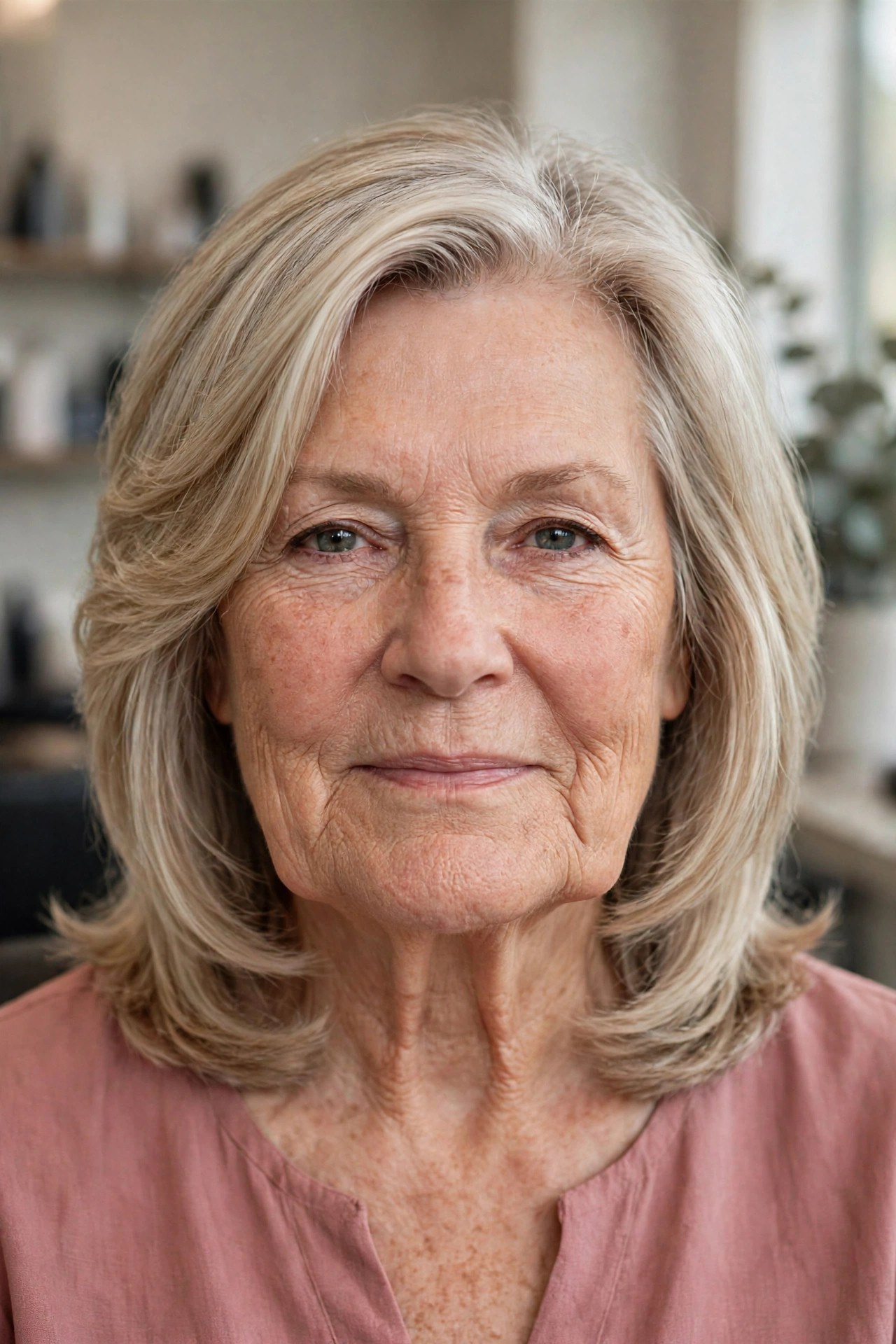
Feathering is a gift to a square face when the feathers are directed inward. Here the layers are brushed toward the face and their ends curve gently under, wrapping the jaw in a soft C-shape on each side. Instead of the jawline being the widest, hardest line in view, it is half-hidden inside a curve — and the face reads rounder and softer without losing its structure.
This shape flatters women whose hair has lost some density, because feathered ends look intentional and airy rather than thin. Dry it with a round brush, rolling each front section toward your chin and letting it cool in that curve before you move on. If your mornings are rushed, the shoulder length also pulls back neatly, and the front feathers left loose keep the softening frame in place.


4. Long Layers Below the Collarbone with Curtain Bangs
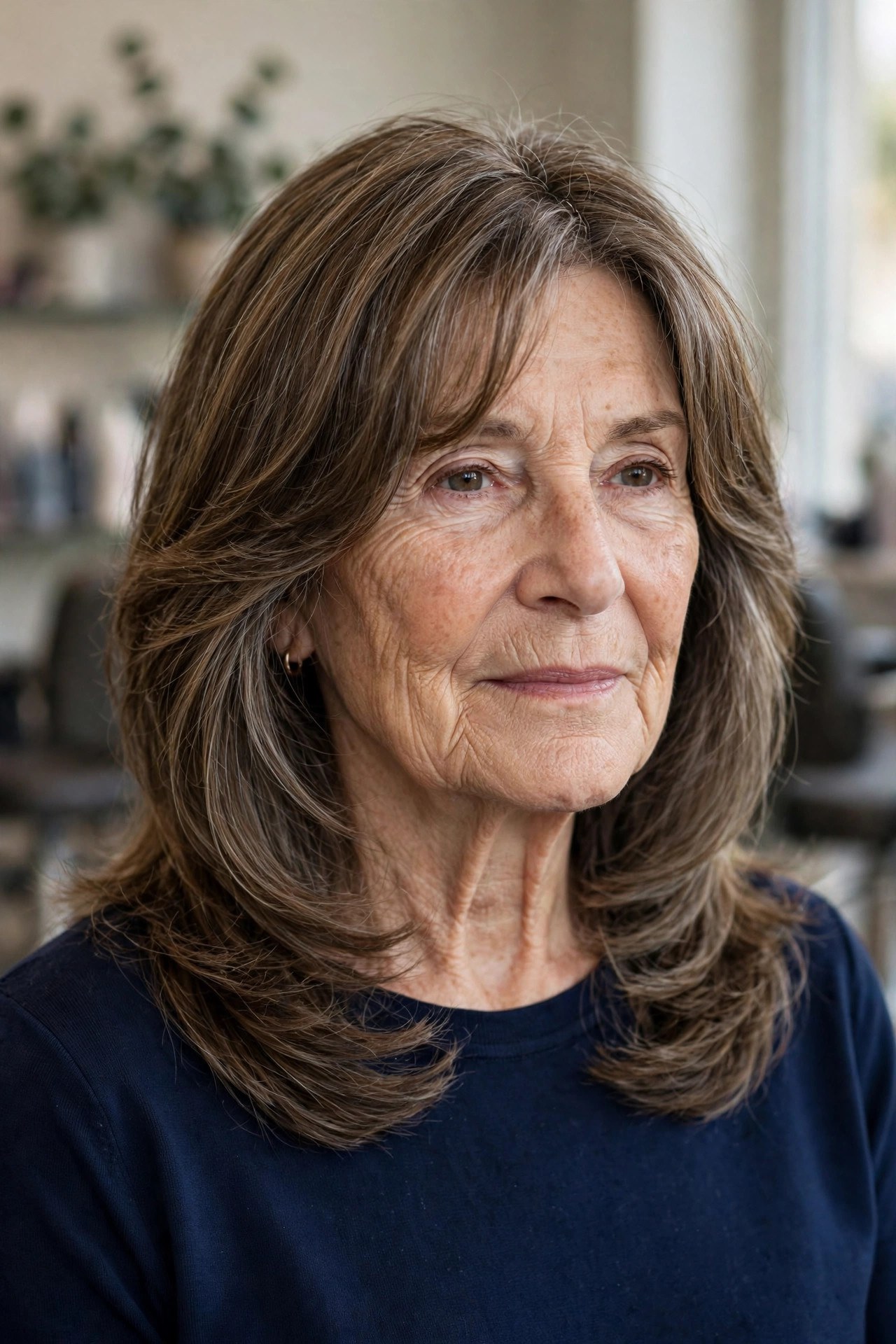
Length itself softens a square face, because hair that falls well past the jaw pulls the eye downward and lends the face some of its length. The curtain bangs complete the geometry at the top: they open softly in the middle and sweep out to the cheekbones, narrowing the look of a broad forehead while the long layers handle the jaw. Nothing in this cut stops at jaw level — that is the rule to give your stylist, word for word.
Curtain bangs are also the kindest fringe to grow out; in a few weeks they simply become longer face-framing layers. Keep the first layer starting below the chin, condition the ends generously since they are your oldest hair, and sleep on a satin pillowcase so the long front pieces stay smooth instead of frizzing outward at the cheeks.


5. Textured Crop with Crown Volume and a Wispy Fringe
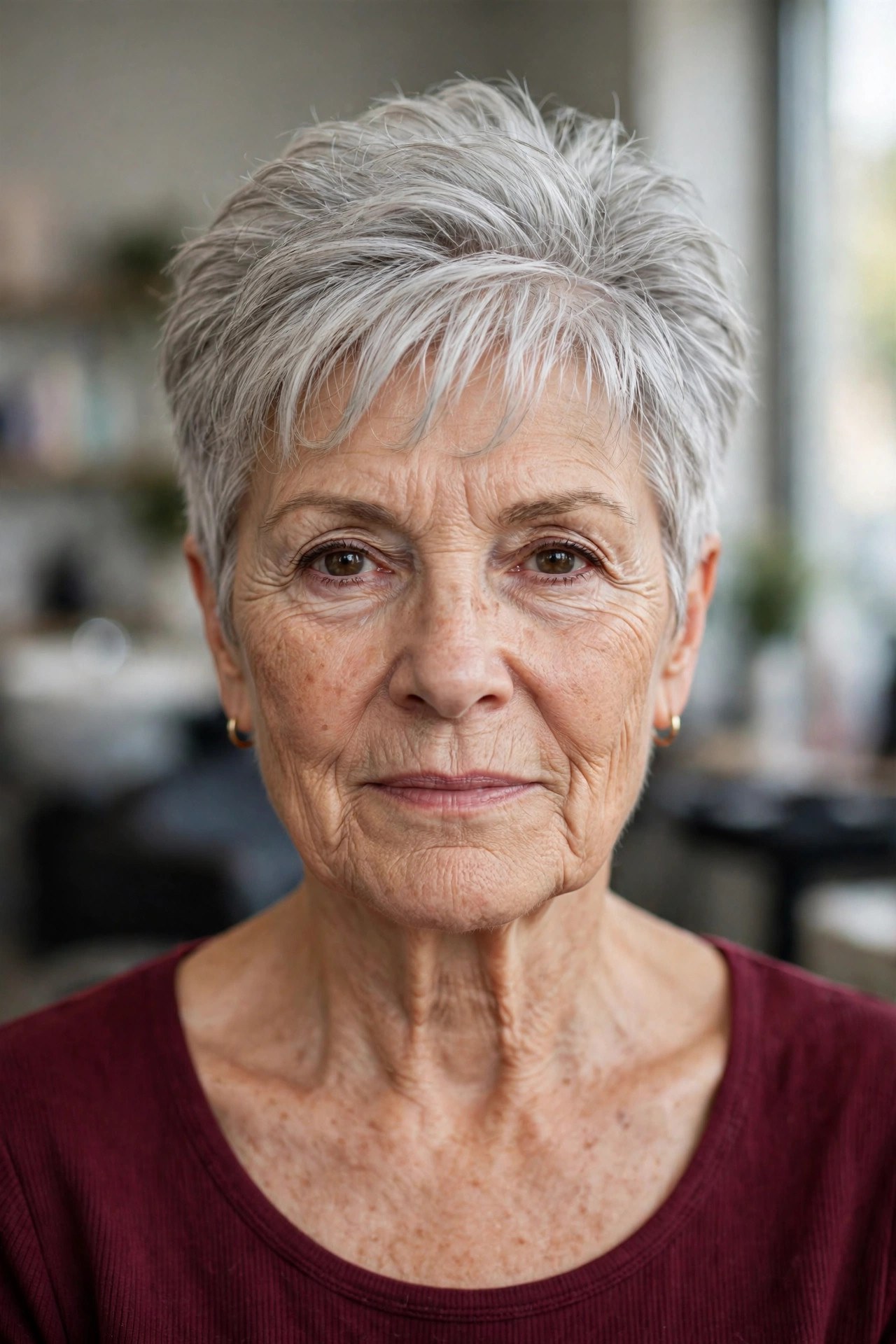
This crop uses height as its softener. The sides are kept close and quiet, the top is left textured and full, and a wispy, see-through fringe skims the forehead. With the volume placed above the face rather than beside it, the square proportions balance out — the jaw no longer dominates, because the eye is drawn up to the lively texture on top first.
It is an especially good answer for fine or thinning hair, since a short crop makes every strand count and the wispy fringe disguises a sparse hairline better than a heavy one would. Work mousse into the roots only, dry the top up and forward with your fingers, and finish by breaking the fringe apart with a tiny amount of putty. Heavy products collapse this cut, so keep everything light.
Every tip in this article depends on your face shape — a round face, for example, wants height and length rather than jaw softening. Try our free Face Shape Finder to confirm your face shape in under a minute, then come back and choose with confidence.
6. Curly Bob That Falls Below the Jawline
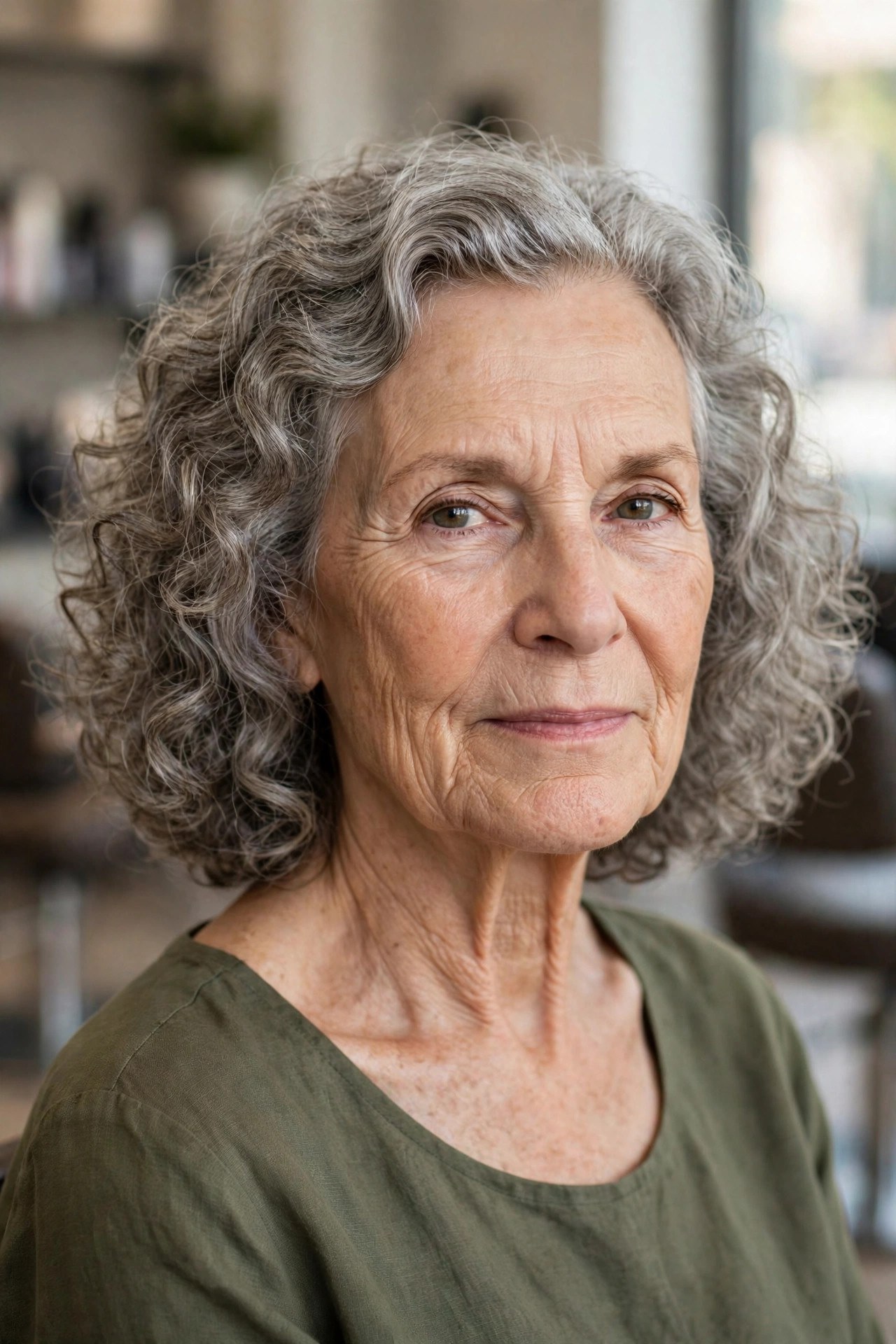
Natural curl is a square face’s built-in softener — every curl is a curve — as long as the length is right. This bob lets curls fall below the jawline, so the roundest, bounciest part of the hair sits under the jaw rather than springing out beside it. Worn with a side part, the curls frame the face in soft spirals and the strong jaw simply becomes one curve among many.
The cutting method matters more than the styling: ask for a dry cut, curl by curl, so the length is judged in its natural state and no curl is accidentally shortened to jaw level when wet. Define with a curl cream on damp hair, scrunch, and do not touch it while it dries. Curly readers who want the opposite geometry lesson can compare our guide to hairstyles for round faces over 60, where curls are deliberately placed for height instead.


7. Soft Shag with Rounded Layers and Side Bangs
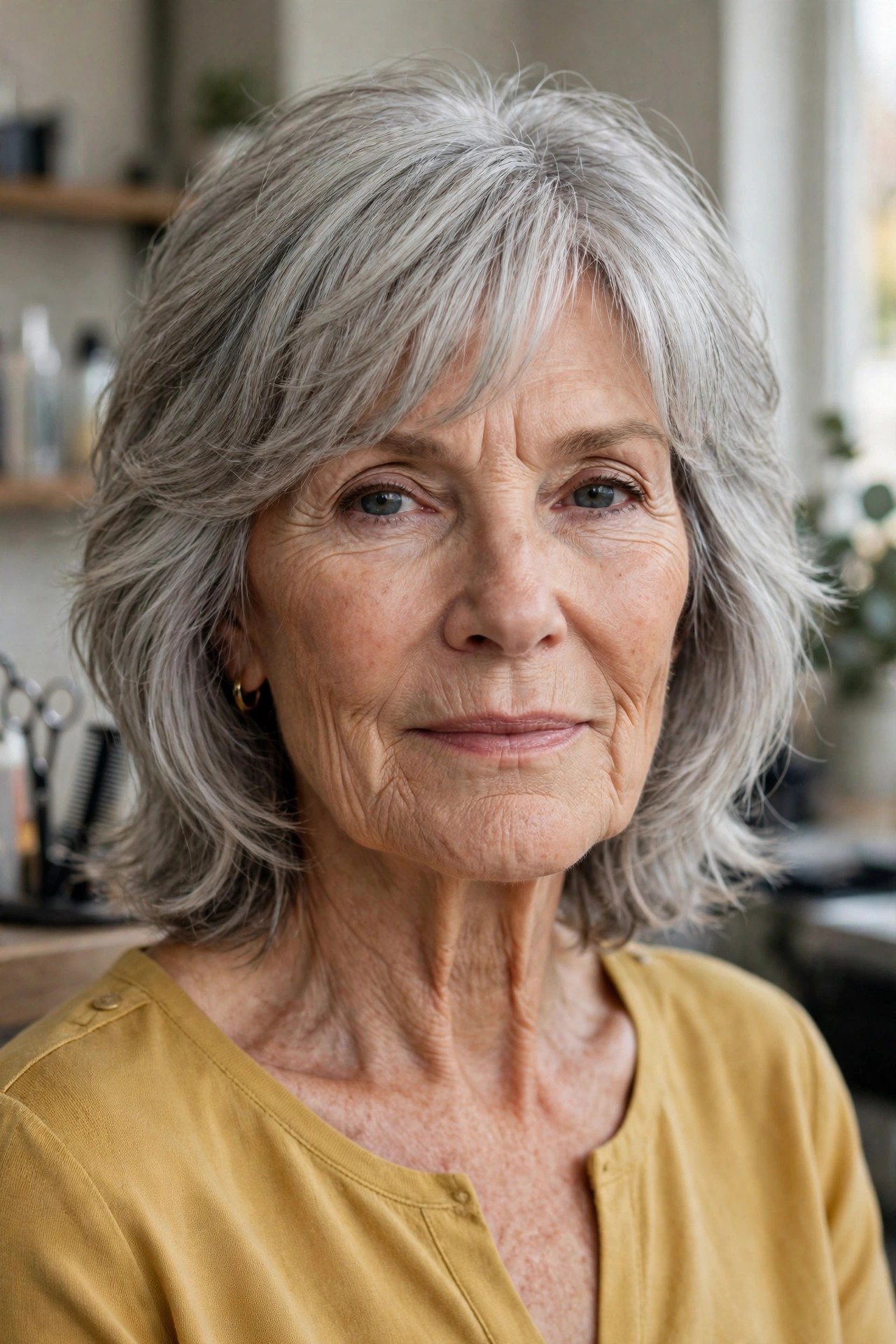
A shag softens by breaking every outline. Its rounded layers stack softly around the head, the ends are wispy rather than blunt, and a long side bang melts into the layers at the cheekbone. On a square face, that broken, curving outline is exactly what is needed — there is no single straight line anywhere for the jaw to echo, so the whole face looks gentler.
Ask for the layers to be rounded, not squared off, and for the side bang to stay long and blendable. The shag is forgiving to style: scrunch in a texture spray, rough-dry while lifting the roots, and let the ends stay piecey. It also grows out kindly over eight to ten weeks, which suits anyone who prefers fewer salon visits — just book a fringe tidy in between if the bang starts to separate awkwardly.

8. Asymmetrical Wavy Bob, Longer in Front
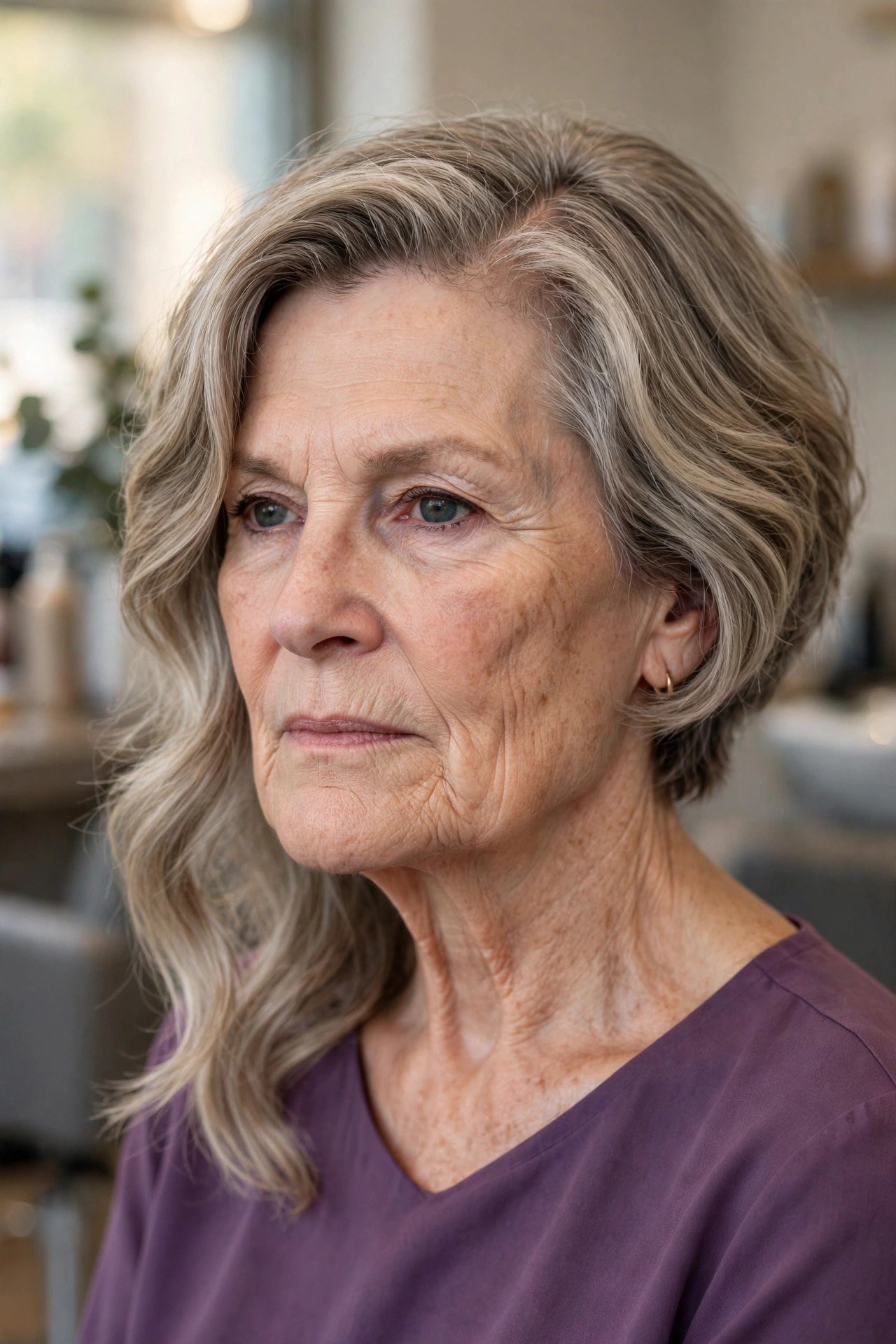
Symmetry is what makes a square face read square, so take the symmetry away. One side of this bob is shorter and tucked close; the other pours forward and down past the chin in a long, wavy point. The asymmetry gives the eye a diagonal to follow instead of a level jawline to measure, and the soft wave through the longer side doubles the effect with curves.
Keep the difference between the sides clear but civilized — about an inch to an inch and a half — so it reads as design, not accident. This is also a kind cut for photographs, where square faces often look wider than they do in life. If you have been comparing bob shapes generally, our classic guide to bob haircuts for women over 50 shows which bob lengths to borrow and which to leave on the page.


9. Silver Shoulder Waves with a Side Part
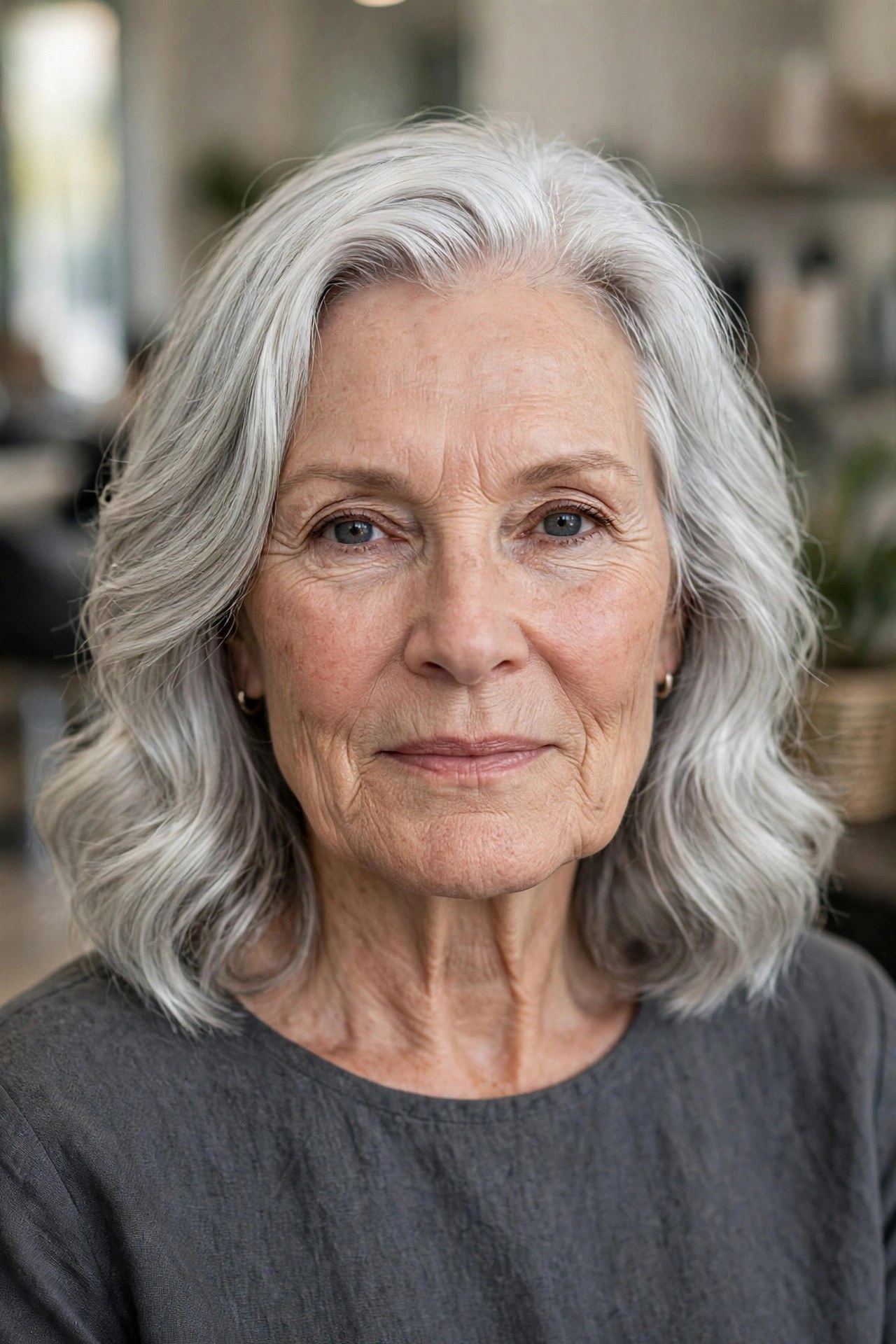
Silver hair and a square face are a handsome combination when the styling stays soft. These shoulder-length waves begin around the cheekbones and loosen toward the ends, wrapping the jaw in movement, while a side part sweeps the top diagonally. The brightness of silver actually helps: light, gleaming waves draw attention to the hair’s curves and away from the face’s angles.
Silver’s two housekeeping rules apply — a purple shampoo once a week keeps the waves bright instead of yellow, and a toning gloss restores the shine that makes waves look liquid rather than dry. Form the waves away from the face with a hot-air styler, then leave the last inch uncurled so the shape stays long. Avoid brushing the waves out fully; separate them with fingers to keep the bends defined.


10. Face-Framing Layers with Softly Flipped Ends
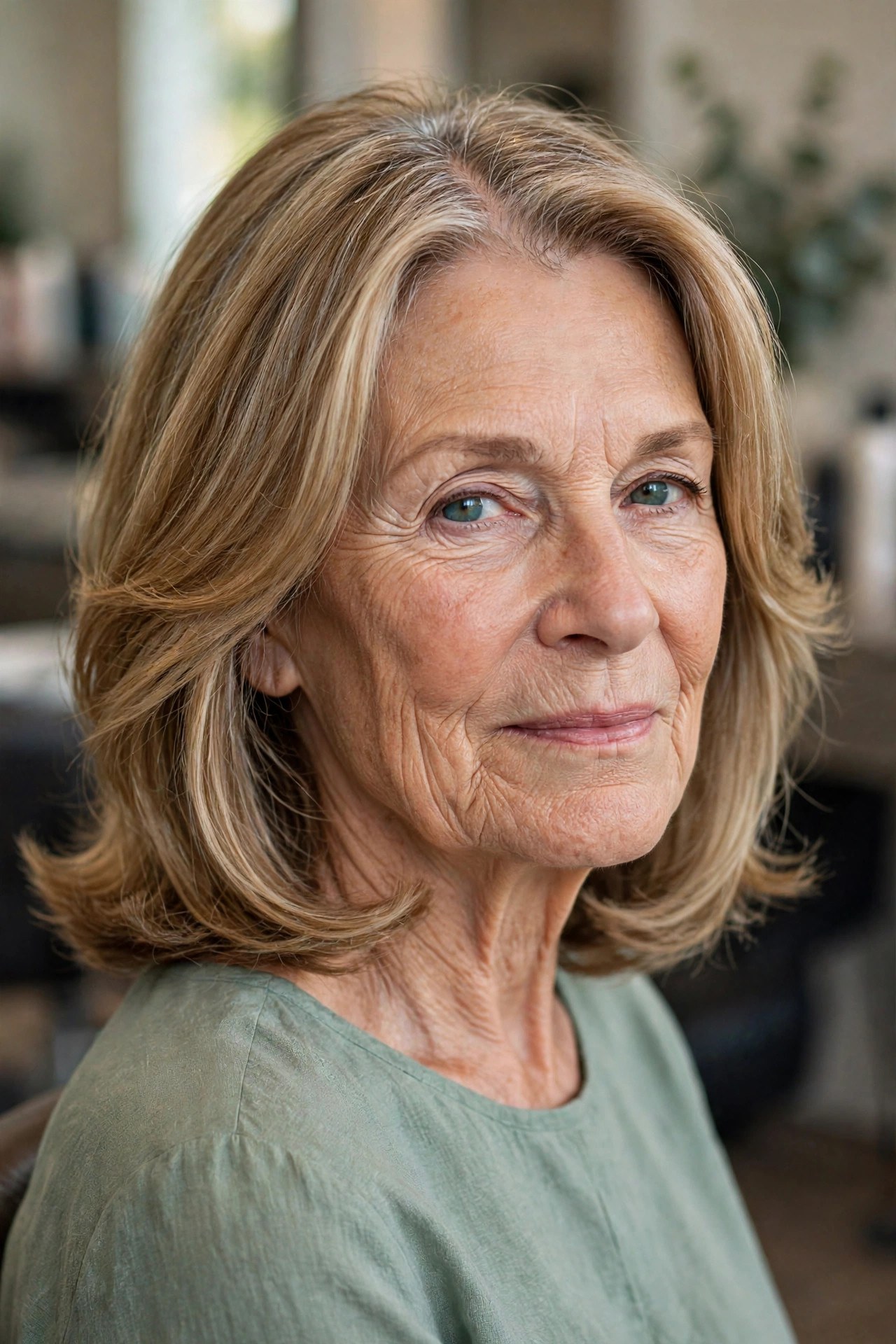
The flip is a small move with a large effect on a square face. The face-framing layers fall past the chin, then flick outward at the very ends, which leads the eye away from the jaw and outward into movement instead of letting it rest on the jaw’s corners. Worn with a side part, the longer side sweeps across the forehead and the whole outline feels lighter and more playful.
This cut suits medium hair that holds a bend, and it is refreshingly honest to style: blow-dry the front sections with a round brush, rolling the ends away from the face in the last few seconds. A light hairspray misted from a distance holds the flick without gluing it. If your hair is very fine, keep the layers longer and fewer — too many short layers will flip into frizz rather than a clean flick.

11. Wispy Bangs with a Layered Bob Past the Chin
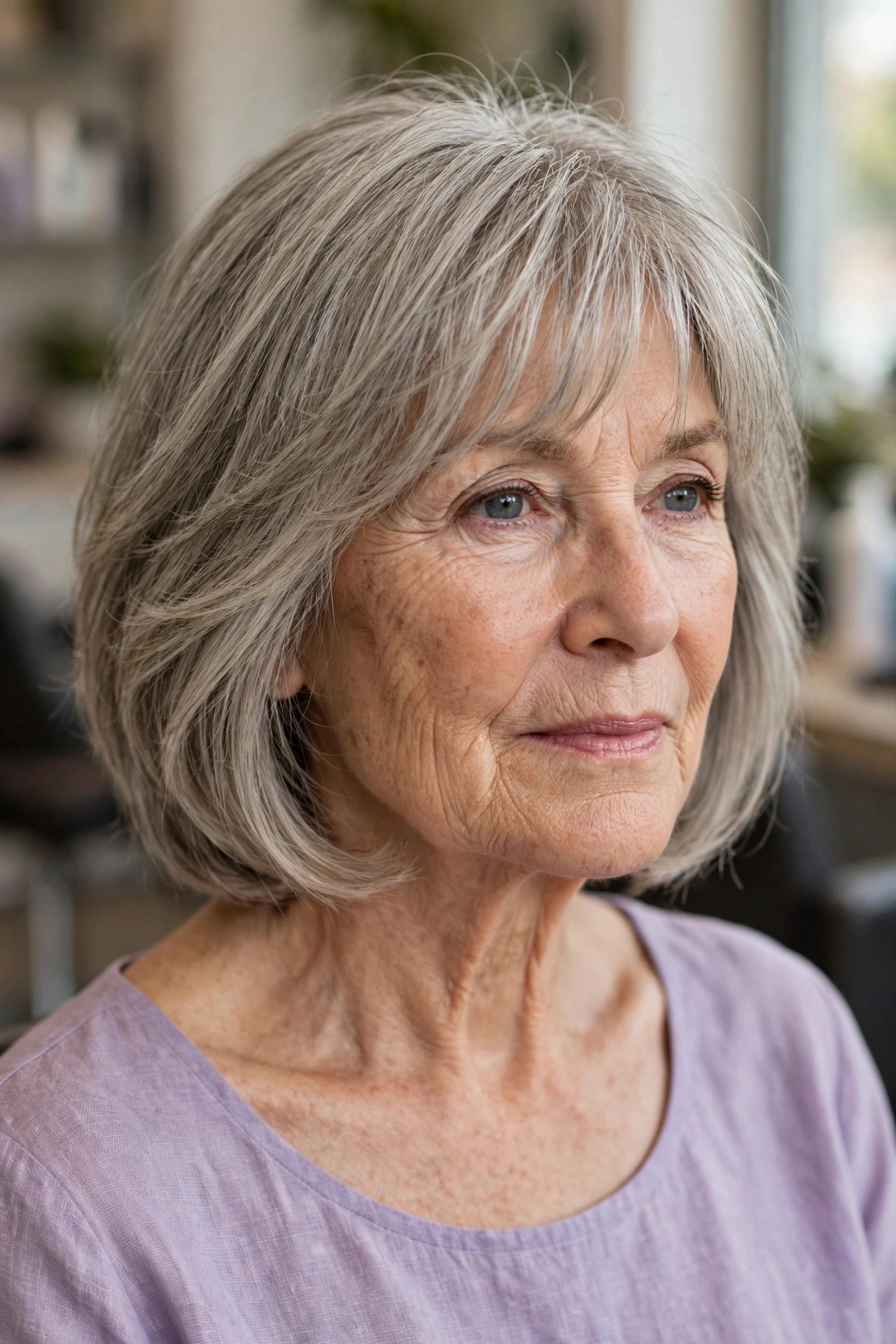
A wispy bang is the gentle alternative to the straight-across fringe a square face should avoid. Cut sheer and feathered, it softens a broad forehead without drawing a hard horizontal line across it, and it flows into a layered bob whose ends clear the chin and curve softly inward at the jaw. Forehead softened at the top, jaw softened at the bottom — the face in between looks balanced.
Tell your stylist the bang must stay wispy: you should almost be able to see through it, and it should be cut slightly longer at the sides so it blends into the bob. Dry the bang first, sweeping it side to side with the dryer nozzle while damp, because mature hair tends to keep the direction it dries in. A dusting of dry shampoo at the fringe roots on day two stops it clinging to the forehead.

12. Voluminous Curls at Shoulder Length
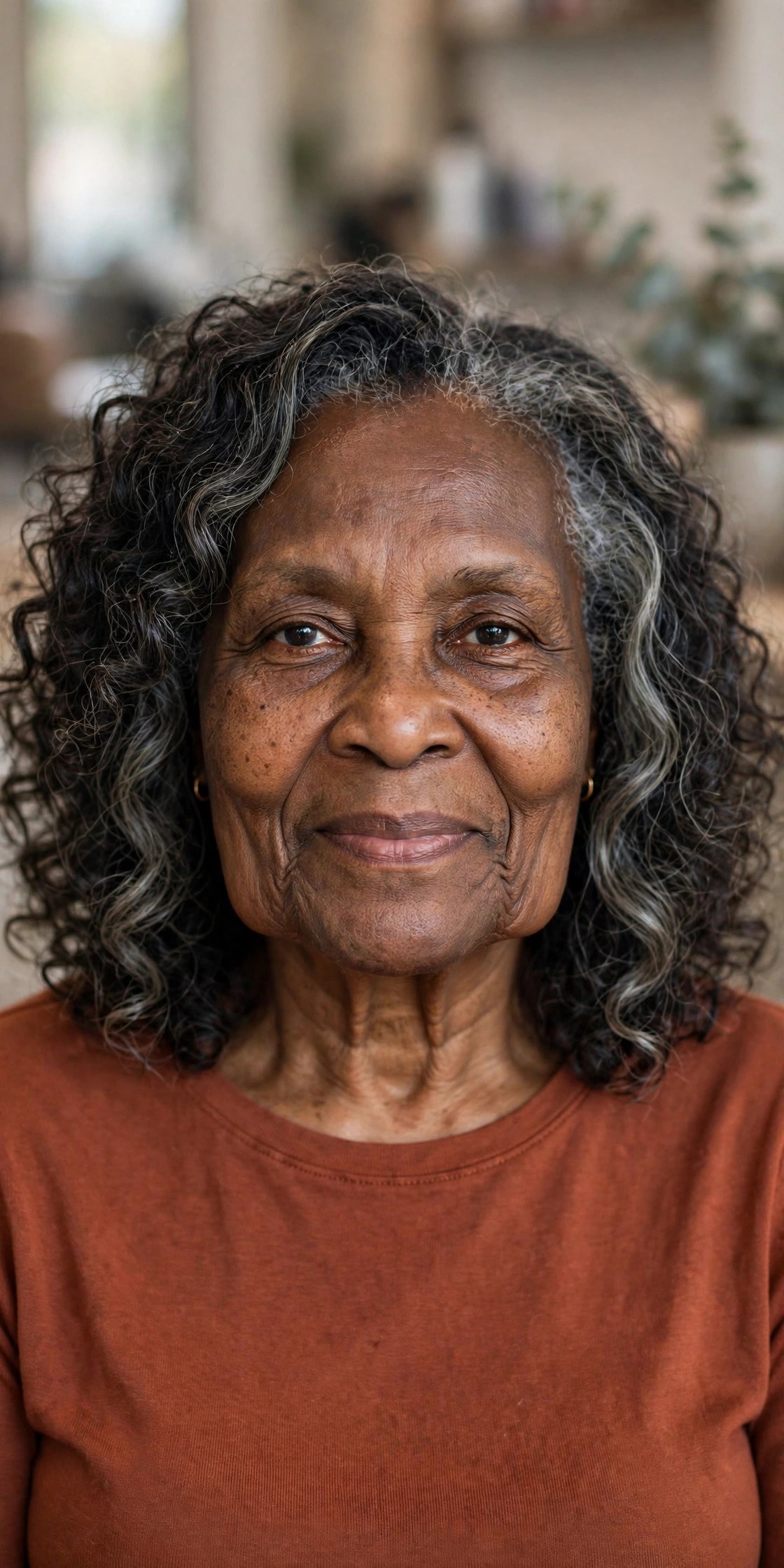
When curls are given shoulder length and real volume, they build a soft cloud around the face that a square jaw simply disappears into. The fullness sits at the sides and below the chin rather than at the jaw itself, the part is worn to the side, and gray streaks through the curls catch the light and add to the sense of movement. It is a joyful, unapologetic shape — softness by abundance.
Volume needs moisture first: work a rich curl smoothie through soaking-wet hair, then a gel cast if your curls frizz, and let everything dry undisturbed. Scrunch out any crunch once fully dry. At the salon, ask for shaping that removes bulk from directly beside the jaw while keeping the length — that one adjustment is what keeps big curls flattering instead of widening on a square face.


13. Layered Pixie-Bob with a Long Side Sweep
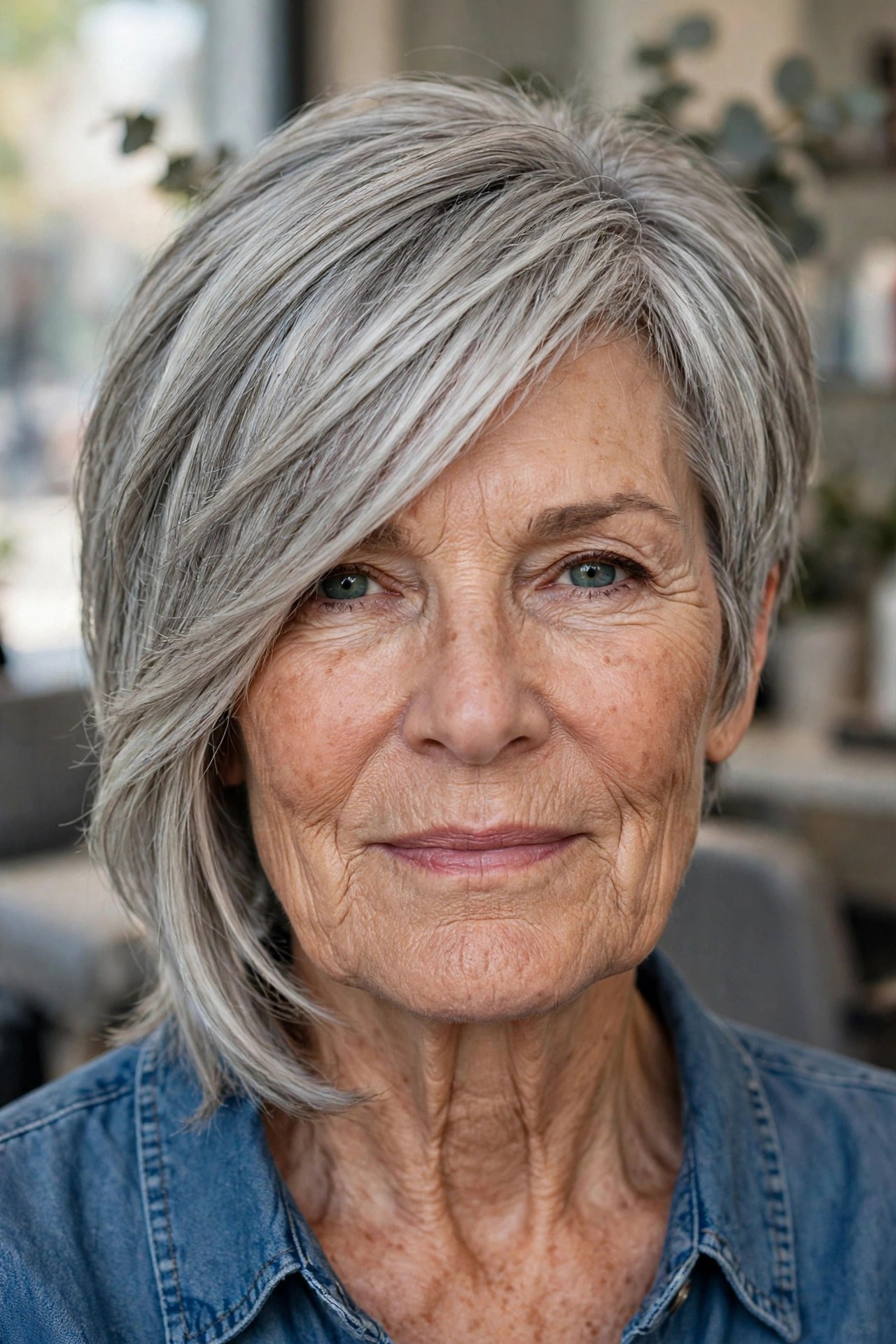
The pixie-bob is the diplomat of this list — longer and softer than a pixie, shorter and livelier than a bob. Its defining feature is the very long side sweep that falls diagonally across the forehead and down one side of the face past the cheekbone. That long diagonal does the softening work of a much longer cut, while the cropped back keeps the neck clean and the whole style easy.
It is a strong choice if your jaw is your most prominent feature and you want the eye led firmly upward to your eyes. Keep the sweep’s length when you book trims — growing it out ‘just a little shorter’ each visit quietly turns this into an ordinary bob. A root-lift spray on the heavy side, dried up and over, keeps the sweep airy rather than flat against the forehead.
14. Long Gentle Waves with Layers Starting Below the Chin
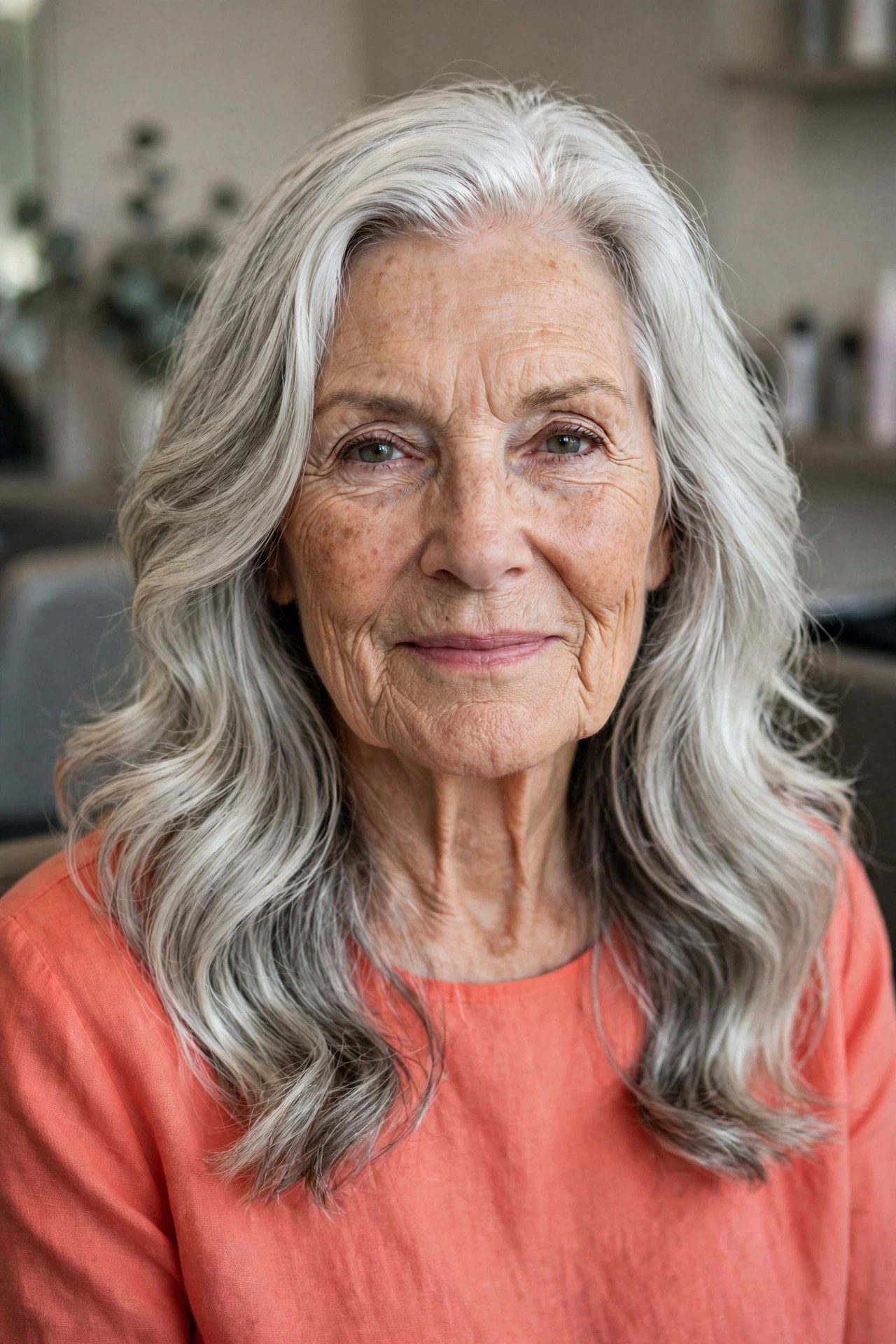
For women who love their length, this is the safest long formula for a square face: waves throughout, but every layer begins below the chin. Because no layer releases its volume at jaw level, the waves fall in long, soft curtains on either side, lengthening the face and covering the jaw’s corners in gentle bends. The side part finishes the job by breaking the forehead’s width.
Long hair over 60 asks for end care more than styling skill — trim little and often so the lowest layers stay healthy, and always use heat protection before forming waves, since older ends are fragile. A sea-salt spray scrunched through the lower half refreshes day-two waves in a minute. If the waves ever start to feel heavy, ask for internal layers that remove weight without shortening the outline.

15. Rounded A-Line Bob with Curved-Under Ends
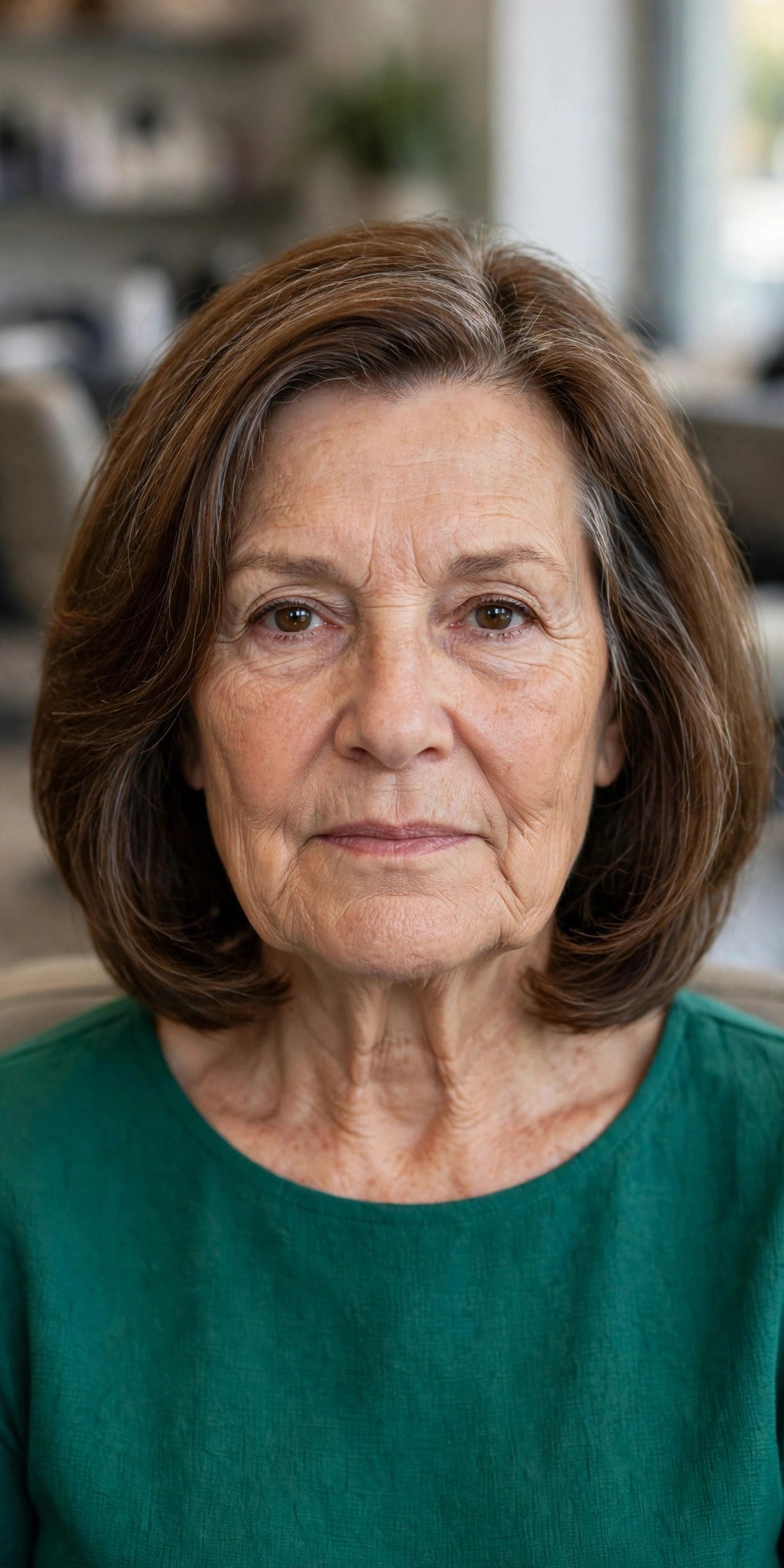
The A-line earns its place here only in its rounded, below-chin form. The back is cut shorter and softly stacked, the sides travel forward and down, and the front ends — falling well below the chin — curve under in a smooth arc. That arc is the point: instead of a blunt horizontal edge parked beside the jaw, the hair forms a rounded frame that makes the jaw inside it look narrower and softer.
Two salon instructions protect this cut: the front must stay below the chin, and the under-curve must be styled in, not ironed flat. A mini flat iron passed once over the surface, always over heat protection, keeps the front pieces sleek, and the curve is set with a round brush as you dry. Worn with a side part, the longer front side also sweeps diagonally, adding a second softening line.


16. Feathered Bob with Jaw-Skimming Soft Curls
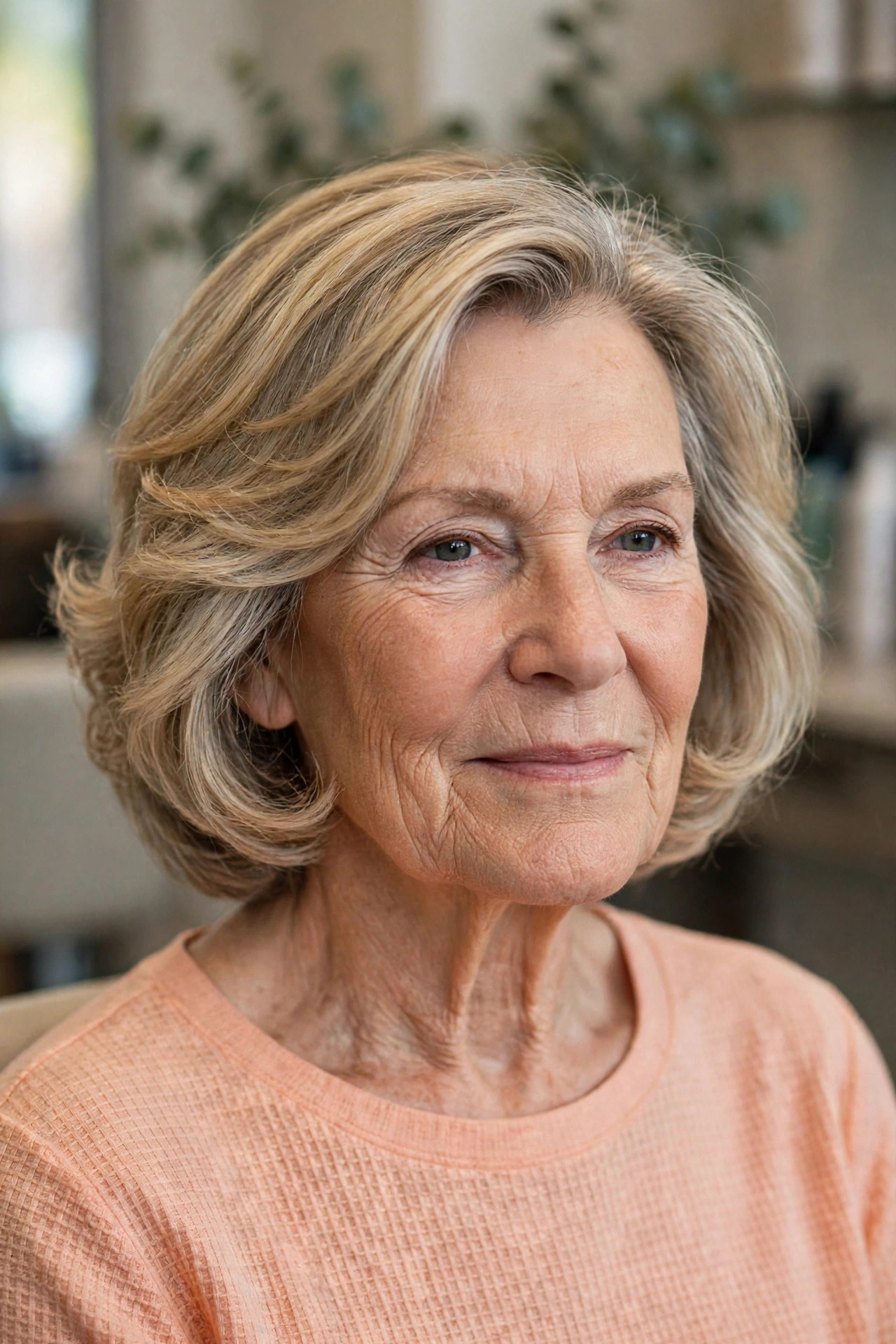
This bob lets soft curls do at the jaw what straight hair cannot: sit right beside it and still soften it. The feathered layers keep the shape light, and the ends are curled into loose, jaw-skimming bends that blur the jawline’s edge rather than framing it. With a side part lifting the crown, the overall read is romantic and gentle — a lovely option for occasions as well as everyday wear.
It flatters hair with a natural wave most, since the curls then form with a brush and dryer alone; straighter hair can use a hot-air brush to bend the ends under and outward alternately. Keep a shine serum for the feathered tips, which can look dry on gray-blended hair. One caution: if the curls tighten into a round halo at cheek level, the effect flips — ask for the curl to start low and stay loose.

17. Medium Shaggy Waves with a Curtain Fringe

Think of this as the relaxed cousin of idea 4: the same curtain fringe softening the forehead, but the lengths are shaggier, wavier, and deliberately less polished. The tousled waves fall past the chin in uneven, curving pieces, and that irregular outline is precisely what a structured, angular face needs — order softened by a little cheerful disorder.
Styling is scrunch-and-go: texture spray through damp hair, a twist of the front pieces away from the face, and air-drying or a diffuser if you own one. The curtain fringe should be dried first, swept to each side with your fingers, so it opens instead of parting in the middle and hanging straight. This cut tolerates a long grow-out, making it a kind pick for low-maintenance routines.
18. Tapered Cut with Soft Waves and Volume on Top
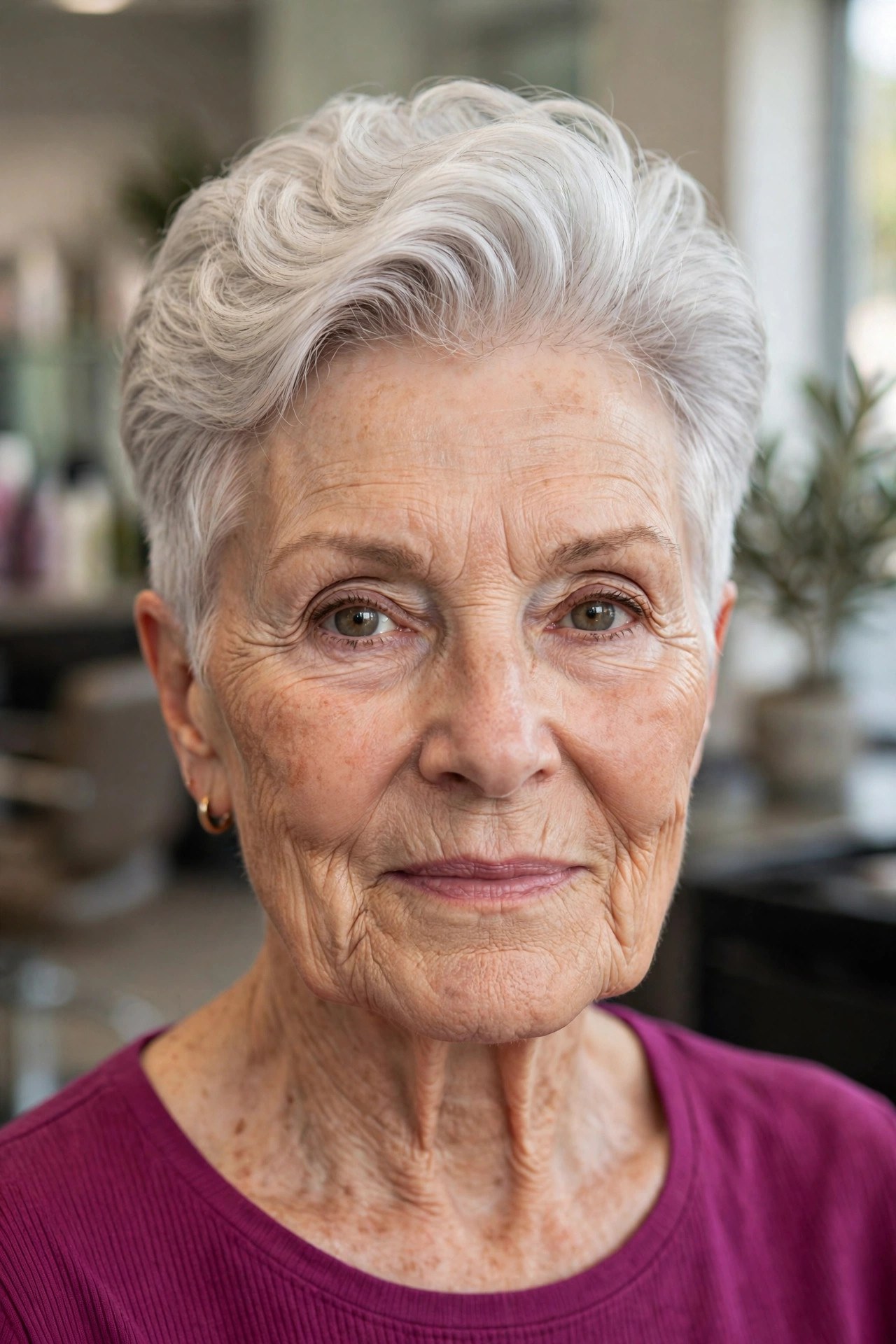
Here the softening strategy is subtraction: take nearly all the hair away from the jaw’s neighborhood, and put the interest on top. The sides are tapered close and neat, ending well above the jaw, while the top is left long enough to wear in soft, lifted waves. A square face framed this way looks balanced rather than strong-jawed, because the widest, softest part of the style sits at the crown.
This is one of the easiest cuts in the list to live with — a two-minute finger-style with mousse most mornings. It also showcases earrings and necklines beautifully, since the sides are clear. Keep the taper tight with trims every four weeks; once the sides grow out to jaw level and start to kick outward, the cut quietly stops doing its softening job.
19. Half-Up Waves with Loose Face-Framing Tendrils
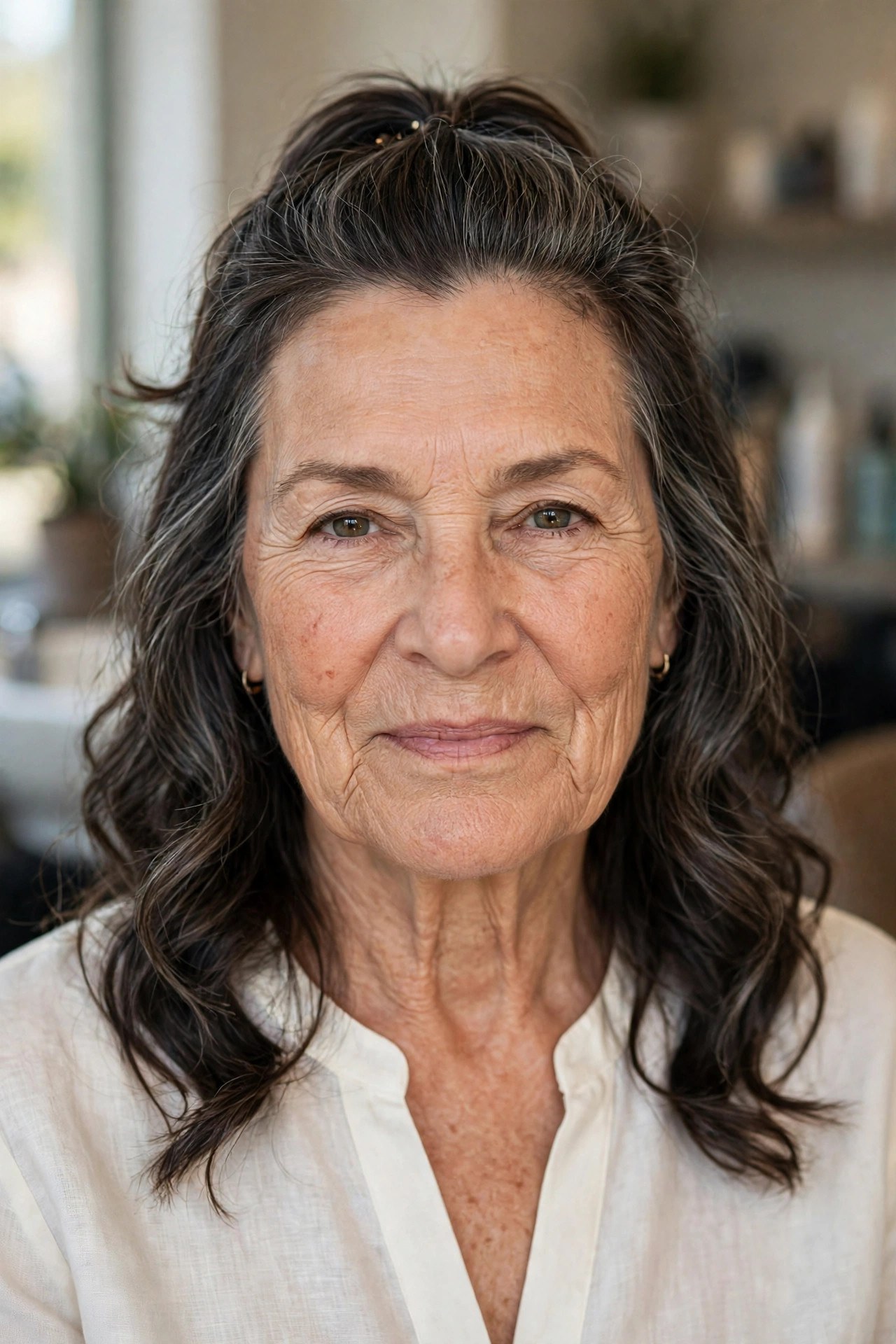
Not every softening style is a cut — this one is a way of wearing longer hair that square faces respond to beautifully. The top is gathered loosely half-up, which lifts the crown, and two soft tendrils are left free to curl down beside the jaw. Those tendrils are doing real work: they place a curve on each side of the jaw and break up its width, while the waves below add more softness still.
Keep the half-up section loose, never scraped back tightly — a severe pull-back exposes the full square outline you are trying to soften. Secure it with a flat claw clip worn high, and curl the tendrils away from the face so they arc outward at the ends. This is also a kind style for a bad-hair day or an event, since the gathered top hides flat roots and the face-framing pieces look deliberate.

20. Layered Blowout with Inward-Curving Ends
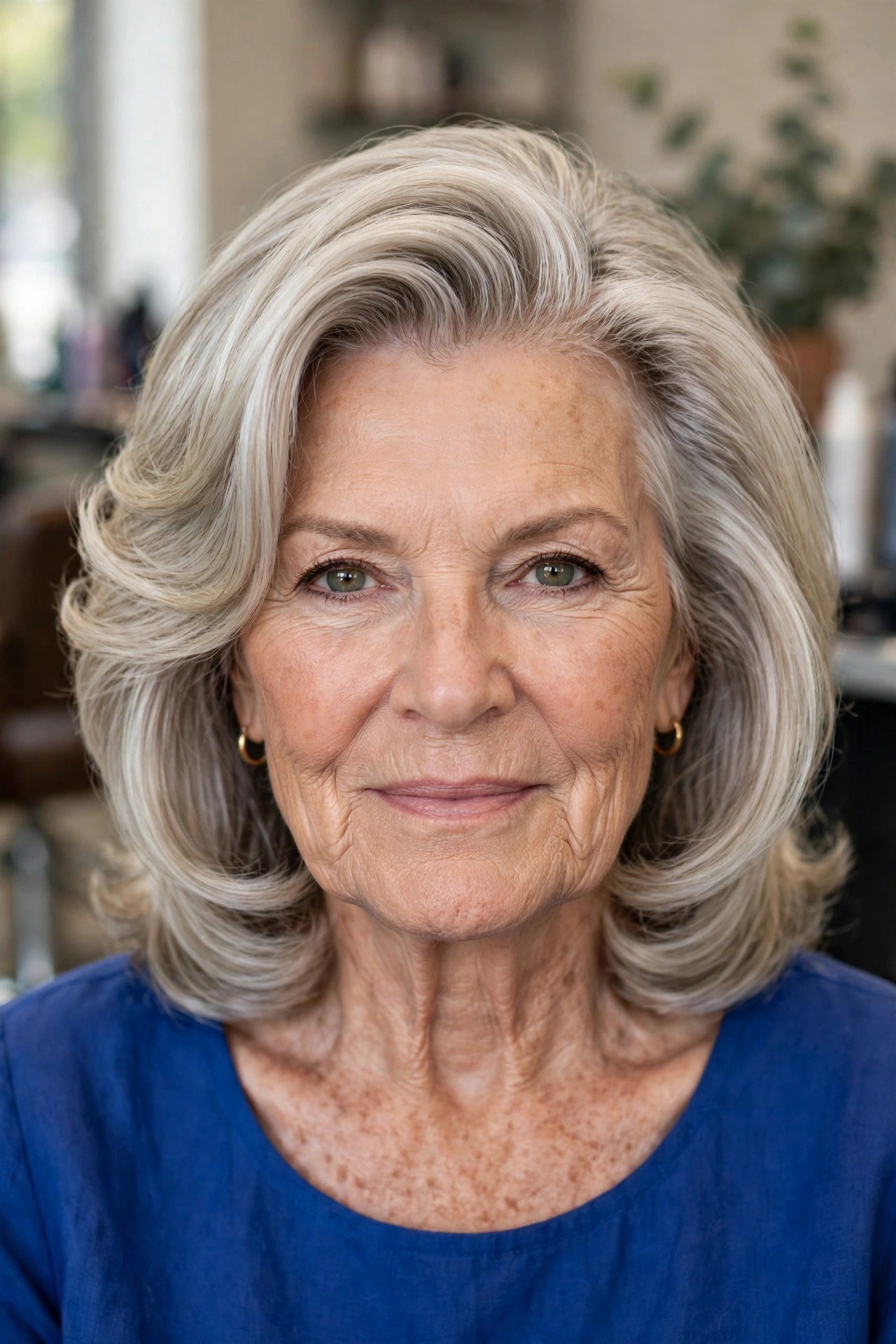
Finish with the polished classic: a shoulder-length blowout whose bouncy layers all curve inward, hugging the face in soft C-shapes that wrap and soften the jaw on both sides. The crown is lifted, the part is deep to the side, and the movement is all smooth curves — the opposite geometry of a square face, which is exactly why it works so elegantly.
The blowout is a technique as much as a cut: dry in sections with a large round brush, rolling each front section toward the chin and letting it cool in the curve, then finish the crown up and over for lift. Women who wear glasses will find this frame especially friendly — the inward curves sit neatly above the frames rather than fighting them, a pairing explored further in our guide to hairstyles for women over 60 with glasses. A satin pillowcase keeps the curves smooth overnight so day two needs only a root refresh.
Recommended Products
These six support the softening routine behind most of the cuts above: a volumizing mousse for side-part lift, the round brush that sets inward curves, a hot-air styler for waves and blowouts, a purple shampoo to keep silver waves bright, a texturizing putty for pixie tops, and a curl cream for the curly styles.
Care and Styling Tips for Softening a Square Jaw
- ✅ Put curves beside the jaw. Waves, curls and inward-curving ends belong at jaw level; straight, blunt edges do not.
- ✅ Part to the side. A deep side part draws a softening diagonal across the forehead and adds lift in one move.
- ✅ Let length clear the chin. Bobs and layers should fall past the jaw, or stop well above it — never exactly at it.
- ✅ Keep fringes wispy or swept. Diagonal and see-through fringes soften; straight-across, heavy fringes harden a square forehead.
- ✅ Lift the crown, calm the sides. Volume belongs on top; width beside the cheeks and jaw works against you.
- ✅ Direct feathered ends inward. Dry front sections toward your chin with a round brush and let them cool in the curve.
- ✅ Protect older ends. The softening layers are your oldest hair — heat protection on moderate settings, always.
- ✅ Sleep on satin. A satin pillowcase keeps waves and blowout curves smooth, so mornings need only a light refresh.
Frequently Asked Questions
What hairstyles soften a square face over 60 the most?
The strongest softeners combine three things: a side part, curves at jaw level, and length that avoids stopping at the chin. Wavy lobs past the chin (idea 2), inward-curving feathered layers (idea 3), and layered blowouts (idea 20) use all three. Shorter cuts soften differently — by lifting the eye upward with crown texture and a diagonal fringe, as the pixies in ideas 1, 5 and 13 do.
Which hairstyles should a square face avoid?
Three shapes consistently harden a square jaw: the blunt chin-level bob, whose straight edge sits exactly beside the jaw; the straight-across heavy fringe, which draws a hard line across the forehead; and the sleek center part worn flat, which frames the face in straight vertical lines. Each one echoes the face’s own angles instead of contrasting them. Almost any other cut can be adapted with a side part and softer ends.
Can women over 60 with square faces wear short hair?
Yes — short hair is often the easiest softener of all, because it moves the interest up to the crown and eyes and leaves the jaw unbracketed. The rules are to keep the top soft and textured rather than severe, choose a wispy or side-swept fringe over a straight one, and keep the sides from growing out to jaw level, where they would start to widen the face again.
Do glasses work with square faces and these hairstyles?
Very well, with two small adjustments. Slightly rounded or oval frames soften a square face just as curved hairstyles do, so let your glasses and your hair make the same argument. Then keep face-framing layers either above the frames or long enough to fall cleanly below them — layers that end exactly at frame level tangle and puff. The blowout in idea 20 and the pixie-bob in idea 13 both sit especially neatly with glasses.
Are bangs a good idea for a square forehead?
The right bangs are. A broad forehead is half of a square face’s geometry, and a wispy, sheer fringe (idea 11), a long side sweep (idea 13), or curtain bangs that open softly (idea 4) all break up that width and soften forehead lines at the same time. What to avoid is the blunt, straight-across fringe, which simply redraws the forehead’s straight top line lower down.
How do I explain the softening idea to my stylist?
Use the geometry words: curves against angles. Ask for layers that start below the chin, ends that curve inward or stay wispy rather than blunt, a side part built into the cut, and no horizontal line at jaw level. Showing your stylist two or three of the ideas above — and naming what each one is doing to the jaw — gets a better result than a single photograph of a model with a different face shape.
A square face after 60 is not a flaw to disguise — it is a strong, handsome structure that simply looks its best framed in curves. Give it a side part, keep the jaw company with waves, curls or inward-curving layers, and let your lengths either clear the chin or stay well above it, and the softness follows. Choose the idea above that fits how you actually like to spend your mornings, take its principle to your stylist, and enjoy a face that still looks like you — just gentler around the edges.